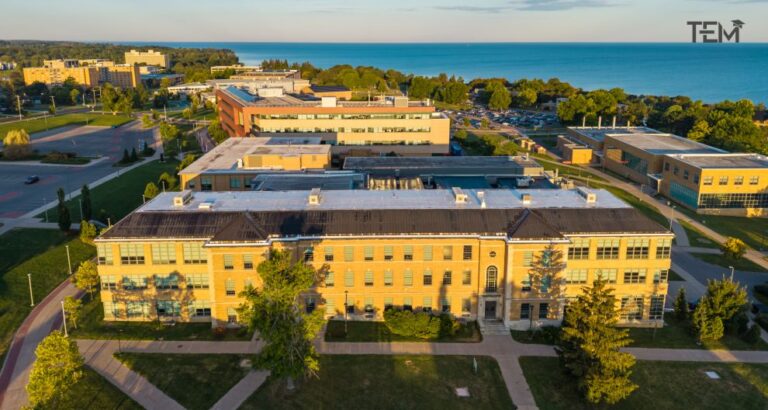
The State University of New York at Oswego (SUNY Oswego) has spent more than 160 years proving that the best way to prepare a teacher is to put them in front of real students, in real classrooms, long before they ever graduate.
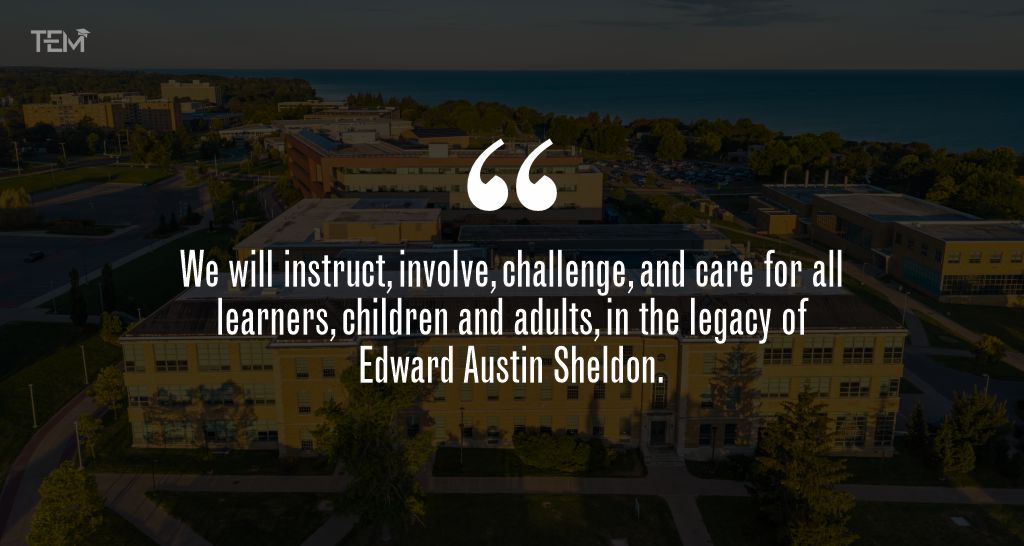
In 1861, a man named Edward Austin Sheldon looked at how teachers were being trained across the country and decided the entire enterprise needed rethinking. The dominant method of the day was abstract, theoretical, and removed from the actual texture of a classroom. Sheldon believed otherwise. He opened what would become the Oswego Primary Teachers’ Training School in Oswego, New York, with a conviction that would prove far more durable than he could have imagined: that teachers learn best by doing.
What began as a single, stubborn pedagogical belief has grown, over more than a century and a half, into SUNY Oswego’s College of Education, Health, and Human Services (CEHHS). The founding principle has not been retired or quietly archived. It is still the animating logic of every program the college runs, every field placement it arranges, and every partnership it builds.
That kind of institutional continuity is rarer than it sounds.
A Vision With Expectations
The college’s mission and vision statements, published on its website, carry the weight of genuine intention rather than the hollow cadence of institutional boilerplate.
The vision describes graduates who are committed to their chosen profession, who value diversity in all its forms, who advocate for social justice, who pursue ongoing professional development, and who move through their careers with a strong sense of professional identity. The college also commits, through that same vision, to fostering “a vibrant intellectual community that values teaching, collaboration, and scholarship, while promoting and supporting socially just policies and practices.”
The mission extends that further. It speaks of working “in partnership with citizens of the world,” of building on “the wisdom of the past, the realities of the present and the promise of the future,” and of preparing graduates who will become socially conscious catalysts for change.
That last phrase is worth pausing on. A catalyst does not sit still. The language is deliberate, and it reflects an institution that understands its graduates are entering a profession that has never been purely academic.
The college ties all of this together in a conceptual framework that calls for graduates who are reflective, humble, informed, and collaborative, prepared to empower all learners for success not just at school, but at home and in life.
The Full Range of What Is Taught
CEHHS operates a genuinely broad portfolio. On the certification side, students can pursue Adolescence Education, Childhood Education, Teaching English to Speakers of Other Languages, Career and Technical Education, Curriculum and Instruction, Literacy Education, School Counseling, School Psychology, Special Education, Educational Leadership, and Technology Education. Each pathway is available at the undergraduate or graduate level, whether as a BS, MST, MSEd, MS, or CAS, depending on the specific program.
Beyond certification, the college also offers degrees in Higher Education Leadership, Workforce Education, Mental Health Counseling, Health Promotion and Wellness Management, Health Promotion and Behavioral Wellness, and Technology Management.
What binds this wide range of programs is not subject matter but philosophy. “Our goal in preparing future educators is to give them exposure to rural, urban, and suburban placements in the field,” the college explains, “which allows them not only to compare and contrast instructional practices but also to expose them to school settings they may not have otherwise experienced.”
That breadth of exposure is not incidental. It is engineered.
Who Gets to Teach
One of the quieter but more consequential challenges in American education is the gap between the diversity of students sitting in K-12 classrooms and the relative homogeneity of the people teaching them. SUNY Oswego takes that gap seriously, and its response goes well beyond recruitment language.
The college’s Teacher Opportunity Corps (TOC-II) program is led by the Director of Clinical Practice and Partnerships and funded through a five-year, $1.63 million grant connected to New York State’s My Brother’s Keeper (MBK) initiative. The program serves 50 students, from first-year undergraduates through graduate students, and also supports alumni as they navigate the early years of their teaching careers.
Running in parallel is the Cultivating Representation in School Psychology (CRISP) project, led by a member of the school psychology faculty. Fellows in both programs receive tuition and certification support, mentorship, and enhanced clinical experiences with regional educational partners.
The outcomes have been concrete. “Through these partnerships, we have increased the diversity of our educator preparation programs, strengthened our recruitment and retention efforts, and enhanced pathways to employment here in central New York,” the college reports.
These are structural investments, not symbolic ones. They are an acknowledgment that changing who teaches requires changing who is supported along the way.
Equity as a Practice, Not a Policy Statement
New York State has implemented the Culturally Responsive-Sustaining Education Framework, a statewide initiative designed to help educators build student-centered environments that affirm diverse identities, elevate historically marginalized voices, and empower learners as agents of social change. SUNY Oswego treats this not as a compliance requirement but as a natural extension of what it was already doing.
Faculty hold that educators and field professionals are, by the nature of their work, socially conscious catalysts for change in their communities. Students are prepared to recognize their own biases, understand how those biases can shape professional decisions, and work proactively to address injustices within and beyond their immediate professional contexts.
That is not a comfortable curriculum to sit with. It asks something real of students. The fact that the college builds this into the core of its programs rather than relegating it to an elective or a single seminar reflects a genuine institutional commitment.
Faculty as Innovators: The Science of Reading Initiative
One of the clearest windows into how CEHHS faculty do their work is the college’s role as a SUNY Science of Reading pilot campus.
With grant funding in hand, faculty from Childhood Education, Special Education, Teaching English to Speakers of Other Languages, and Literacy Education are engaged in a two-year project that takes professional development seriously. Each faculty member receives individualized professional development. The group participates in a statewide community of practice. A technical assistant has been engaged specifically to audit and revise literacy coursework and sequencing across all four involved areas.
As the project moves into year two, faculty will begin piloting the revised curriculum in direct collaboration with regional P-12 educators who are already hosting SUNY Oswego students in their classrooms.
The feedback loop, in other words, does not run in one direction. The classrooms inform the college. The college, in turn, reshapes what goes back into the classrooms.
Measuring What Actually Matters
CEHHS holds accreditation through the Association for Advancing Quality in Educator Preparation (AAQEP), and it uses that accreditation as an active accountability structure rather than a credential to display.
Quality is evaluated through multi-method reviews of curriculum, partnerships, and student outcomes. The college tracks course performance, key assessments, retention outcomes, and certification progression following degree completion. Feedback from partners is incorporated through Program Advisory Groups and ongoing quality assurance processes.
“We solicit feedback from our alumni and partners through our Program Advisory Groups and quality assurance processes,” the college notes, “and engage in recursive updates to our class activities and key assessments within the context of our accreditation mandates, certification requirements, and relevant professional standards.”
The word recursive is doing a significant amount of work in that sentence. It implies a cycle that does not close, a continuous loop of evaluation, refinement, and re-evaluation. That is, not coincidentally, the same posture the college asks of its graduates: ongoing professional development not as a box to check, but as a permanent orientation toward one’s own practice.
Support That Does Not End at the Classroom Door
SUNY Oswego’s investment in students extends into the practical territory of career readiness. The student teaching coordinator works in close collaboration with the campus-wide Career Services team to bring local educational leaders to campus for mock interviews, resume and cover letter review, and guidance on navigating a first job offer.
For students preparing to enter a competitive hiring landscape, these are not soft benefits. A practiced interview and a polished resume can be consequential.
The Clinical Practice and Partnerships Office within CEHHS also works alongside faculty and external partners to ensure that field placements are genuinely high-quality, meaningfully diverse in setting, and genuinely preparatory for the work that awaits beyond graduation.
Looking Ahead: STEM, Career Education, and a Regional Vision
The next chapter for CEHHS is already in motion. The college is in the process of finalizing two grant-funded projects aimed at strengthening collaboration with industry and P-16 partners across the region, with a concentrated focus on STEM and career and technical education.
The ambition behind these projects extends beyond individual program improvements. The stated goal is to position central New York as a hub for innovation in educator preparation, to build stronger pipelines to careers in education, and to align classroom learning more closely with professional expectations across the full P-16 continuum, from early childhood through post-secondary.
It is a regional vision, and it is in keeping with everything that has come before it: the belief that preparation is a community endeavor, that education does not happen in isolation, and that the college’s work does not conclude when a diploma is handed over.
Still Teaching Teachers
SUNY Oswego began in 1861 with one insistence: that teachers learn best by doing. That insistence has not softened over the intervening 160 years. It has deepened, expanded, and grown into something that shapes not just individual classrooms but entire communities, not just how teachers teach but who gets to become a teacher, and not just what students learn but how that learning is continuously refined through honest engagement with the world outside the college walls.
Edward Austin Sheldon would likely recognize the spirit of it all. The scale, though, would almost certainly astonish him.
Quote