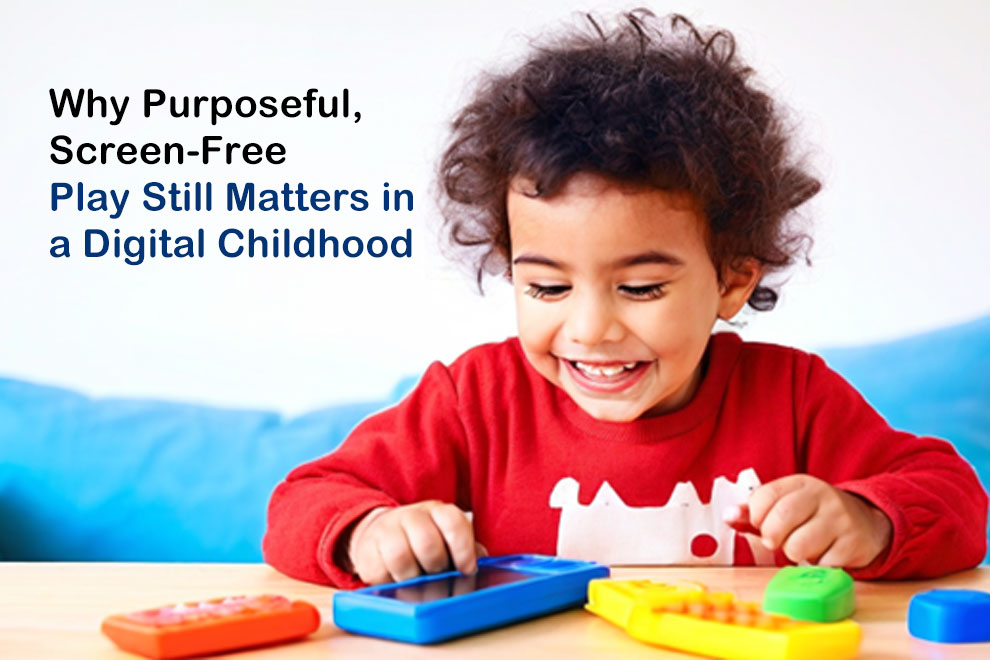
How open-ended educational play can support attention, language, creativity, movement, and family connection without treating technology as the enemy. Digital tools are now woven into childhood. Video calls connect families, interactive apps can explain difficult concepts, and technology can support creativity, communication, and access to information. The question for parents and educators is not whether children should ever use screens. A more useful question is what else a healthy childhood needs alongside them.
Children also need time to move, build, pretend, draw, sort, talk, negotiate, experiment, and become bored enough to invent something new. These experiences are easier to overlook because they are not always measurable and they do not arrive with notifications or progress bars.
Purposeful, screen-free play helps protect space for these slower forms of learning. It gives children opportunities to direct their own attention, use their bodies, handle real objects, and interact face to face. In a balanced childhood, that kind of play is not a rejection of technology. It is a complement to it.
What Makes Play Educational?
Educational play does not need to look like school. In fact, some of the most valuable learning happens when children are deeply involved in an activity because they find it interesting.
A puzzle can strengthen visual reasoning and persistence. Pretend play can support language, storytelling, and social understanding. Building materials introduce balance, shape, planning, and spatial relationships. Art materials give children a way to represent ideas and make choices. Board games can involve counting, turn-taking, strategy, and emotional regulation.
The defining feature is active participation. Children are making decisions rather than simply receiving information. They have something to manipulate, imagine, test, arrange, or communicate.
Screen-Free Play Gives Attention Somewhere to Land
Many digital experiences are designed to change quickly. Images move, sounds respond, rewards appear, and the next piece of content is always available. Physical play often moves at a different pace.
A child working on a puzzle may spend several minutes studying the same shapes. A block structure may require careful adjustment. A drawing may evolve slowly. A pretend-play scenario can continue for an afternoon. These activities provide practice staying with a task when the environment is not constantly supplying a new stimulus.
This does not mean that every screen reduces attention or that every toy improves it. What matters is the pattern of experience. Children benefit from regular opportunities to engage with activities that require them to generate some of the momentum themselves.
Real Objects Create Rich Sensory Information
Physical play involves information that a flat screen cannot fully reproduce. Children feel weight, texture, resistance, temperature, size, and balance. They learn how much force is needed to connect two pieces, how objects occupy space, and how materials behave when dropped, stacked, squeezed, rolled, or combined.
These experiences are particularly important in early childhood, when children are building an understanding of the physical world. Even simple actions—pouring water, fitting shapes, threading beads, arranging blocks—combine perception and movement.
Fine-motor activities also ask children to coordinate hands and eyes with precision. Larger construction, outdoor play, and movement games involve the whole body. A varied play environment therefore supports learning through more than sight and sound.
Pretend Play Builds Language and Perspective
One of the strengths of screen-free play is that an object does not always dictate what it must be. A wooden block can become a phone, a piece of food, a building, or a vehicle. A cardboard box can become a shop, spaceship, animal clinic, or house.
This flexibility creates room for symbolic thinking. Children use one thing to represent another, build stories, assign roles, and negotiate what happens next. When children play together, they practice explaining ideas, listening, taking turns, and adapting when someone else has a different plan.
Adults can support this without scripting the entire game. A few open-ended materials and a question such as “What should we build today?” can be enough to start a much larger story.
Educational Toys Can Support Play Without Controlling It
Parents are often faced with an overwhelming number of products described as educational. A useful filter is to ask how much thinking the child has to contribute.
Some toys are highly structured, which can be helpful when teaching a specific sequence or skill. Others are open-ended and can be used in many ways. A balanced play environment can include both.
When choosing educational toys for kids, look for options that encourage the child to do something meaningful: build, solve, compare, create, experiment, role-play, sequence, sort, or explain. Age appropriateness matters, but so does replay value. A toy that can grow with a child or be used in several ways often supports richer engagement than one with a single fixed outcome.
Screen-Free Does Not Have to Mean Silent or Solitary
Physical play can be deeply social. Board games create shared rules and conversation. Construction projects invite collaboration. Pretend play can involve siblings, friends, parents, or classmates. Arts and crafts can become a shared project rather than an individual task.
These moments create natural opportunities for language. Children ask for materials, explain what they are building, disagree, solve conflicts, and tell stories about what they have made.
Family play also provides a context in which adults can observe a child’s interests without the pressure of formal assessment. A child who repeatedly creates elaborate buildings may be drawn to spatial challenges. Another who invents characters and dialogue may be especially engaged by storytelling. Play gives adults clues about what motivates a child.
Boredom Can Be Productive
Parents understandably want children to be engaged, but an uninterrupted stream of entertainment can leave little room for children to decide what to do next. A small amount of boredom can create the space in which imagination begins.
When a child says, “There’s nothing to do,” the immediate solution does not always need to be a new activity or a screen. Accessible materials—blocks, art supplies, books, puzzles, costumes, simple science materials, or outdoor objects—can allow the child to create the next step.
At first, self-directed play may require support, especially for children accustomed to highly structured entertainment. Over time, the ability to start, continue, and adapt an activity independently can become a valuable skill in itself.
Create a Balanced Play Environment, Not a Perfect One
Families do not need to eliminate screens or create an ideal playroom. Balance can come from simple routines and thoughtful availability.
One approach is to keep a small selection of materials visible and rotate them periodically. Another is to create screen-free anchors in the day, such as before school, during meals, immediately after school, or before bedtime. Outdoor time, reading, building, art, music, and family games can each fill different needs.
It can also help to avoid treating screen-free time as a punishment. If physical play is framed only as the thing children must do when technology is taken away, it may feel less appealing. Instead, make it an ordinary and enjoyable part of family life.
Match the Activity to the Child, Not the Label
Children vary widely in temperament, interests, sensory preferences, and developmental pace. The activity that absorbs one child may frustrate another.
A child who loves movement may enjoy building large structures or outdoor challenges. A detail-focused child may prefer puzzles, model building, drawing, or sorting. A social child may gravitate toward role-play and games. A child fascinated by how things work may enjoy simple machines, construction, or experiments.
Educational value increases when an activity meets a child at the right level of challenge. Too easy, and it may be abandoned quickly. Too difficult, and the child may need so much adult help that the experience stops feeling like play.
The Goal Is a Richer Childhood, not a Screen-Free Identity
Technology will remain part of children’s lives, and many digital tools are genuinely useful. The purpose of protecting screen-free play is not to create fear around technology. It is to make sure that other forms of development continue to receive time and space.
Children benefit from experiences in which they are producers as well as consumers: making a structure instead of only watching one, inventing a story instead of only following one, solving a physical problem instead of only tapping through a predetermined path.
A balanced environment gives children access to both worlds. Digital tools can open doors to information and communication, while physical play keeps children connected to movement, materials, imagination, conversation, and the immediate world around them.
Conclusion
Purposeful play remains valuable precisely because childhood is becoming more digital. Children still need opportunities to work with their hands, direct their own attention, negotiate with other people, explore real materials, and make something that did not exist before.
Screen-free educational play does not need to be elaborate or expensive. A puzzle at the kitchen table, a box of building pieces, a family game, an art project, a pretend store, or a simple experiment can all create meaningful learning.
The most useful goal is not perfect balance every day. It is a childhood with enough variety that children can learn through screens when screens are helpful—and also know how to imagine, build, create, talk, and explore when the screen is turned off.