The sidewalks came first. Before the story of this district can be told properly, it helps to picture them: freshly poured concrete paths leading toward a school building, put there so that children walking to class would not have to share the road with cars. It is a small, almost invisible kind of infrastructure, the sort of thing that rarely makes it into a glossy feature about education. But it is also, in its own quiet way, the whole story of Willow Springs School District 108 in miniature. Somebody noticed a need. Somebody worked with somebody else, in this case the Village of Willow Springs, to fix it. And a child got to walk to school a little more safely than before.
Multiply that gesture by a hundred years, and you begin to understand a district that has spent more than a century figuring out how to take care of the children who show up at its door.
A Building That Remembers
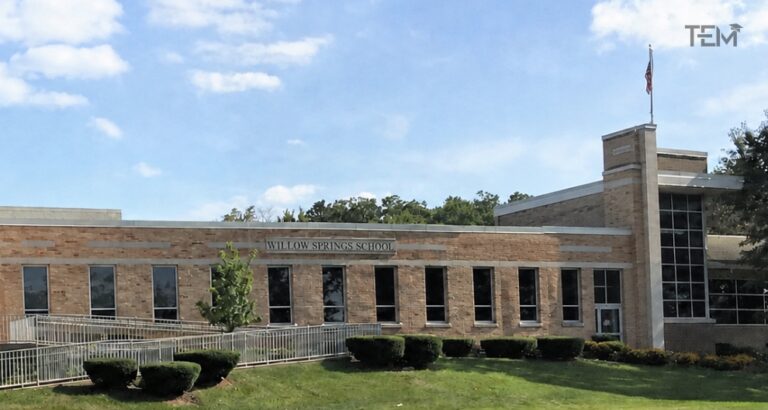
Willow Springs School District 108 traces its roots back to 1901, when it was known simply as Spring Forest School. The building most families would recognize today was constructed in 1913, and it has been added to and renovated many times since, a physical record of every generation that has passed through its halls. In 2026, that record continues to be written: a renovation of the primary wing is currently underway, one more chapter in what the district describes as more than a century of educational excellence.
The district serves students from Prekindergarten through 8th grade, and its stated purpose, in the words of its mission, is “to empower our community to develop a curiosity and passion for learning, discover their interests, and become successful lifelong learners.” Its vision speaks of collaboration, of providing “the skills, knowledge, and resources necessary to ensure an innovative, engaged, and inclusive environment for excellence in education.”
These are the kinds of sentences that appear in mission statements everywhere, the sort a visitor might skim past. But Willow Springs has given its language a second life through a motto that is easier to picture: “Where a Love of Learning Grows Every Day.” And more recently, through something even more concrete: an initiative called “I AM WILLOW,” built around five words the district has asked its students and staff to live by: being Respectful, Responsible, Kind, Hard-Working, and Ready to Learn. It is not a slogan painted on a wall and forgotten. It is, as the district tells it, the thread that ties academic ambition to something more personal, the shaping of compassionate, responsible citizens.
One School, Two Towns
Unlike sprawling districts with multiple campuses and layers of administration, Willow Springs is, structurally speaking, refreshingly simple. It is a single-school district, one building serving one community, though that community actually spans two places: the Village of Willow Springs, Illinois, and the unincorporated area of Justice, Illinois. There is something clarifying about that arrangement. When there is only one school, there is no question of which building gets the new gym or which neighborhood feels forgotten. Everyone is, quite literally, under the same roof.
Inside that single building, the academic program is organized not by the traditional elementary and middle school split but by grade bands: Early Childhood for Transitional Kindergarten and Kindergarten, Primary for grades 1 and 2, Intermediate for grades 3 through 5, and Junior High School for grades 6 through 8. The curriculum itself is aligned to the Illinois Learning Standards and covers English language arts, mathematics, science, and social studies, supplemented by art, music, physical education, STEM, and library/media instruction, along with social-emotional learning, athletics, and extracurricular activities.
What Excellence Looks Like, Up Close
Ask most districts to define educational excellence, and the answer tends to arrive dressed in test scores. Willow Springs takes a different route. Excellence here means “ensuring every student is challenged, supported, and empowered to reach their full potential,” a definition that stretches deliberately beyond academics into the development of what the district calls the whole child, academically, socially, emotionally, and physically.
That philosophy translates into a specific set of strategic priorities: making sure students have access to grade-level curriculum and complex texts, giving them room to persevere through challenging, real-world problems, and building the critical thinking and collaboration skills that will outlast any single school year. And running underneath all of it is the expectation, borrowed straight from I AM WILLOW, that students bring respect, responsibility, kindness, hard work, and readiness to learn not only into the classroom but onto the playground and the athletic field as well.
A Classroom Built for More Than One Kind of Learner
Walk into nearly any English language arts or math classroom at Willow Springs, and there is a good chance you will find two adults at the front of the room instead of one. The district has structured the majority of its ELA and math instruction as co-taught, pairing a general education teacher with either a special education teacher or a certified Multilingual, or ML, teacher. It is a deliberate answer to a student population that includes a wide range of cultural backgrounds, languages, socioeconomic experiences, and learning needs, and it allows students to access grade-level instruction while still receiving the specific support they require.
The effort to build belonging does not stop at the classroom door. The district runs cross-grade buddy programs that connect older students with younger ones, and it leans on the fact that many of its own staff members live in the community they serve or reflect the backgrounds of the families in their classrooms. That overlap between the people who teach and the people who are taught is not incidental. It is, by the district’s own account, part of what makes the relationships built there feel authentic rather than assigned.
Partnerships Still Taking Shape
Not every part of a school’s story is a finished achievement, and Willow Springs is candid about the fact that community partnership building is, in its own words, “an area we continue to strengthen.” Over the past two years, though, that strengthening has taken visible form. The district has hosted an English language learning program for families and Early Childhood workshops where parents step into the classroom to learn about developmental milestones alongside their children.
Its Parents for Children organization, known as PFC, organizes Back-to-School celebrations and an End-of-the-Year Bash that pull the wider community together. Beyond the school gates, Willow Springs partners with the local police department on an annual Shop with a Cop program, works with the Village of Willow Springs on initiatives such as constructing sidewalks that improve student safety on the walk to school, and joins in community traditions like the village’s holiday tree decorating. Most recently, the Student Council has begun volunteering at the Willow Springs monthly food pantry, a small addition to the list, perhaps, but one that says something about where the district hopes its students’ instincts will eventually lead them.
Life Beyond the Bell
For a single-school district, the range of activity on offer is not small. Students can join co-ed cross country, co-ed soccer, cheerleading, and boys’ and girls’ volleyball, basketball, and softball, athletic programs the district says have grown increasingly competitive thanks to the dedication of its coaching staff. Beyond the field, there is band, theater club, student council, art club, homework club, and yearbook club, with the district actively inviting students to propose new clubs of their own rather than waiting to be asked.
Who Runs the Building
Behind the daily rhythm of the school sits a leadership structure built around two key roles: the Principal and the Assistant Superintendent, each overseeing a piece of the district’s instructional program, operations, and student support. The district describes its relationship with the teachers’ union as a genuinely collaborative one, and this year it is introducing part-time instructional coaches, a new layer of support meant to strengthen teaching practice and, in turn, student learning. Staff have been recruited from across the Chicagoland area and beyond, bringing with them a range of experience the district credits with enriching its culture and instructional programs alike.
Equity, Defined by Need
At Willow Springs, equity is not treated as an abstract value but as a response to a specific population, one that includes a significant number of English Learners and students receiving special education services. The district’s answer has been to remove barriers where it can: co-taught classrooms, targeted supports, and consistent access to grade-level learning for every student, regardless of where they start.
But the district also recognizes something more basic: that a child cannot fully engage with a math lesson on an empty stomach or with an untreated toothache. So Willow Springs provides free breakfast and lunch for all students, offers free physicals for families, and has built partnerships with the Ronald McDonald Care Mobile for vaccinations and with mobile dental services for on-site cleanings. It is an unglamorous kind of equity work, the sort that rarely photographs well, but it is the kind that keeps children in their seats and ready to learn.
The People Who Notice
For a small, PK through 8 district, the roster of support staff is notably deep. Willow Springs employs a full-time Student Advocate through the South Cook Regional Office of Education, two social workers, two speech-language pathologists, and a full-time occupational therapist. For needs beyond what the building itself can provide, the district partners with the AERO Therapeutic Center and proudly hosts an AERO outlying site on its own campus.
Underneath all of these formal services sits something less measurable: a buddy program, teacher partnership, and intentional connections between students and staff – the district’s stated belief that every student should have at least one trusted adult in the building who knows them, supports them, and helps them feel connected. It is a modest goal on paper. In practice, it may be the hardest one to guarantee, and the one the district seems proudest of trying.
What Comes Next
Willow Springs’ ambitions for the future are, fittingly, tied to its past. Over the next five years, the district plans a full renovation of its school facility, phased through each grade-band wing so that Early Childhood, Primary, Intermediate, and Middle School students each eventually get their turn in a modernized space. There are hopes, too, of expanding library access beyond the school day, turning it into a shared resource for the wider community and ensuring every student can find a book in which they see themselves reflected.
Academically, the goal is continuity rather than reinvention: building on the growth already seen in recent years, with success measured by whether every student is making meaningful growth toward proficiency – and beyond – in reading and mathematics.
Leading With a Single Question
At the head of this district are Assistant Superintendent William Seidelmann and Principal Rachel Skala, a pairing the district describes as complementary in strength and united in commitment. Seidelmann and Skala have shaped a leadership style around one recurring question, “What is best for students?”, and around a belief that improvement is something done alongside staff, not handed down to them.
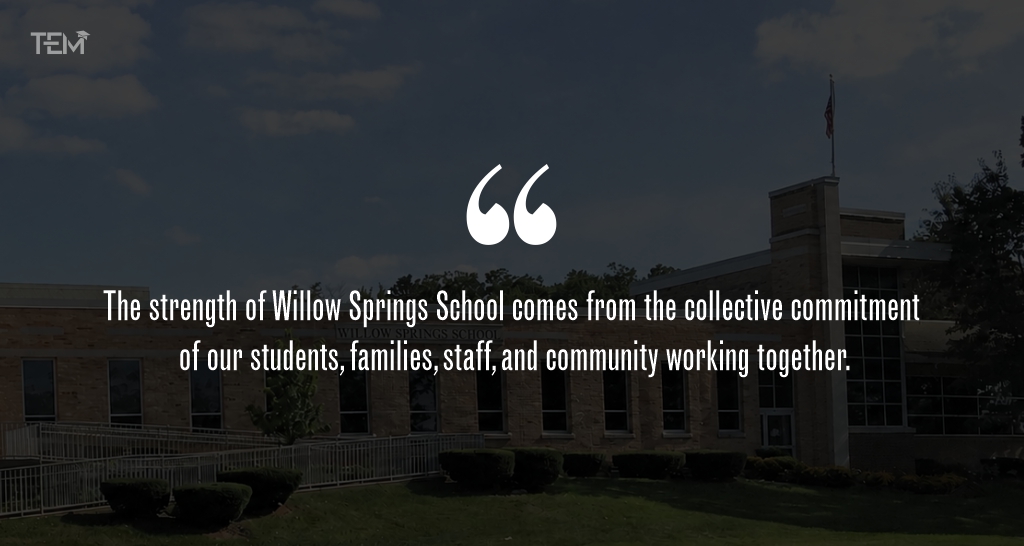
That philosophy has produced, by the district’s own telling, a culture that students themselves have helped shape, one that has made Willow among the most welcoming schools its leadership has encountered for new students, families, and staff alike. The message the district offers to the families who send their children through its doors each morning is simple enough to fit on a wall: “We Are Willow.”
It is easy, in education writing, to reach for grand language about legacy and vision. But sometimes the truer measure of a school district is found in smaller things: a sidewalk built so a child can walk safely to class, classrooms designed so every learner receives the support they need, a food pantry shift taken on by students who did not have to volunteer at all. Willow Springs School District 108 has been quietly doing this work since 1901. In 2026, with a construction crew still finishing the primary wing, it does not look finished. It looks, instead, like a district that continues to evolve while staying true to the promise it made more than a century ago.
Quotes