Date: 09/21/2026
Author: Maria Smirnova
An experienced ESL instructor and researcher in technology-enhanced language education shares effective techniques that language professionals can use to help immigrants build confidence and find their voice.
“The communicative approach” has become almost career currency for aspiring ESL instructors. A recent systematic review by Li Chen and Tajul Rosli Bin Shuib, covering 18 empirical studies, reaffirmed that communicative teaching helps learners turn classroom English into real conversation, while ESL vacancies explicitly require experience with the methodology. But does an approach built around immediate interaction work equally well for immigrants coping with anxiety, disrupted education, and the stress of starting again?
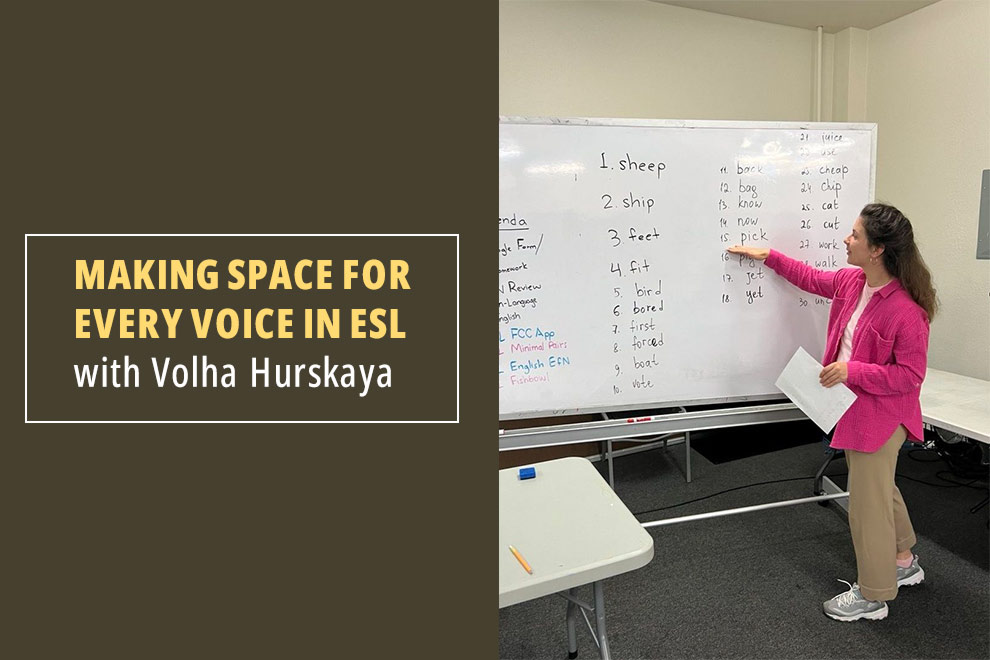
“Communication begins with psychological safety,” argues Volha Hurskaya, an ESL instructor and researcher in technology-enhanced language education. For nearly a decade, she has taught English first in Belarus and later to immigrants in the United States. The author of more than 20 academic publications and two books, she also reviews research for journals including the Canadian Journal of Learning and Technology and Digital Applied Linguistics and Technology in Language Teaching & Learning, among others. Drawing on this experience, Volha considers whether the communicative approach is always appropriate for learners under stress and which teaching methods can better support immigrants adapting to a new language and country.
English language proficiency can shape the work an immigrant finds and the opportunities available to them. A Guardian publication described Nataliya Zhuk, a former engineering laboratory manager who fled the war in Ukraine for California at 58. Limited English initially kept even jobs that did not require her engineering qualifications out of reach. She combined ESL classes with individual tutoring and eventually secured a permanent part-time retail position. At the time of publication, however, she remained far from the engineering career and financial independence she had known in Ukraine.
“Many of the learners I meet have been respected professionals before they had to start again in a new country,” explains Volha. “No single method works for everyone, so I combine approaches depending on what a person needs at that moment. The affective-humanistic approach may sound less impressive on a résumé, but it can help learners feel valued and find the confidence to speak.”
The affective-humanistic approach became part of language education in the 1970s, drawing on the ideas of Carl Rogers and Abraham Maslow. This method focuses on the whole person, understanding that feelings like anxiety and confidence, as well as personal experiences and relationships, all influence learning. In this approach, the teacher acts as a guide who builds trust, listens to students, encourages teamwork, and allows room for mistakes.
“This approach combines both the thinking and emotional sides of learning, which is especially helpful for immigrants and refugees who are working to rebuild their confidence in a new country,” notes Volha.
Concern for psychological safety also shapes Hurskaya’s research. At the 2026 World Conference on Science, Innovation and Human Progress, she presented a study, “Reducing Foreign Language Anxiety Through AI-Mediated Speaking Practice in the USA,” exploring how AI-supported rehearsal can help adult ESL learners build confidence before real-world conversations.
Educators can also further explore how technology can respond to individual learners’ goals through Hurskaya’s extensive body of academic work. Her most-cited co-authored study, “The Role of Artificial Intelligence in Creation of Future Education: Possibilities and Challenges,” looks at the bigger picture of AI in education. Two articles in Academic Visions, “Approaches to Personalizing the Learning Process in Teaching English with the Help of Artificial Intelligence” and “Virtual Environments as a Means of Enhancing the Efficiency of English Language Teaching for Learners,” bring the focus closer to the language classroom, showing how technology can be tailored to learners’ abilities.
Gamification offers another way to make practice feel more personal. In 2025, Volha co-authored “Gamification as a Means of Individualizing 21st-Century Learning”, a book presenting game-based learning as a tool for personalization and motivation. Applied to ESL, this approach can help learners see mistakes as part of progress rather than as failure.
“Used thoughtfully and in moderation, technology can make language learning easier while helping newcomers navigate an unfamiliar city,” Hurskaya says. “You may be surprised to learn that some students struggle with basic smartphone or laptop functions, so in non-profit US settings we help them build digital literacy skills while practicing the English they need in everyday life.”
Volha suggests several techniques educators can use in class, and students can keep using on their own.
- Map-based tasks. Students use navigation and public transit apps to find addresses, plan routes, read directions, and estimate travel times in English.
- AI conversation rehearsal. A chatbot can act out a job interview, medical appointment, school meeting, or store conversation. This lets students practice the exchange as many times as they need before trying it in real life.
- Voice-note practice. Students record messages, listen to themselves, and try again before making a phone call or asking for help.
- Everyday digital tasks. Filling out online forms, writing emails, booking appointments, or looking up local services helps students build both language and digital skills.
- Gamified practice. Short missions, adjustable difficulty levels, and visible progress can make repetition more engaging while allowing learners to advance at their own pace.
However, the communicative approach remains the industry’s default. An analysis in Oxford University Press’s ELT Journal connects the global coursebook market with a commercialized form of communicative teaching that dominates much of English-language education.
“I have never met an instructor who relies on a single method or follows just one textbook,” Hurskaya adds. “We all find what fits the situation. For me, this usually means blending communicative and affective-humanistic approaches with carefully chosen digital tools. When I plan a lesson, I explore different materials and then select, adapt, or create what best meets students’ needs.”
While communication remains the goal of English-language learning, Volha Hurskaya shifts attention to the path each learner takes to reach it. With the right balance of trust, flexibility, and technology, the classroom can become a place where learners begin rebuilding their everyday lives.
Also Read: Babbel vs Duolingo: Which Language App Is Better in 2026?