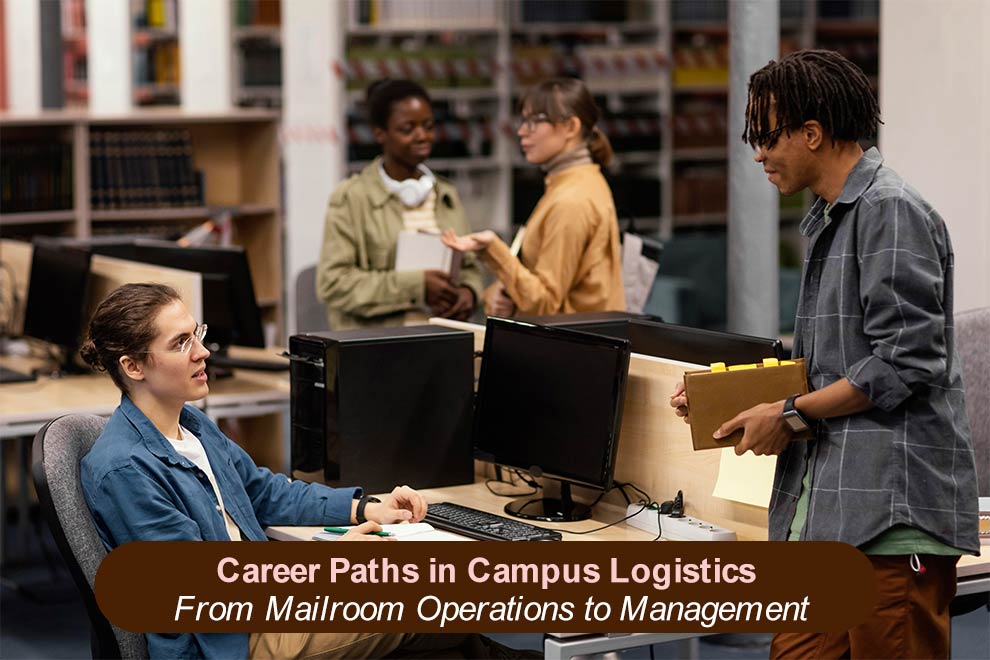
Campus logistics is easy to overlook until something does not arrive where it should. Universities and colleges depend on internal operations teams to receive packages, organize deliveries, maintain records, coordinate distribution, and help goods reach students, faculty, staff, and departments.
For people considering careers in administration, facilities, or operations, campus logistics can provide practical experience with both physical workflows and digital systems. An entry-level position in a mailroom or receiving area can introduce skills that later support progression into supervisory and management roles.
Modern operations increasingly involve automated mailroom management, including package registration, tracking, automated notifications, searchable records, and collection management. Learning how these tools support physical operations can give employees a useful foundation for broader logistics responsibilities.
Why Campus Logistics Is More Than Mail Delivery
A university can function like a small city from a logistics perspective.
Deliveries may need to reach residence halls, academic departments, administrative offices, laboratories, libraries, facilities teams, and other locations. Recipients also have different schedules, and parcel volumes may fluctuate during the academic year.
Campus logistics professionals therefore need more than the ability to sort packages.
They must understand receiving procedures, location information, internal distribution routes, recipient communication, storage management, recordkeeping, and exception handling.
These responsibilities create opportunities to develop transferable operational skills.
A campus mailroom can be an entry point into operations because it teaches employees how people, physical items, digital records, and workflows connect.
Starting as a Mailroom or Receiving Assistant
Many campus logistics careers begin with frontline work.
A mailroom or receiving assistant may accept deliveries, register packages, sort items, organize storage areas, notify recipients, prepare items for internal distribution, and record collections.
These tasks provide direct experience with the package lifecycle.
Accuracy is particularly important. Entering the wrong recipient, recording incomplete information, or storing a parcel in the wrong location can create problems later in the process.
Frontline employees also learn how routine workflows interact with real-world exceptions. Packages may arrive for former students, contain incomplete addresses, or be delivered to the wrong campus location.
Learning to resolve these situations in accordance with established procedures develops practical problem-solving skills.
Building Digital Mailroom Skills
Technology literacy is becoming increasingly relevant to campus logistics careers.
Employees may work with software that creates digital package records and supports tracking throughout the internal delivery process. Understanding these systems involves more than knowing which buttons to press.
Staff should understand why accurate registration matters, how package statuses change, how automated notifications work, and how searchable records can support investigations.
Collection tracking is another important skill. Recording the final handoff helps keep the digital record aligned with the parcel’s physical location.
These capabilities can later be transferred to other operational systems involving inventory, assets, facility requests, or workflow management.
Moving Into a Senior or Lead Role
Experienced employees may progress into lead positions where they take responsibility for more than their own daily tasks.
A mailroom lead might help coordinate workloads, support new employees, monitor outstanding packages, handle unusual delivery issues, and ensure procedures are followed consistently.
The transition requires a change in perspective.
| Career Stage | Typical Development Focus |
| Mailroom assistant | Receiving, sorting, registration, storage |
| Experienced operator | Tracking, exceptions, recipient support |
| Team lead | Workflow coordination and staff guidance |
| Supervisor | Performance, training, procedures, reporting |
| Operations manager | Planning, improvement, resources, technology |
| Broader facilities/logistics role | Cross-functional operational management |
At the entry level, success often depends on completing assigned tasks accurately. At the supervisory level, employees must increasingly understand why problems occur across the entire workflow.
Developing Supervisory Skills
A campus logistics supervisor may oversee staff schedules, training, workload distribution, service procedures, and operational exceptions.
Communication becomes particularly important.
Supervisors need to explain procedures clearly to employees while also working with students, faculty, administrative teams, couriers, and other campus stakeholders.
Training is another major responsibility.
New employees need guidance on digital registration, package tracking, storage organization, automated notifications, collection procedures, and exception handling. Supervisors should also reinforce the connection between digital records and physical actions.
A parcel moved without the corresponding record being updated can create confusion even when the physical handling itself was correct.
Learning to Use Operational Data
Career progression increasingly requires the ability to interpret operational information.
Frontline staff primarily use package records to complete individual tasks. Managers can use aggregated information to understand broader workflow patterns.
For example, records may help reveal recurring periods of high parcel activity, collection backlogs, or locations that frequently generate delivery exceptions.
Data should not replace direct observation or employee feedback. Instead, it gives managers another way to identify where investigation may be worthwhile.
An operations professional who can combine system information with knowledge of the physical workflow is better equipped to identify practical improvements.
Process Improvement Opens New Opportunities
Employees interested in moving beyond daily mailroom duties should learn to recognize inefficient processes.
Perhaps staff repeatedly spend time searching for parcels because storage locations are inconsistent. Maybe recipient information frequently needs manual correction. Another campus area might experience recurring delivery problems because its addressing process is unclear.
Recognizing these patterns is the beginning of process improvement.
The next step is determining the cause and evaluating practical changes.
This ability is valuable well beyond mailrooms. Facilities and logistics managers routinely need to examine workflows, identify bottlenecks, standardize procedures, and determine where technology or automation can reduce repetitive administrative work.
Management Requires a Wider Operational View
An operations manager needs to consider the entire service rather than individual packages.
Responsibilities may include staffing, procedures, technology, storage capacity, service expectations, training, reporting, and coordination with other campus functions.
Managers also need to balance efficiency with reliability.
Automating recipient notifications, for example, can reduce repetitive communication. However, staff still need procedures for packages that cannot be matched to recipients. Similarly, digital tracking improves visibility only when employees consistently maintain accurate records.
Good management therefore combines people, processes, technology, and physical infrastructure.
Campus Logistics Skills Can Transfer Beyond Higher Education
Experience gained in campus logistics can also support careers outside colleges and universities.
Receiving and mailroom operations introduce employees to principles used in corporate workplaces, residential properties, healthcare facilities, warehouses, and other environments where physical items must be tracked through internal processes.
Transferable skills include accurate recordkeeping, workflow coordination, customer service, digital system use, exception management, staff training, and operational problem-solving.
Employees who develop supervisory experience can add workforce coordination and process improvement to that foundation.
The value lies not simply in having handled packages. It comes from understanding how to manage an operational process reliably.
Building a Career From Frontline Operations
Campus logistics offers a practical route into the wider field of workplace operations.
An employee might begin by receiving deliveries and maintaining digital records. Experience can lead to responsibility for exceptions, training, workflow coordination, and team supervision. From there, opportunities may expand into mail services management, logistics coordination, facilities operations, or broader operational leadership.
Progression depends on developing skills beyond the immediate task.
Employees who understand digital mailroom systems, maintain accurate records, communicate effectively, investigate exceptions, interpret operational data, and look for ways to improve processes can build a strong foundation for advancement.
A campus mailroom may be where that career begins, but the skills learned there can reach much further.
Also Read: How To Track And Monitor Shipments For Better Logistics Control