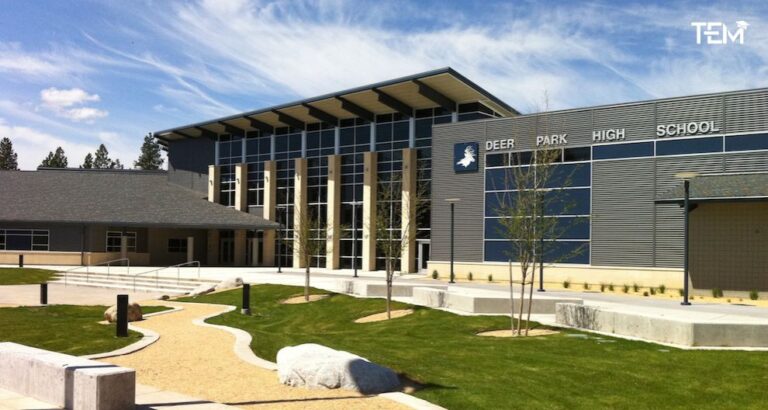
Twenty miles north of Spokane, the land folds itself into a wide valley, mountains rising on three sides, the sort of geography that makes a person feel both sheltered and a little bit forgotten. Fields, forests, lakes, and the occasional deer wandering into a backyard define this stretch of the Inland Northwest. Just over 5,000 people live within the city limits of Deer Park, and roughly 15,000 more are scattered through the surrounding countryside, close enough, within about fifteen minutes, to call the city center their own. It is not a place designed to announce itself. And yet it has quietly become one of the more instructive stories in American public education.
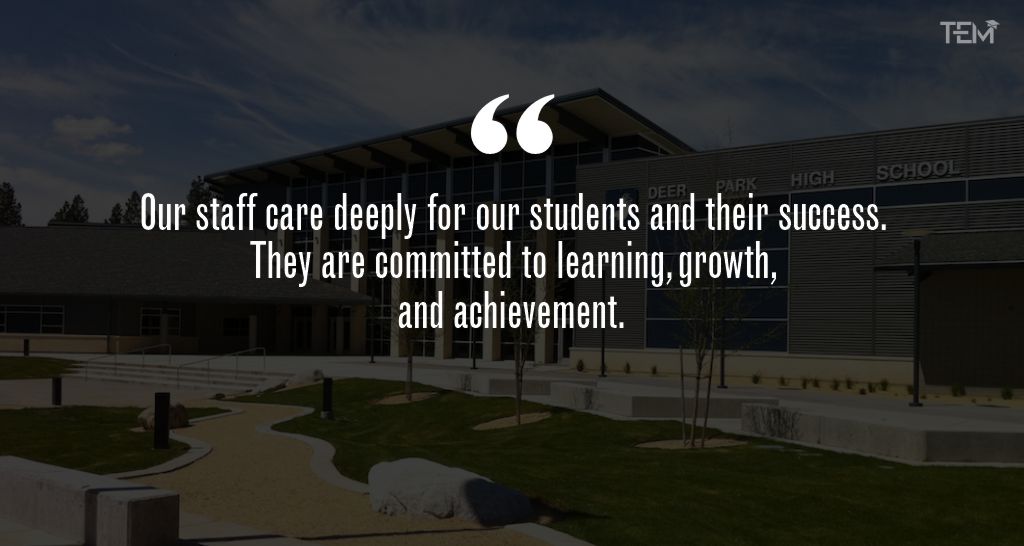
The Deer Park School District covers approximately 173 square miles and serves nearly 11,000 households, a footprint far larger than its town-sized reputation would suggest. The city of Deer Park is growing! Six schools operate out of seven buildings, a small distinction that matters once you understand the district’s shape. A preschool sits across the street from one of the elementary schools. Deer Park Elementary School holds kindergarten through second grade. Arcadia Elementary School takes over for grades three through five. Deer Park Middle School serves grades six through eight, and Deer Park High School, a four-year comprehensive school, carries students from ninth grade through graduation. DPHS also runs an ‘Alternative’ program housed on its own campus, a quieter option for students who need a different rhythm to their school day.
Then there is Home Link, the district’s fifth school, a parent-partnership program built for families who want a hand in shaping their child’s education. It serves approximately 600 students across kindergarten through twelfth grade, running out of two sites, the Clayton School and the A.R. Hegre Building in Deer Park. It is the kind of program that rarely makes headlines but says a great deal about a district willing to bend its structure to fit its families rather than the other way around.
The Words a District Chooses
Every strategic plan has a mission statement. Few of them read the way Deer Park’s does. “Every student will learn, grow, and do their best,” the mission reads. “We will set high goals and give strong support through good teaching and caring relationships.” The vision is even shorter, almost a chant: “Our schools. Our community. Our future.” Deer Park Schools is a place where we belong, we learn, and we inspire excellence.
The district’s promise to its families runs longer, nine commitments stacked one after another: providing meaningful opportunities for all students, fostering high expectations for academic success, supporting learning through quality instruction, building positive relationships grounded in honesty and integrity, ensuring a safe and respectful learning environment, strengthening connections with families and the broader community, creating a school culture where every student can thrive, promoting open communication and transparency, and providing school and campus facilities that meet the needs of all students. Behind those promises sit five stated values: Student Success and Growth, Equity and Belonging, Strong Positive Relationships, Community Collaboration and Support, and Transparency and Open Communication.
It would be easy to read a list like that as boilerplate. What makes it feel less like boilerplate is how directly the numbers that follow seem to answer it.
What the Numbers Say
The district’s strategic planning team pored over its own data before setting priorities, and what surfaced were a handful of stubborn truths: successes and challenges exist across every school, students thrive when they feel safe and respected, robust support systems at every educational level matter, high expectations lead to meaningful learning, strong relationships build trust and growth, the community wants to be involved, and open communication strengthens connection.
The figures behind those observations are specific. 93 percent of students graduated in 2024. 82.3 percent of students attended school 90 percent of the time or more. 71 percent of families reported feeling supported through the district, and 85 percent of students said they felt supported at school. For a fuller accounting, the district points families toward its report on the Washington Office of Superintendent of Public Instruction’s report card site, a public ledger of where the district stands.
Four Priorities, One Plan
Out of that self-examination came four priorities that now anchor the district’s Strategic Plan for 2025 through 2030.
The first, Wellness and Belonging, is built on the idea that all students and staff will have a sense of belonging and feel safe, valued, and respected. Its goals are to increase participation, use evidence-based practices while monitoring progress through data, and enhance practices so that feeling safe and valued becomes consistent rather than occasional.
The second, Academic Engagement, rests on the belief that students are challenged and inspired by learning that connects to their future. Its first goal asks students to demonstrate proficiency of essential standards for each course and grade level. Its second goal asks that students engage in learning that applies to their present life and future goals, not learning for its own sake.
The third priority, Building Bridges, Making Connections, carries the district’s own rallying cry, #schoolscantdoitalone, printed sideways down the strategic plan’s page like a banner. Its three goals are to encourage and monitor family participation, cultivate community resource connections, and survey students, staff, and families to keep listening as conditions change.
The fourth priority, Addressing Facility Needs, ensures that the District is maintaining its community assets and that children and staff have safe buildings to learn in.
Classrooms Built Like Job Sites
Ask Deer Park High School what it is proudest of academically, and the answer arrives fast: it’s not only offering rigorous coursework; it also offers a Career and Technical Education program. The stated goal is direct: that all students are prepared for post-secondary pathways, careers, and civic engagement, whether that means the workforce, an apprenticeship, a two or four-year college, the military, or trade school.
The CTE program is organized into four pathways. Health Science offers Principles of Biomedical Science and Biotechnology, and Body Systems. Agriculture Education and Science runs a longer list: Agriculture Physical Science, Agriculture Biology, CASE Plant Science, also called Botany, CASE Animal Science, Floriculture Introduction, Horticulture Introduction, Advanced Horticulture and Floral, Greenhouse Operations and Management, Supervised Agriculture, and Experience or AG Leadership, several of which are marked as eligible for articulation credit at Spokane Community College. Skilled and Technical Sciences covers Woodworking Foundation at both the introductory and advanced levels, Welding Technology, also introductory and advanced, Broadcasting Technology and Production, and Introduction to Engineering and CADD. Business and Marketing rounds out the program with Digital Communication Tools, Introduction to Marketing, Marketing Management or Advanced Marketing, Marketing Operations tied to DECA, IT Academy built around Microsoft Office, Financial Math, Worksite Learning Experience, and Web Page, Digital, Multimedia, and Information Design at both introductory and advanced levels.
The Clubs That Act Like Businesses
Three student organizations give that coursework somewhere to go. DECA supports the Business and Marketing pathway through four actual student-run enterprises: Jitter-Bucks, a food and beverage operation; Stag Prints, which handles custom apparel; Very Vendy, a franchise and remote food and beverage venture; and DP Transfers, focused on manufacturing and design. DECA students also organize community outreach, an annual food drive and veteran appreciation event among them, run large-scale projects like Night at the North Pole, and compete in Marketing, Business Administration, Hospitality, Finance, and Entrepreneurship at regional, state, and international levels. According to the district, DECA students are five times more likely to receive a job offer or scholarship they apply for, a statistic the program credits to the real-world experience built into it.
SkillsUSA exists to satisfy the Industrial Technology Program’s need for a career and technical student organization, and with local industry and its Advisory Committee’s input, the district chose welding as its discipline, covering OFC-A, MIG, TIG, and SMAW techniques. Three regional competitions led to a culminating event at Spokane Community College, with the state event held annually in Tacoma each March.
FFA rounds out the trio, built on the three-circle model of Classroom, FFA, and Supervised Agricultural Experiences. Open to students in grades nine through twelve, it teaches the science, business, and technology of plant and animal production along with environmental and natural resource systems, while giving students, in the district’s own words, a chance to “meet new people, travel, and learn leadership skills that they can use for the rest of their lives.”
Meeting Students Where They Actually Are
Deer Park’s goal is to create a learning environment where everyone feels a sense of belonging and is seen, valued, and heard. Academic ambition means little without attention to how differently students arrive at school. Many of Deer Park’s schools have adopted trauma-informed practices, and every school in the district operates under PBIS, a framework built to recognize when students are meeting or exceeding expectations, both academically and behaviorally.
Equity work is treated as an ongoing discipline rather than a finished task. The district collects and analyzes student data, and when gaps surface, staff sit down to build plans that address them directly. One current focus is strengthening PLC and MTSS processes, including inclusionary practices for students who receive special education services, a commitment the district folds directly into its strategic plan and goals.
A District That Shows Up Off Campus
Deer Park’s relationship with its community extends well beyond parent-teacher conferences. The district participates in City Council events and groups, including the Parks and Recreation Task Force, and maintains ties with the Chamber of Commerce, Rotary, the local Food Bank, booster clubs, the Historical Society, and connects with regional faith-based leaders. It also hosts community forums where residents can show up and ask questions directly, a practice that lines up neatly with the fifth value on the district’s list, transparency and open communication.
The People Running the System
Behind the classrooms sits a leadership structure the district describes simply as “an amazing leadership team to support our staff.” Departments include Business and Finance, Teaching and Learning, Special Education, Human Resources, Maintenance and Facilities, Transportation, and Technology, alongside every school’s principals and assistant principals and a school board focused on student growth and learning.
Support for students extends further still. Using local funds, the district has placed a nurse’s aide at every school and built post-secondary support into daily operations, including help with FAFSA completion, scholarship applications, and college applications, alongside school counselors. For mental health needs beyond what a single school can offer, the district partners with its regional Educational Service District. It also works with outside organizations, including LaunchNW, STCU, and Greater Spokane Incorporated, and university partners to extend what the schools alone can provide.
Defining the Student on the Other Side of Graduation
In the spring of 2026, a district committee finished work on something it calls the Profile of a Graduate, a shared community vision defining the skills, competencies, and attributes a Deer Park student needs to thrive after high school, spanning Pre-K through twelfth grade.
It is organized around two broad ideas. Empowerment and Critical Thinking covers three traits: being confident, independent, and self-reliant; demonstrating critical thinking and problem-solving by weighing pros and cons and questioning assumptions; and being personally and socially accountable, taking full responsibility for one’s actions while caring about their effect on others. Leadership and Community Connection covers three more: effective communication across different audiences and settings, flexibility and adaptability through change and unfamiliar challenges, and contributing to society by thinking beyond self-interest to help build a positive community.
Taken together, the profile reads less like a checklist and more like a description of the kind of adult a small town hopes to send back into the world.
A Small Town’s Promise
Ask the district to describe itself in plain terms, and the answer comes back unadorned. “Deer Park is a special community,” the district says. “It is a small-town, tight-knit community that comes together to support schools and each other. We are growing! Although we are growing, we still maintain a ‘small-town’ feel and welcome our community to connect and join our schools.”
Its superintendent, described by the district as someone here simply “to serve Deer Park,” is focused on making sure every student feels connected, valued, and heard, so they can be at their very best to learn and grow. It is a modest way to frame the work, especially set against a strategic plan with levies, bonds, articulation agreements, and a five-year horizon attached to it. But modesty may be the point. In the strategic plan, the district notes that promises have already been made to the community about the experience their children will have in these schools. What remains is simply keeping them.
Quote