In a small community in southern Arizona, a school can become much more than a place where children go to learn. Over time, it can become part of the community’s identity, a place where families return across generations and where teachers come to know children not only as students, but as individuals. That kind of connection is difficult to create and even harder to preserve as the world around a school changes.
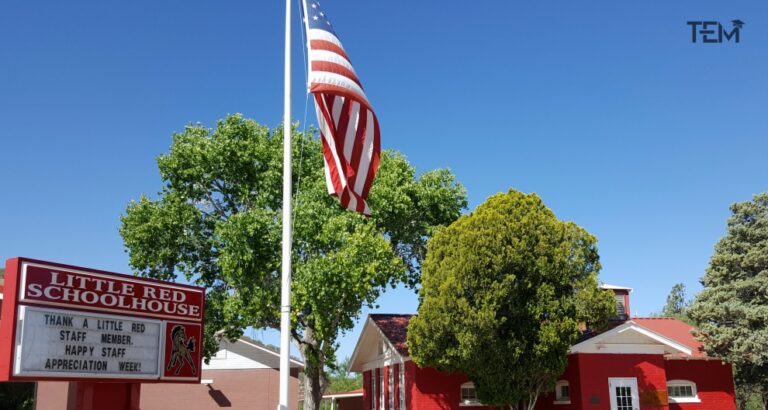
For more than a century, one school in the rural communities east of Nogales has carried that connection forward. Founded in 1921 as a one-room schoolhouse, Santa Cruz Elementary District #28, also known as Little Red School, has grown from its humble beginnings into a K–8 public school district serving families in the region. Its classrooms, curriculum, technology, and student services have evolved considerably since those early days, but the sense of belonging that shaped the school in its first years remains central to its identity.
The history is visible not only in the school’s name, but in the way people relate to it. Generations of families have passed through its classrooms, creating relationships that can extend well beyond a child’s school years. Former students return as parents, families remain connected to the community, and educators have the opportunity to watch children grow from kindergarten through eighth grade. That continuity gives Little Red School a level of familiarity and personal attention that is difficult to replicate in a larger system.
A Legacy That Keeps Evolving
That closeness does not come at the expense of high academic expectations. Students are challenged to build strong foundations in reading, mathematics, science, social studies, writing, technology, and critical thinking while receiving support when they need it. Teachers can respond to individual learning needs through differentiated instruction, small-group work, intervention, enrichment, and specialized services. The goal is to help every student make meaningful progress while developing the confidence to take on greater challenges.
The school also recognizes that education is more than academic achievement. Its ‘Choose Love’ approach places character alongside learning, encouraging students to practice kindness, honesty, courage, responsibility, compassion, gratitude, forgiveness, resilience, and service. These principles reinforce the district’s broader goal of developing knowledgeable, responsible, productive citizens who can contribute positively to an ever-changing world.
Today, Superintendent/Principal Kathy Romero leads the district with a focus on maintaining that balance between tradition and progress. The school continues to embrace new technology, evolving instructional practices, and changing student needs while protecting the personal relationships and high expectations that have defined its character for generations.
That may be the most remarkable part of the Little Red story. More than 100 years after its first classes, the school has not remained the same. It has continued to change because education itself has changed. Its achievement lies in adapting to those changes without allowing its core values to become secondary.
Its century-long history is therefore not simply a story about an old school that endured. It is the story of a community that continued to invest in its children, generation after generation, while finding ways to carry its values into the future.
One School, One Community
At Little Red School, tradition is not something kept behind glass. It lives in the way the school operates each day. Since 1921, its guiding values have remained service, integrity, personal responsibility, high expectations, and genuine care for children. The school has updated its instruction, technology, and programs, but those changes have not altered its sense of belonging.
Its one-school K–8 structure helps preserve that closeness. Teachers and staff often work beyond their formal roles, families stay involved, and students grow up knowing the adults around them. The Governing Board also plays a hands-on role, with members volunteering because they care about the school and the rural community it serves.
That structure also means the district provides the academic programs, student services, required reporting, and state-mandated responsibilities of a much larger system with a comparatively small staff. Employees frequently take on multiple responsibilities, reinforcing the culture of shared responsibility that defines the school.
For students, that continuity matters. Educators can follow their growth across eight grades, understand changing needs, and build relationships with families over time. Little Red can therefore offer the range of a full K–8 educational experience while retaining the personal attention, continuity, and belonging associated with a much smaller community.
High Expectations, Everyday Care
A school’s mission becomes meaningful when students can feel it in their daily lives. That starts with a team of experienced professionals who know their students well and take pride in their work. Nearly 99 percent of employees have stayed with the district over the past five years, and 100 percent of its teachers are highly qualified.
Those adults create classrooms where expectations are clear, and progress is closely watched. Students who need help receive it, while those ready for more are given opportunities to stretch further. Safety extends beyond academics, too. Bullying, aggression, defiance, and disrespect are addressed consistently, while kindness remains part of the school’s daily culture. The result is an environment where students understand expectations and can rely on adults to respond consistently when challenges arise.
Where Every Student Has a Story
Size can change the way a school knows its students. In a small K–8 setting, teachers and staff can follow a child from kindergarten through eighth grade, seeing changes that might otherwise be easy to miss. They know academic strengths, personalities, family circumstances, concerns, interests, and the goals taking shape for the future.
That knowledge becomes especially valuable when teachers and specialists review student data and determine what support is needed. Instead of waiting for a problem to become entrenched, the district uses regular review and multiple indicators to identify where a student may need a change in instruction, additional practice, or a different level of challenge.
Children, in turn, grow up surrounded by adults who know them and expect them to succeed. They have room to ask questions, make mistakes, take on challenges, and keep trying. Rather than allowing a child to be defined by a single score, placement, or challenge, the school treats progress as an ongoing process and adjusts support as students grow.
Helping Students Move Forward
Academic progress begins with knowing where a student stands, then deciding what will help that student move forward. Teachers combine grade-level instruction with small-group and individualized support, allowing students to strengthen essential skills without losing access to challenging content.
Specialists add another layer of support. An experienced reading specialist works with developing readers, gifted educators challenge advanced learners, and special education services provide individualized instruction for students with learning differences. The district also draws on NWEA MAP, DIBELS, MyAccess writing assessments, curriculum benchmarks, classroom work, observations, grades, attendance, and other indicators to monitor progress and adjust instruction. Each child can receive support suited to their needs.
The work extends beyond academics. The K–8 ‘Choose Love’ program teaches courage, gratitude, forgiveness, compassion, honesty, respect, and responsibility. In this setting, character education is not presented as a separate goal, but as part of preparing students to use what they learn with judgment, empathy, and responsibility.
A Place Where Educators Matter
A school’s character is shaped by the people who return to it each morning. Little Red has built a professional culture where teachers, paraprofessionals, support staff, and administrators are treated as individuals whose ideas, experience, and well-being matter.
The four-day school week is part of that culture. Extended school days provide focused instructional time, while the additional day gives educators room for family responsibilities, appointments, preparation, and rest. The structure is intended to support both meaningful instructional time and a healthier balance outside the classroom.
Educators also have a voice in the school’s direction. They receive professional development, work collaboratively, and are encouraged to share ideas and concerns with accessible leadership. That professional trust helps the district maintain consistency while giving educators room to respond to the students in front of them.
The district’s employee retention rate reflects the strength of that environment, but the source attributes that stability not only to scheduling, but also to a culture in which employees feel connected and valued to the mission and to one another.
Seen, Heard, and Valued
Inclusion begins with knowing the child, not simply knowing the student record. Teachers take time to understand personalities, backgrounds, strengths, abilities, and concerns, creating relationships where children feel comfortable speaking openly and asking for help.
That sense of security gives students room to participate, make mistakes, and keep learning. A challenge is treated as something to work through rather than a label to carry. Differentiated instruction, intervention, enrichment, special education services, and social-emotional support are shaped around individual needs.
This approach is particularly important in a school where more than 92 percent of students are English Language Learners. English-language development is integrated throughout the instructional day through vocabulary instruction, modeling, visual supports, sentence frames, guided conversation, cooperative learning, checks for understanding, and regular opportunities to listen, speak, read, and write. Students are expected to engage with grade-level content while receiving the language scaffolds necessary to participate fully.
The message remains consistent: every child deserves the chance to succeed. Some may need more time, others more challenge, and some simply need an adult willing to listen. The district’s role is to remove barriers without lowering the expectations attached to learning.
Technology With a Purpose
Technology has found a place in the classroom without taking the teacher’s place. Every student has a Chromebook, while Google Classroom, personalized learning programs, smart projectors, and document cameras give teachers more ways to present lessons and respond to individual needs.
The tools also provide useful information. Teachers can see where students are working, track progress, reinforce skills, and offer additional practice when needed. Those who are ready for greater challenges can move ahead.
Still, the foundation remains familiar: direct instruction, meaningful reading, writing, problem-solving, collaboration, and critical thinking. New tools are welcomed when they make those experiences better. The district’s approach is to use technology as a purposeful instructional tool while preserving the direct teaching and human relationships at the heart of learning.
When a Community Shows Up
Education takes on a different meaning when families and neighbors take part in it. Parents at Little Red are welcomed as members of the educational team, sharing the school’s responsibility for children’s well-being and growth.
That partnership reaches across Santa Cruz County. The Santa Cruz County Superintendent’s Office helps connect families with resources, wellness education, prevention programs, books, school supplies, and clear backpacks, while local organizations contribute additional materials and support. The Sheriff’s Office’s D.A.R.E. program gives fifth graders lessons in decision-making, bullying, and personal responsibility.
Much of the connection happens through school traditions. Families gather for festivals, sports, book fairs, food drives, and the annual school trip. The Christmas Store gives students a chance to shop for their loved ones, turning a seasonal activity into a lesson about generosity.
These partnerships give the school’s community-minded values a practical expression, allowing support for students to extend beyond the classroom and into their families’ everyday lives.
The Next Century Starts With the Next Child
The future of SCED #28 rests on a simple priority: giving every child the instruction, attention, and opportunity to grow. The district plans to keep strengthening teaching, addressing learning gaps, expanding opportunities, and supporting the educators who make that work possible.
Change will continue to test schools, just as it has for more than a century. Little Red intends to meet it without giving up the relationships, traditions, discipline, and high expectations that define its character. Innovation will have a place, but so will the values that have carried the school this far.
The ambition is therefore not merely to preserve a historic school, but to keep improving the educational experience for each generation that enters its classrooms.
A Public School Worth Celebrating
There is a reason Little Red School can feel different from the usual picture of public education. Its individualized attention, firm standards, close family ties, and personal care can sometimes make people mistake it for a private school. Yet it remains proudly public, demonstrating how a small rural public school can combine rigorous academics, individualized instruction, advanced technology, character education, and a strong sense of family.
The purpose of sharing its story is not to fill classrooms. Families already wait for a place. Instead, the story is an opportunity to celebrate what the community has built and sustained for more than a century.
Its legacy lives in former students who return, families who remain connected, educators who give years of their lives to the school, and children who leave knowing they mattered. What begins in the classroom continues into high school, college, careers, families, and communities, where former students carry the school’s lessons and values with them.
That is the lasting measure of Little Red: not simply that it has survived for more than a century, but that successive generations have found reasons to remain connected to it. Its history continues through the people it has shaped, while its future is built one child at a time.
Quote