The Education Magazine
November 3, 2026
How does the human brain react in real time to everything from learning a new skill to fighting an illness? Stanford University is launching a major five-year initiative to find out. Backed by AI and advanced brain imaging, the Stanford Digital Brain Project aims to build computational models or digital twins of human brain activity.
The Stanford University’s Wu Tsai Neurosciences Institute leads the Stanford Digital Brain Project launch; the interdisciplinary project unites experts across medicine, engineering, and the humanities. By analyzing 14,000 hours of imaging data gathered from 100 participants, researchers will train custom AI foundation models to predict brain responses. With foundational support from philanthropists Mark, Mary Stevens, and Clara Wu Tsai, the initiative hopes to transform our understanding of complex brain networks and eventually pave the way for better detection and treatment of neurological disorders.
How Will the Stanford Digital Brain Project Collect Human Brain Data?
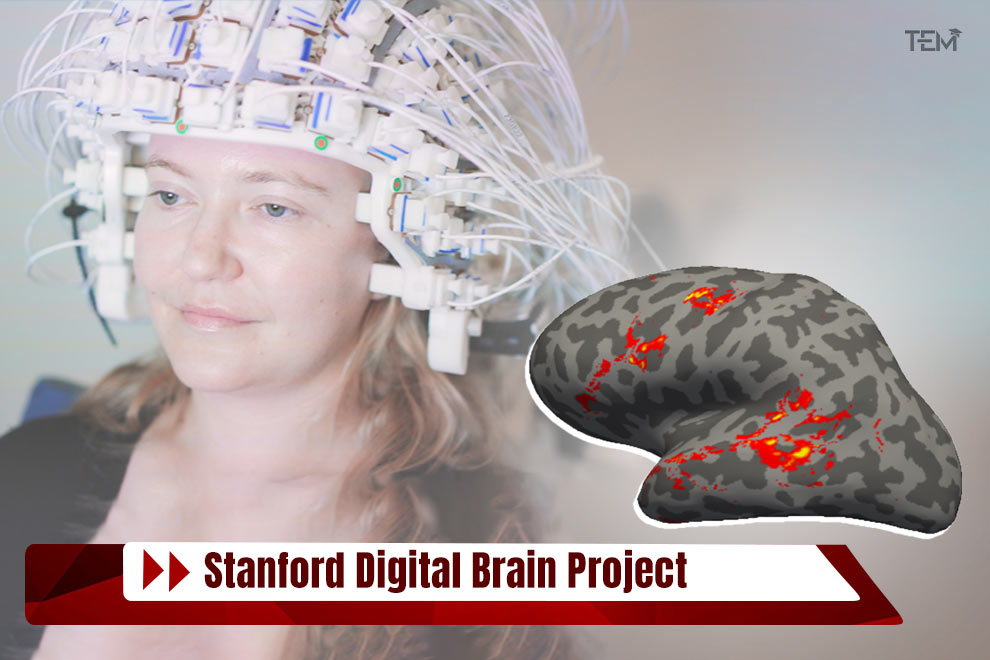
The Stanford Digital Brain Project will use two advanced imaging technologies to capture different aspects of brain activity. These include a 7-Tesla functional magnetic resonance imaging (fMRI) scanner and an optically pumped magnetometer magnetoencephalography (OPM-MEG) system.
The 7-Tesla MRI scanner measures changes in blood flow associated with brain activity. It provides high spatial resolution, allowing researchers to identify where activity occurs in the brain. However, these blood-flow changes take several seconds to reflect neural activity.
The wearable OPM-MEG system detects tiny magnetic fields generated by electrical activity in the brain. It records changes within milliseconds, although it provides less precise information about the location of their sources.
Combining 7-Tesla MRI scanner and OPM-MEG system technologies will help researchers understand both where and when brain activity occurs.
According to The Transmitter, the first of 10 planned data-collection campaigns will involve 10 participants undergoing brain scans approximately twice a week for a year using both technologies. Initial experiments will include watching videos and completing simple decision-making tasks. Later activities may involve interactive video games and virtual reality.
Across this wider Stanford Digital Brain Project, researchers will study brain functions related to perception, memory, language, movement, attention, emotions, social interaction, and reasoning.
What Are Brain Foundation Models and How Will Stanford Digital Brain Project Use Them?
An important goal of the Stanford Digital Brain Project is to develop AI foundation models trained on large and diverse collections of brain-imaging data. These models will learn patterns in brain activity and use them to predict how different brain networks may respond to particular situations.
Stanford researchers will use an AI training approach similar to the one behind large language models (LLMs). While LLMs learn from extensive text collections to generate responses to prompts, the Stanford models will learn from brain-imaging and behavioral data to predict how different brain networks respond to various experiences and tasks.
An associate professor of psychology and computer science at Stanford, Dan Yamins, has played a leading role in developing the initiative to build brain foundation models. He explained that these models could help scientists make quantitative predictions about how brain circuits process information and investigate hypotheses that would be difficult to test through laboratory experiments alone.
The Stanford researchers will first develop models of key brain systems involved in perception, memory, and attention before expanding to the entire human brain model. Stanford’s Marlowe GPU computing cluster will provide the computing resources required for this work.
How the Stanford Digital Brain Project Could Help Treat Brain Disorders?
The Stanford Digital Brain Project aims to advance research into neurological and mental health conditions, including depression, Parkinson’s disease, autism, and Alzheimer’s disease.
Brain activity and the networks involved in a disorder can vary between individuals. This can make it difficult to identify treatments that work consistently. Predictive brain models could help Stanford researchers identify differences in brain activity and investigate how specific interventions might affect different networks.
For example, scientists could simulate the effects of a proposed brain-circuit intervention for depression before testing it in a clinical study. They could also conduct virtual experiments to develop hypotheses about brain networks associated with autism and Alzheimer’s disease.
Stanford researchers believe these Predictive brain models could eventually help identify early biomarkers of disorders and guide more personalized treatments. However, these are research goals, not established clinical applications. The models will require further testing and validation before they can guide patient treatment.
Can AI Models Accurately Explain Human Brain Activity?
Although the Stanford Digital Brain Project represents a large investment in AI-driven neuroscience, researchers outside Stanford have raised questions about its scientific feasibility and usefulness.
A professor at the University of Washington, Bing Wen Brunton, who is not involved in the initiative, also questioned whether a model that predicts brain activity accurately will necessarily explain how the brain works. Existing AI models generally represent particular brain regions rather than the entire brain, making comprehensive AI brain modeling a significant challenge.
However, accurately predicting brain activity does not necessarily mean that an AI model can explain how brain cells and neural networks produce that activity. Researchers still need to determine whether these models can reveal the biological processes behind brain function.
How Stanford’s Digital Brain Research Could Shape Future Neuroscience?
The Stanford Digital Brain Project will contribute to open neuroscience research by making its datasets and computational models freely available to researchers worldwide.
Stanford plans to build on existing resources such as OpenNeuro, a platform for sharing neuroimaging datasets, and the Brain Imaging Data Structure, which helps organize brain-imaging information.
The Stanford Digital Brain Project research team plans to begin collecting data in early 2027. As the five-year initiative progresses, researchers will compare model predictions with actual brain activity and human behavior to assess and improve their accuracy.
The Stanford Digital Brain Project does not promise an immediate digital replica of an individual’s brain. Instead, it aims to develop predictive tools that could help scientists investigate how the human brain works, understand neurological conditions, and explore new approaches to future treatments.