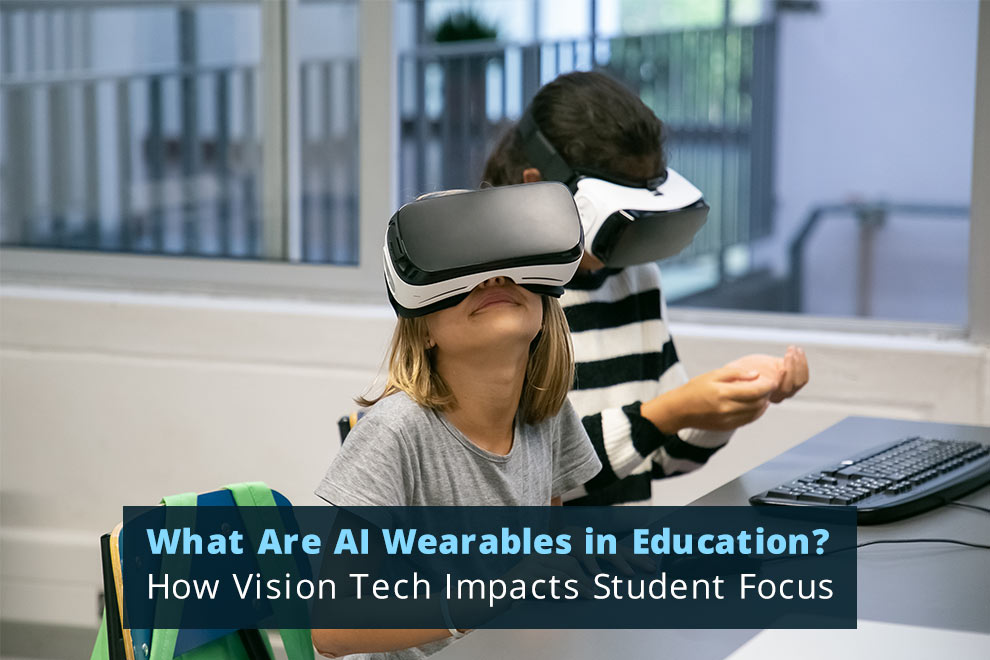
AI wearables in education are biometric and visual data-collection devices—primarily AI glasses, wristbands, and earpieces—that record, process, and analyze student engagement in real time. They do not just capture information. They interpret it. Students use these devices to transcribe lectures automatically, translate languages on the fly, and overlay augmented reality models directly onto physical textbooks. The most practical insight for educators right now is brutally simple. The hardware is already sitting in your students’ pockets and on their faces. You cannot ban it effectively. You must integrate it or get bypassed entirely.
The market for this hardware is not a speculative bubble. It is a massive consumer shift engineered by tech conglomerates. A 2026 report shows that the wearable AI market will reach $310.6 billion by 2033. The sheer volume of capital flooding into this sector guarantees its ubiquitous presence in modern classrooms. Hardware manufacturers want to normalize continuous data capture. Schools are simply the easiest, most captive training ground available.
What Is the Core Function of AI Wearables in the Classroom?
Functionality varies heavily by form factor. But the end goal is always identical. Frictionless data transfer between the immediate environment and the student.
The devices break down into three primary categories. Each serves a distinct educational utility.
Audio-Processing Earpieces: Devices that translate spoken word instantly. A professor speaks in Spanish. The student hears English. The processing delay is practically nonexistent.
Biometric Tracking Bands: Wristbands measuring heart rate and galvanic skin response. These tools assess stress levels during exams. They identify exactly when a student loses focus.
Vision-Enabled Frames: Standard-looking glasses with an integrated camera that capture the wearer’s complete field of view. The onboard software processes equations on a whiteboard and feeds the solution to an earpiece.
This aggressive shift toward wearable technology forces a total reevaluation of what we consider actual benefits of AI in education. The advantage is no longer just fast grading for exhausted teachers. It is the real-time augmentation of the student’s cognitive capacity. They don’t have to memorize anymore. They just have to query the machine perfectly.
But vision tech brings biological side effects. Staring at augmented overlays for eight hours a day causes intense eye strain. Students often complain about bloodshot eyes after heavy study sessions with augmented displays. Many dismiss this entirely, citing classic red-eye myths and blaming it on a lack of sleep or other recreational habits. The truth is usually just localized screen fatigue. Extended focal lock on near-eye displays dries out the sclera.
How Does Vision Tech Collect Data During Lectures?
You might assume AI eyewear just records dumb video. You would be dead wrong. They process highly contextual environments.
When a student wears vision-enabled frames during a lab experiment, the device runs continuous object recognition. It identifies the beaker, the chemical compound, and the volatile reaction. The software then immediately compares the student’s physical actions against the digital syllabus rubric.
Here is the exact data pipeline:
Capture: The onboard optical sensor records a high-definition 4K feed of the student’s hands.
Process: The edge-computing chip inside the frame runs a localized neural network.
Cross-Reference: The system pings a cloud database to verify the chemical reaction parameters.
Feedback: A subtle audio cue tells the student they missed a fundamental step.
This is hyper-personalized learning. It is also an absolute nightmare for institutional data privacy. Every time a student activates their device, they map the classroom. They record the professor without consent. They capture the faces of their peers.
We are seeing a rapid, chaotic evolution in AI literacy requirements. Literacy used to mean knowing how to format a basic spreadsheet. Now it means understanding how a neural network interprets a live video feed. Students need to know what actually happens to the data their frames collect. Most do not have a clue.
Are AI Eyewear Devices Distracting or Enhancing?
The debate is loud. The data is highly mixed. Tech companies sell these devices as the ultimate focus tools. Panicked educators often see them as the ultimate cheat codes.
Consider the math. A student wearing AI frames can look at a complex calculus problem and see the step-by-step solution projected onto the physical lens. Is that learning? Or is that just advanced transcription enabled by a massive server farm?
Faculty members are justifiably alarmed. A recent survey clearly shows that 84% of faculty agree AI reduces critical thinking and deep engagement with core course material. They see students offloading the entire cognitive struggle to the machine. The struggle is exactly where the neural pathways form. Without the struggle, the student retains absolutely nothing.
Yet, when used correctly, the performance metrics are undeniable. These tools can act as persistent, personalized mentors. In fact, aggressive research indicates that AI tutoring can achieve an effect size of up to 1.3 standard deviations compared to traditional active learning environments. That is a massive statistical jump. It effectively turns a C student into an A student without hiring a human.
The difference lies entirely in the software constraints. If the AI simply feeds the answer, the student rots. If the AI tutors use rigorous Socratic questioning to guide the student based on their visual field, the student accelerates rapidly.
How Widespread Is the Adoption of AI Wearables in Schools?
Look around any college campus right now. The hardware is already deployed. It just looks like regular fashion accessories.
This stealth adoption makes it incredibly difficult for administrators to regulate. You can easily ban smartphones during a test. You cannot easily force a student to remove their prescription eyewear just because the frames look slightly thicker than average.
The adoption curve is violently aggressive. Hard data from 2025 shows that 26% of teens use ChatGPT for their schoolwork. That is just the baseline text interface. As the friction of typing disappears, that number will spike dramatically. When asking a question is as easy as looking at a textbook and whispering sub-vocally, usage becomes ubiquitous.
The marketing machines behind these devices are relentless. They target the consumer directly, not the district. EdTech companies used to sell to lumbering school superintendents. Now, hardware companies sell directly to teenagers on social media. They bypass the sluggish institutional procurement process entirely.
Students buy the hardware for social media content creation.
They bring the hardware into the lecture hall out of habit.
They realize the hardware can easily solve their homework.
The hardware becomes a permanent academic crutch.
This is a bottom-up technological revolution. The schools are completely reactive and perpetually behind the curve.
How Do AI Wearables Affect Student Assessment?
Testing environments are breaking down structurally. The traditional model relies heavily on isolation and deprivation. Put a student in a quiet room. Take away their books. Tell them to recall isolated facts.
AI glasses destroy this model completely. If a device can recognize text and query a large language model locally, the exam is compromised instantly.
Administrators are scrambling to implement draconian countermeasures. Some universities use radio-frequency scanners at the door of the testing center. Others are reverting to oral examinations. The oral exam forces the student to demonstrate real-time competency. A machine cannot fake conversational fluency yet. Not without a noticeable, awkward lag.
Let’s look at the assessment arms race:
Proctoring Software: Eye-tracking webcams attempt to catch students glancing at secondary devices.
Hardware Bans: Outright prohibition of any electronic wearable during assessments.
Open-Device Exams: Designing tests where access to all human knowledge is assumed.
The third option is the only sustainable long-term path. If the student has an AI assistant strapped to their face, test them on what they can build with it. Stop testing raw recall. Test synthesis. Test rapid application. If the exam can be passed by a generic AI, the exam is inherently obsolete.
Many educators heavily resist this. They cling to the old, comfortable metrics. They want to measure what a student knows in a vacuum. But the vacuum no longer exists outside the school walls. The modern workplace does not strip employees of their tools. It demands they use them efficiently.
What Are the Privacy Implications of Constant Visual Capture?
The camera is always on. That is the fundamental premise of ambient computing.
For AI eyewear to be useful, it must constantly scan the environment. It needs to know when you are looking at a math problem versus when you are looking at a sandwich. This means continuous background recording.
The implications for a K-12 environment are severe. Minors have strict data protection rights under federal laws. A device that silently records high-definition video of a classroom violates almost all of them.
Consider the data trail left by a single student wearing these frames:
Facial recognition data of unconsenting classmates.
Audio recordings of private conversations in the hallway.
Geolocation logs of their daily, minute-by-minute movements.
Behavioral analysis of their attention span.
Who actually owns that data? The hardware manufacturer? The school district? The student?
Read the brutal terms of service. The manufacturer owns it. They anonymize it, package it, and train their next-generation proprietary models on it. The students are paying hundreds of dollars for the hardware, and they are providing the training data for free. It is a brilliantly ruthless business model. It is a terrible privacy standard.
Schools cannot effectively police this. A teacher cannot demand to inspect the local storage of a student’s eyewear. The legal liability is immense and completely untested.
Can We Measure the ROI of AI Hardware in Education?
School boards love return on investment metrics. They want to know exactly what a specific purchase yields in standardized test scores. AI wearables destroy this clean calculation entirely.
The primary issue is that the schools aren’t buying the hardware. The students are. The district sees no upfront capital cost, but they bear the full burden of the pedagogical disruption. When a wealthy district has 60% of its students using advanced vision tech, and a low-income district has 5%, the achievement gap widens exponentially overnight.
We cannot measure the ROI using traditional benchmarks. If a student uses an AI wearable to ace an obsolete multiple-choice test, the ROI looks artificially high. The test itself is flawed.
To actually measure the impact, administrators must look at brutal workforce readiness. Are these students better prepared to operate in a heavily automated corporate environment?
Do they know how to prompt visual models effectively?
Can they rapidly audit the output of an AI system for hallucinations?
Are they faster at synthesizing disparate data streams?
These are the metrics that matter. A student who can fluidly collaborate with an AI agent will dramatically outperform a student who relies solely on organic recall. The market rewards speed and accuracy. The wearables provide both in spades.
The real cost falls squarely on the curriculum designers. They have to rebuild the syllabus from scratch. That takes time. That takes money. That is exactly where the negative ROI hits the hardest.
How Should Educators Adapt to the AI Hardware Influx?
Ignoring the tech guarantees rapid irrelevance. Banning it guarantees a thriving black market. Adaptation is the only functional survival strategy.
First, redefine cheating. If a student uses an AI to outline an essay, is that academic dishonesty? Or is that just smart resource management? Establish clear, rigid boundaries. Write the rules down. Do not rely on vague “academic integrity” clauses from a decade ago.
Second, shift the curriculum immediately. Prioritize physical, collaborative tasks. You cannot fake a chemistry titration with an earpiece. You cannot bluff your way through a live theatrical performance or a hands-on engineering build.
Third, aggressively train the faculty. Most teachers have absolutely no idea what these devices are capable of. They think AI is just a website you type prompts into. Show them the actual hardware. Let them put on the glasses. Let them experience the real-time translation and the object recognition. Paralyzing fear stems directly from ignorance.
Educators must become orchestrators of technology, not wardens of static information. The information is free. The hardware is ubiquitous. The value of a teacher is exclusively in guiding the student on how to filter, analyze, and apply that overwhelming stream of synthetic data.
The Real State of EdTech Integration
AI wearables are not a passing fad. They are the new baseline for student interaction with information. The transition from desktop computing to mobile computing took a decade. The transition from mobile to wearable AI will happen in half that time. The hardware is remarkably cheap, the models are exponentially faster, and the consumer demand is insatiable.
Schools are currently losing the adaptation race badly. They are fighting the technology instead of redesigning the pedagogy. The data shows massive potential for personalized tutoring and engagement, but only if the assessment models evolve to match the highly advanced tools. Until institutions stop testing raw memorization, AI glasses will remain the ultimate cheating device rather than the ultimate learning tool. The technology is already here. The pedagogical framework is completely absent.