In 2026, millions of students use AI tools such as ChatGPT (OpenAI), Gemini (Google DeepMind), Microsoft Copilot, and Claude (Anthropic) daily for homework, research, coding, and creative projects. As generative AI rapidly transforms classrooms and modern workplaces, knowing how to critically question AI is becoming just as important as knowing how to use it. AI literacy has officially evolved from an emerging tech topic into an indispensable foundational competency, standing right alongside traditional digital literacy and critical thinking.
This guide explores what AI literacy means, why it matters in modern education, and how educators can begin teaching it effectively.
What Is AI Literacy?
AI literacy is the ability to understand, evaluate, use, and question artificial intelligence tools responsibly while recognizing their underlying capabilities, limitations, and ethical implications. It empowers individuals to navigate an AI-driven society with digital safety, critical reasoning, and autonomy
AI literacy isn’t about learning how to build complex machine learning algorithms. Instead, it is about knowing how AI systems make decisions, recognizing when an AI tool is making mistakes (hallucinations), and using generative AI ethically as a collaborative assistant.
AI Literacy vs Digital Literacy
While digital literacy focuses on using computers, navigating the internet, and retrieving information, AI literacy addresses autonomous systems that synthesize, generate, and reason over data.
| Capability Area | Digital Literacy | AI Literacy (AI Fluency) |
| Search & Retrieval | Basic search skills & keywords | Prompt engineering & iterative prompting |
| Fact Verification | Information retrieval & source checking | AI verification & hallucination detection |
| Ethical Awareness | Cybersecurity awareness & privacy | Bias detection, synthetic media detection, & AI safety |
| System Interaction | Operating software applications | Human-AI collaboration & autonomous workflow management |
The Key Difference While digital literacy teaches you how to locate information online, AI literacy equips you to prompt, verify, and ethically evaluate AI-generated content produced by autonomous models.
Why AI Literacy Is Becoming a Core Skill
The transition from static software to autonomous AI agents and enterprise wide AI workflows has accelerated the demand for AI readiness across all industries.
- The Rise of Autonomous AI Agents: Workflows are shifting from simple prompt response interactions to agentic AI that executes multi-step tasks autonomously. Workers and students must know how to supervise, evaluate, and keep a “human-in-the-loop” during these process-automated tasks.
- Global Regulatory Impact: Regulations like the European Union’s AI Act and guidance from the European Commission are pushing organizations and educational bodies to enforce transparent and responsible AI practices.
- Enterprise AI Adoption: Global corporations are shifting hiring priorities toward candidates demonstrating strong generative AI literacy, effective prompt engineering, and critical verification skills.
Key Takeaway: AI readiness is no longer optional—it is a vital pillar of modern workforce readiness and lifelong learning.
Why AI Literacy Matters in Modern Education
Without proper AI education, students risk over-relying on automated outputs without questioning potential underlying algorithmic biases or errors.
Real Classroom Example in Action
- Without AI Literacy: A student prompts ChatGPT for an explanation of photosynthesis, pastes the output directly into a science report, and accidentally includes incorrect citations or false claims generated by model hallucination.
- With AI Literacy: A student asks ChatGPT to explain photosynthesis, reviews the generated summary, checks the facts against a verified biology textbook, and uses follow-up prompts to clarify complex concepts while properly citing the AI tool.
1. Preparing Students for an AI-Driven Workforce
The modern workforce is increasingly shaped by automation, machine learning, and data-driven decision-making.
According to the World Economic Forum’s Future of Jobs Report (2025), 170 million new roles are expected to be created by 2030, while 92 million existing jobs will be displaced a net gain driven largely by AI and technological change.
Preparing students for a rapidly changing world, therefore, starts with equipping them to work alongside these systems.
In fields such as healthcare, marketing, engineering, and finance, professionals already use AI tools to analyze large datasets, generate insights, and streamline complex tasks. Understanding how these systems work enables individuals to use them more effectively and responsibly.
These competences, therefore, help students develop future-ready skills. When learners understand the capabilities and limitations of AI, they are better prepared to integrate technology into problem-solving, research, and innovation.
Rather than viewing AI as a replacement for human intelligence, AI-literate students learn how to combine human creativity with machine efficiency, a skill that will define many emerging careers.
2. Building Critical Thinking in the Age of AI
One of the most important aspects of this skillset is the ability to evaluate information critically.
Unlike a textbook with a named author and editorial review, AI-generated content carries no inherent accountability; it can sound authoritative while being partially or entirely wrong.
This means critical thinking is no longer just an academic virtue; it is a practical survival skill for navigating AI-mediated information.
In this way, this competency supports one of education’s most enduring goals: helping students become thoughtful and informed decision-makers.
3. Encouraging Responsible Use of AI Tools
Another reason this competency is essential in education is the growing importance of ethical technology use.
Schools are uniquely positioned to shape how the next generation relates to AI, not as passive users, but as informed ones who understand when to rely on AI, when to question it, and when to set it aside entirely.
By building ethical awareness into curricula, institutions help students develop the judgment that no algorithm can replicate.
Core Skills That Define AI Literacy
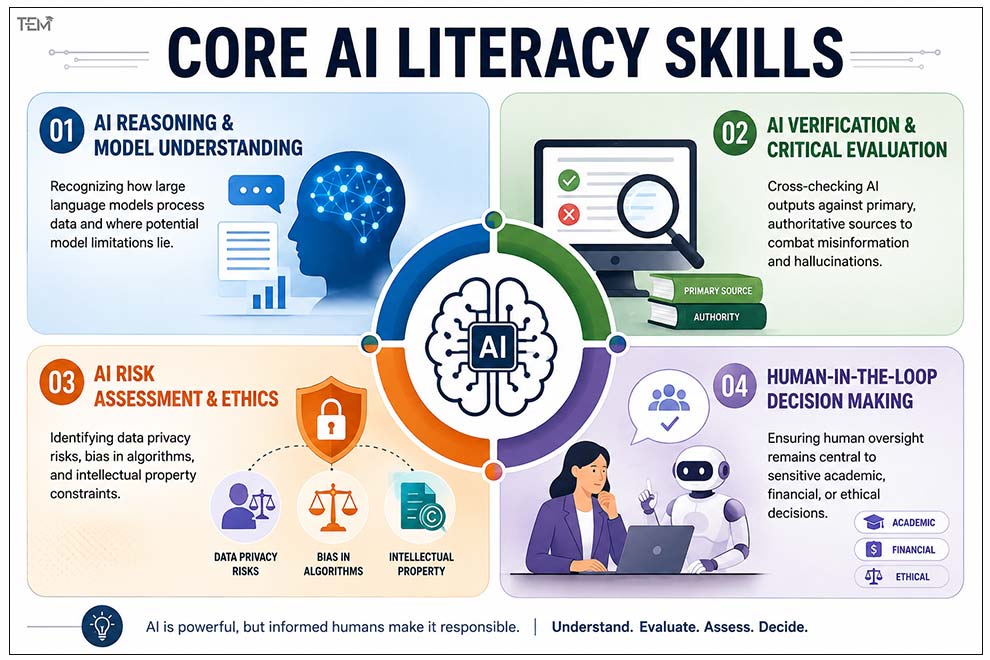
This skillset is often described as a combination of technical understanding, critical thinking, and responsible technology use. While different frameworks present these competencies in slightly different ways, most research identifies several core skills that learners should develop.
Writing Effective AI Prompts (Prompt Engineering)
To get reliable outputs from AI tools, students and educators must master structured prompt engineering:
- Clear Instructions: Define explicit constraints, formats, and expected outputs.
- Contextual Framing: Provide background context, target audience, and specific role instructions.
- Iterative Follow-ups: Refine results through follow-up prompts rather than accepting initial drafts.
- Output Evaluation: Rigorously verify all claims, figures, and quo
1. Understanding How AI Systems Work
The first step toward this kind of literacy is gaining a basic understanding of how artificial intelligence systems operate. Students do not need to become machine learning engineers, but they should understand key ideas such as data, algorithms, and pattern recognition.
AI models analyze large volumes of data to identify patterns and generate predictions or responses. Understanding this process helps students recognize that AI outputs are based on probability and training data rather than true comprehension.
When learners understand these underlying mechanisms, they become more thoughtful users of AI technologies.
2. Evaluating AI-Generated Information
Another essential skill is the ability to evaluate AI-generated outputs. Because AI systems can produce convincing responses quickly, students must learn how to verify the accuracy and reliability of the information they receive.
This involves asking questions such as:
- Is the information supported by credible sources?
- Could bias influence the response?
- Does the output align with verified knowledge?
Developing these evaluation skills helps students avoid misinformation and strengthens their research capabilities.
3. Using AI Tools Responsibly
Responsible AI use requires an understanding of both the opportunities and limitations of technology. AI tools can assist with tasks such as brainstorming ideas, summarizing information, or analyzing data, but they should not replace original thinking.
Students must learn how to integrate AI into their work ethically and transparently. This includes acknowledging when AI tools are used and ensuring that the final work reflects genuine understanding.
Responsible use also involves protecting personal data and respecting intellectual property.
4. Collaborating With AI for Problem Solving
This also involves learning how to work alongside intelligent systems. Rather than treating AI as a simple tool, students increasingly interact with it as a collaborative partner in learning.
For example, AI can help learners explore complex topics, generate alternative perspectives, or analyze large datasets. When students learn how to guide AI systems effectively, they can use technology to expand their creativity and problem-solving capacity.
The goal is not to replace human thinking but to enhance it through thoughtful collaboration with intelligent technologies.
Global Frameworks Shaping AI Literacy
Leading global policy organizations have established international standards to guide AI integration in education:
- UNESCO AI Competency Framework: Outlines core competencies for educators and students, focusing on human agency, ethics, and social responsibility.
- ISTE (International Society for Technology in Education) AI Guidance: Focuses on empowering students to become innovative designers, computational thinkers, and ethical digital citizens using AI tools.
- U.S. Department of Education AI Guidance: Emphasizes human-centric AI implementation, accessibility, equity, and safeguarding student data privacy.
- OECD & OECD PISA: Benchmarking international educational assessment standards to include AI readiness and problem-solving in digital environments.
- Code.org & World Economic Forum (WEF): Driving baseline AI and computer science literacy initiatives to prepare youth for future workforce shifts.
1. Digital Promise’s AI Literacy Framework
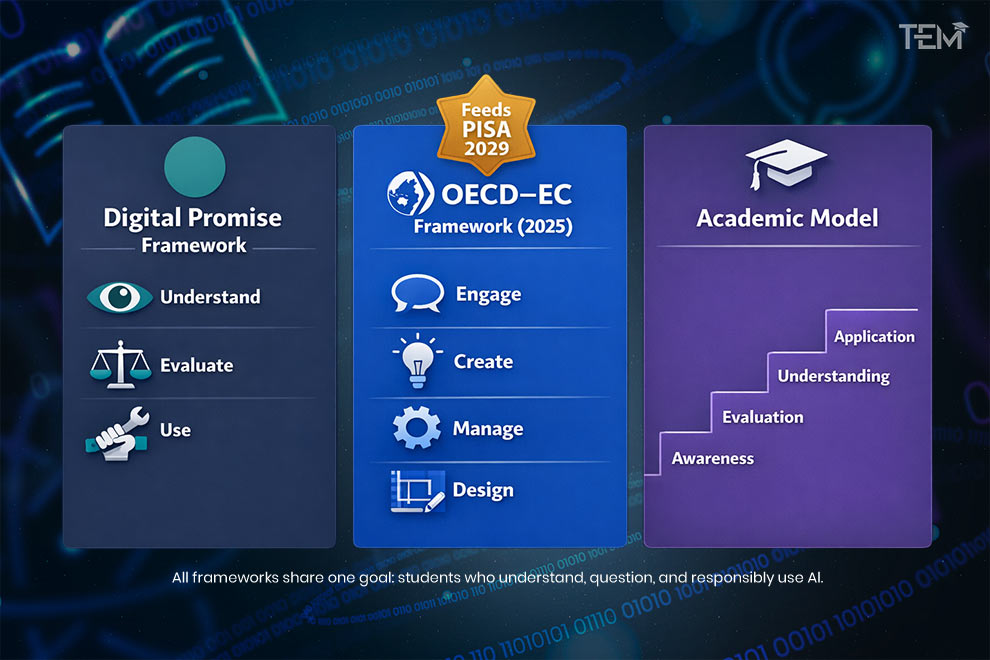
One of the most widely referenced models in education comes from Digital Promise, a nonprofit organization focused on innovation in learning. Their framework identifies three primary modes of engagement with artificial intelligence:
- Understand: learners develop a foundational understanding of how AI systems function, including the role of data and algorithms.
- Evaluate: centering human judgment and justice, students critically consider the benefits and costs of AI for individuals, society, and the environment, including questions of fairness, bias, and ethical responsibility.
- Use: learners apply AI tools responsibly in practical contexts such as research, problem solving, and creative work.
What distinguishes this framework is its emphasis on human judgment. Rather than presenting AI as an authority, the model encourages students to question and interpret AI outputs thoughtfully.
2. OECD and European Commission AI Literacy Framework
In May 2025, the OECD and European Commission released a joint draft framework titled “Empowering Learners for the Age of AI”, developed with support from Code.org and an international network of educators, researchers, and policymakers.
The framework defines competences across four core domains: Engage with AI, Create with AI, Manage AI, and Design AI. It emphasizes that students must develop not only technical skills but also ethical reasoning, critical judgment, and an understanding of AI’s broader societal implications.
The framework directly contributes to the PISA 2029 Media and AI Literacy (MAIL) assessment, the first time this field will be formally measured in OECD’s Programme for International Student Assessment, and aligns with the EU’s Digital Education Action Plan 2021–2027.
The growing involvement of these international organizations signals that this is not simply a technological trend but a long-term educational priority with measurable global benchmarks.
3. Academic Models of AI Literacy
Researchers in education and computer science have also contributed to the development of AI in these frameworks. Many academic models approach it as a progressive learning journey, where students gradually move from basic awareness to deeper understanding.
These models often include stages such as:
- Awareness: recognizing where AI is used in everyday life.
- Understanding: learning how AI systems analyze data and generate outputs.
- Evaluation: critically assessing the reliability and fairness of AI decisions.
- Application: using AI tools responsibly to support learning and innovation.
By structuring this learning in progressive stages, educators can introduce complex concepts gradually, ensuring that students build both technical understanding and critical thinking skills over time.
How Schools Can Teach AI Literacy
IEffective AI education moves beyond passive lecturing into hands-on, project-based learning. Educators can enhance student engagement through structured classroom activities and Adaptive Learning environments.
Practical Project-Based Learning Exercise: Model Comparison
- Assign students a single research question (e.g., “What are the primary causes of economic inflation?”).
- Have students run the exact prompt across three distinct LLMs: ChatGPT, Gemini, and Claude.
- Ask students to build a side-by-side evaluation table analyzing:
- Hallucinations & Accuracy: Did any model cite fake studies or inaccurate figures?
- Citations: Are source citations real and verifiable?
- Bias & Tone: Is the response balanced or does it present a biased perspective?
- Reasoning Depth: Which model provided the most logically sound breakdown?
Teachers can also gamify these evaluations using interactive [Classroom Games] focused on spotting AI hallucinations.
1. Integrating AI Across Subjects
Artificial intelligence affects fields ranging from science and engineering to social sciences and the humanities. Schools can introduce relevant concepts across different subjects to highlight these connections.
For example:
- Science classes can explore how AI assists in medical research and climate modeling
- Social science courses can examine the ethical and societal implications of AI technologies
- Language or media studies can analyze AI-generated content and its impact on communication
By integrating this curriculum across disciplines, educators encourage students to view technology through a broader intellectual lens.
2. Teaching Students to Question AI Outputs
A critical component of this education is the ability to question the reliability of algorithm-generated information. Educators can encourage this skill by asking students to compare AI-generated responses with trusted academic sources.
For instance, students might examine how an AI system answers a research question and then verify the information through scholarly articles or textbooks. This exercise helps learners recognize that AI outputs must be interpreted and validated rather than accepted without scrutiny.
Developing this habit strengthens students’ research skills and encourages responsible engagement with technology.
3. Classroom Activities That Build AI Awareness
Practical learning experiences can help students understand AI concepts more effectively than theoretical explanations alone. Classroom activities might include:
- Exploring how recommendation algorithms shape social media feeds
- Analyzing examples of biased or inaccurate AI-generated information
- Experimenting with AI-powered tools to understand their strengths and limitations
These activities encourage students to see AI not only as a technological innovation but also as a system influenced by human decisions, data quality, and design choices.
AI Literacy in K–12 Education
Implementing age-appropriate AI instruction helps build foundational habits early:
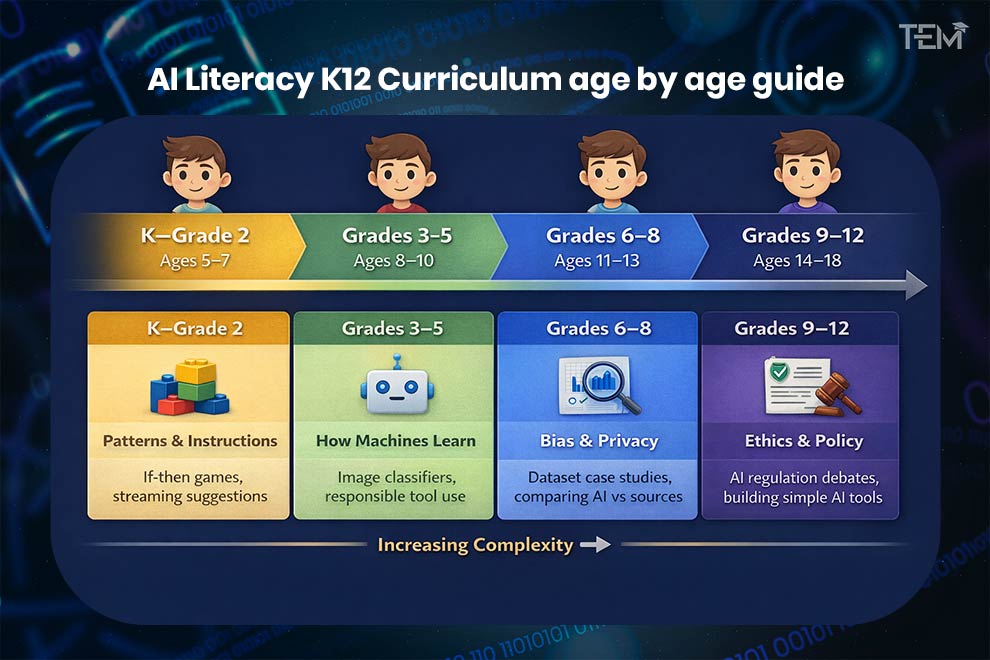
One of the most common questions from educators is where to start. The good news is that these concepts can be introduced at every stage of a student’s education, with the level of complexity scaled to match developmental readiness.
| Grade Level | Focus Area | Core Learning Objective |
| Elementary (K–5) | Basic Awareness | Recognizing the difference between human intelligence and machine rules. |
| Middle School (6–8) | Safe Usage & Ethics | Identifying AI in everyday life, understanding data privacy, and detecting basic bias. |
| High School (9–12) | Applied Competency | Prompt engineering, verifying AI outputs, citation rules, and analyzing workplace impact. |
Institutional Policy Note: K–12 schools must establish age-appropriate AI usage policies that align with strict data privacy regulations and institutional academic integrity guidelines.
AI Literacy in Higher Education
Higher education institutions are rethinking traditional pedagogy to address the reality of AI-assisted scholarship.
- Clear AI Citation Policies: Universities must define transparent rules for when and how AI tool assistance must be cited.
- Responsible AI Disclosure: Students and researchers should disclose how AI tools were used during ideation, coding, or proofreading.
- Understanding AI Detection Limitations: Institutions must acknowledge that automated AI detectors carry significant false-positive rates and cannot replace human assessment of academic work.
- Research Ethics: Safeguarding propriety research data from being uploaded into public LLM training datasets.
For deeper strategies on maintaining standards, explore our comprehensive guide on maintaining AI Academic Integrity
1. Preparing Future Professionals
Universities occupy a distinct position in this education; they are not only preparing users of AI, but also future researchers, developers, and policymakers who will help shape it.
In fields such as business, healthcare, engineering, and journalism, students are learning how AI tools can support complex research and high-stakes decision-making.
More importantly, higher education introduces the ethical and regulatory frameworks that govern AI in professional life, questions of accountability, transparency, and societal impact that go well beyond what a classroom activity can cover.
2. Teaching Responsible AI Research
Universities also play an important role in promoting responsible AI use in academic research.
Understanding how AI agents are reshaping academic research helps both educators and students anticipate the skills they will need. Students increasingly rely on AI tools for tasks such as literature reviews, data analysis, and idea generation.
However, responsible academic practice requires transparency and critical evaluation. Educators, therefore, emphasize the importance of acknowledging AI assistance, verifying AI-generated information, and maintaining academic integrity.
When universities combine technical understanding with ethical awareness, they help students develop a balanced approach to working with intelligent technologies.
Ethical Challenges of AI Literacy
As generative tools become increasingly realistic and multimodal, AI literacy must tackle rising digital threats:
- Deepfakes & Synthetic Media: Identifying hyper-realistic voice clones, manipulated video, and synthetic images.
- AI Companions & Emotional Over-Reliance: Understanding the psychological risks of forming parasocial bonds with anthropomorphic AI conversational bots.
- AI-Generated Scams & Phishing: Developing heightened digital security awareness against sophisticated, automated social engineering tactics.
- AI Copyright & Intellectual Property: Navigating ownership issues surrounding training data and generated creative works.
Learn how to spot and defend against evolving threat vectors in our overview of modern Types of Cyber Attacks.
AI tools are built using vast datasets and complex algorithms. While they can improve efficiency and access to information, they can also introduce risks such as bias, misinformation, and privacy concerns. Teaching these topics, therefore, requires helping students recognize these limitations.
1. Algorithmic Bias and Fairness
One of the most widely discussed concerns in artificial intelligence is algorithmic bias. AI systems learn patterns from the data they are trained on. If the underlying data reflects historical inequalities or incomplete representation, the AI system may reproduce those biases in its outputs.
For example, biased training data can influence how AI systems interpret images, recommend content, or generate information. This awareness helps students understand that AI outputs are not inherently neutral; they are shaped by the data and design decisions behind the system.
Encouraging students to question AI outputs and examine potential bias helps build responsible digital citizens who can critically engage with emerging technologies.
2. Data Privacy and Responsible Use
Another key element of responsible technology use is understanding how data is collected and used. Many AI systems rely on large volumes of personal and behavioral data to function effectively.
Students should learn to ask important questions, such as:
- What data is being collected?
- Who owns the data?
- How is the information stored and used?
- What risks might arise if the data is misused?
Developing awareness around data privacy empowers learners to make informed decisions when using digital tools. It also reinforces the idea that technological innovation must be balanced with ethical responsibility and user protection.
3. Combating Misinformation in the AI Era
Generative AI tools can produce text, images, and videos at an unprecedented scale. While this capability can support creativity and productivity, it also increases the risk of misinformation and synthetic media.
These skills equip students with the ability to critically evaluate digital content. Instead of accepting AI-generated material at face value, learners are encouraged to verify information through trusted sources and examine the credibility of digital content.
In an information ecosystem shaped increasingly by automation, the ability to assess accuracy and reliability becomes a vital skill for both academic success and civic participation.
The Future of AI Literacy in Education
Looking ahead, AI literacy will shift from basic tool usage toward managing complex human-AI systems:
- Personalized AI Tutors: AI systems tuned with [Small Language Models] will deliver hyper-personalized learning pathways tailored to individual student needs.
- Multimodal Learning Interfaces: AI systems will natively process text, voice, vision, and real-time environment data simultaneously.
- AI-Powered Career Coaching: Dynamic tools assisting students with skill gap analysis, interview preparation, and effective workplace [Communication Skills].
- Lifelong AI Literacy & Governance: Continuous education programs ensuring citizens adapt as fundamental [Machine Learning Algorithms] and school governance rules evolve.
Discover how emerging ed-tech is transforming classrooms in our article on [Personalized Learning] strategies.
FAQs
- How is AI literacy different from digital literacy?
Digital literacy focuses on using devices, software, and the internet effectively. The latter goes further by helping people understand how intelligent systems generate outputs, interpret data, and influence decisions so users can evaluate results instead of accepting them automatically.
- At what age should students start learning AI literacy?
Students can begin learning these skills in primary school through simple concepts such as recognizing patterns, understanding how machines learn from data, and discussing responsible technology use. As they progress, lessons can include ethics, bias awareness, and real-world applications.
- Do teachers need coding skills to teach AI literacy?
Teachers do not need programming expertise to introduce these concepts. Educators can use discussions, case studies, and classroom activities to explain how intelligent tools work, examine their limitations, and help students think critically about automated outputs.
- Why are governments and universities prioritizing AI literacy now?
Governments and universities are prioritizing these skills because artificial intelligence increasingly influences education, workplaces, and public services. Teaching these skills helps students understand emerging technologies, evaluate automated decisions, and participate responsibly in a society shaped by intelligent systems.