Have you ever looked up during a massive storm and seen a vibrant, eerie flash of green across the sky? You are certainly not alone. Green lightning is one of the most captivating yet misunderstood atmospheric phenomena in the world. But what exactly causes the sky to put on this emerald light show?
In this guide, you’ll discover what green lightning is, why the sky sometimes turns green before a storm, and the science behind this rare weather phenomenon. We will separate weather science from common myths, proving that you do not need supernatural explanations to appreciate a beautiful green sky.
Whether you are a student of Earth Science or simply curious about a rare weather phenomenon you just witnessed, understanding these light displays offers a fantastic window into our atmosphere. Keep reading to discover how water droplets, ice, and electrical discharge combine to create this spectacular, rare lightning color.
Key Takeaways
- Green lightning is a rare weather phenomenon caused by light interacting with intense storms.
- Its appearance is heavily influenced by atmospheric optics, water droplets, and ice crystals.
- Green skies are often linked to intense thunderstorms, particularly hailstorms, but do not guarantee a tornado.
- Green lightning is explained by meteorology and science, not supernatural myths.
- Learning about it helps improve weather awareness, safety, and interest in STEM fields.
Did You Know?
Scientists believe that the green glow seen during some thunderstorms is caused by sunlight interacting with water droplets and hail inside dense storm clouds not by green-colored lightning itself.
What Is Green Lightning?
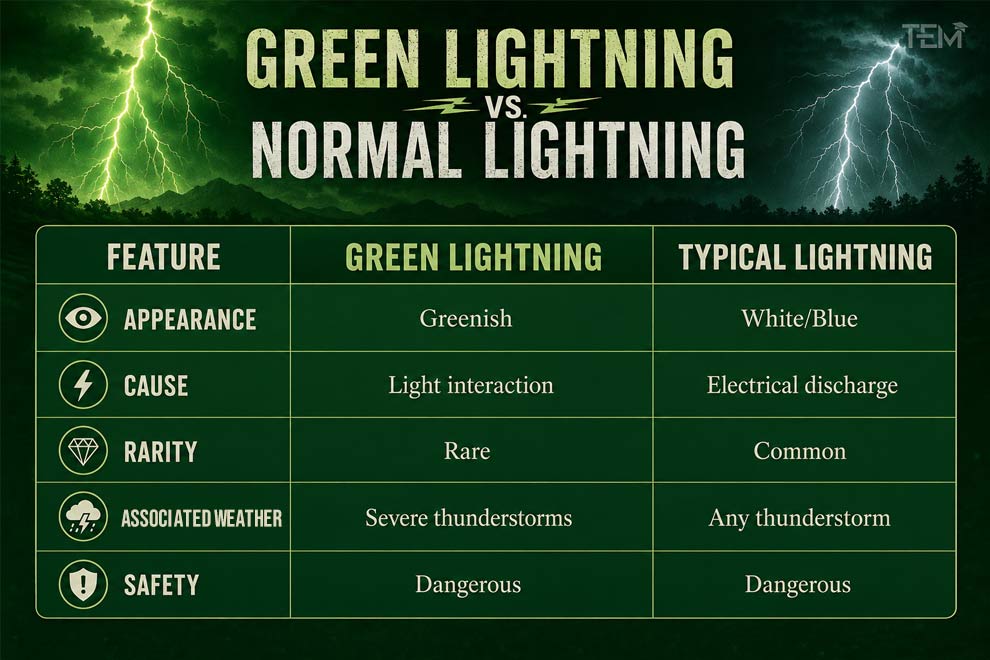
Green lightning is a rare visual phenomenon where a normal electrical discharge appears green. Rather than being a unique form of electricity, it is an optical illusion created by the atmosphere. When lightning strikes inside a particularly dense storm, the light interacts with massive amounts of water droplets and ice crystals in the cumulonimbus clouds. This surrounding environment filters the light before it reaches your eyes, giving the flash a distinct greenish tint.
This phenomenon is strictly associated with severe thunderstorms. It is highly uncommon because it requires a precise combination of cloud thickness, water density, and timing. People tend to notice it simply because it stands out so sharply from the norm. While we are accustomed to seeing bright white or blue flashes, seeing the sky suddenly illuminate in vivid green against dark storm clouds is an unforgettable and striking sight.
What Causes Green Lightning?
The core cause of green lightning comes down to how light travels through a storm. Weather agencies such as the National Weather Service (NWS) and NOAA explain that green skies and green lightning are deeply associated with atmospheric light scattering and severe thunderstorms.
Here is exactly what happens inside the clouds:
- Electrical discharge: A standard lightning bolt emits a powerful blast of white light, which naturally contains all the colors of the visible spectrum.
- Light scattering: As this light travels through the storm, atmospheric particles filter and scatter different wavelengths of light.
- Water droplets and ice crystals: Dense cumulonimbus clouds hold massive amounts of rain and hail. These elements act as a physical filter, absorbing longer red light wavelengths while scattering shorter blue and green wavelengths.
- Storm cloud density: The thicker and taller the cloud, the more intense the filtering effect becomes.
- Sunlight angle: If a storm occurs in the late afternoon or near sunset, the golden-yellow sunlight mixes with the naturally blue hues of the storm cloud, resulting in a distinct green glow.
Why Does the Sky Turn Green During Some Storms?
A green sky before a storm is a well-known warning sign for severe weather. This color shift happens due to atmospheric optics and the specific light wavelengths that penetrate the storm.
Green storm clouds typically indicate a hail-producing storm. Massive thunderstorms hold immense amounts of water and ice. When afternoon sunlight enters these clouds, the ice and water droplets scatter the blue light. When you combine the blue-tinted environment of the storm with the reddish-yellow light of a setting sun, the sky turns a bruised, eerie green.
It is important to clarify: while green skies often indicate severe thunderstorms and a high risk of hail, they do not always mean a tornado is coming. They are simply a sign of an incredibly tall, moisture-packed storm.
Is Green Lightning Real?
Yes, green lightning is absolutely real. While it sounds like science fiction, there is ample scientific evidence backing its existence.
Meteorological organizations and weather photography enthusiasts have recorded numerous observations of this weather phenomenon. While the bolt of lightning itself is not inherently “green” in its energy output, the visual result observed from the ground is undeniably green. Meteorology explains this as an optical effect rather than a change in the electrical discharge itself. The only exception is during volcanic eruptions, where volcanic lightning can sometimes appear green due to the excitation of specific minerals, like copper, in the ash plume.
Green Lightning vs. Normal Lightning
Different Lightning Colors and What They Mean
Lightning colors often come down to what is floating in the air between the storm and your eyes.
- White: Indicates low humidity and dry air. This is often the hottest lightning and causes the most forest fires.
- Blue: Typically means there is a high concentration of hail or ice crystals in the storm.
- Purple: Often occurs in high precipitation scenarios, meaning heavy rain is falling.
- Yellow or Red: Usually indicates high amounts of dust, pollution, or smoke in the air, or that the lightning is occurring very far away.
- Green: Caused by the light interacting with dense, water-logged storm clouds, often signaling severe weather.
Common Myths About Green Lightning
Because of its rarity, many superstitions surround this phenomenon. Here are the facts behind the fiction:
- Myth 1: Green lightning predicts a tornado.
- Fact: It indicates a deep, moisture-rich severe thunderstorm (often with hail), but it does not guarantee a tornado.
- Myth 2: Green lightning is supernatural.
- Fact: It is completely natural, resulting from atmospheric optics and light scattering.
- Myth 3: Only volcanoes create green lightning.
- Fact: While volcanic ash can tint lightning green, standard thunderstorms can also create this effect through water and ice refraction.
- Myth 4: Green lightning occurs only in one country.
- Fact: It can happen anywhere in the world where severe cumulonimbus clouds form.
- Myth 5: Green lightning is more dangerous than normal lightning.
- Fact: The electrical discharge is the same. However, the storm producing it is likely severe, making the environment dangerous.
The Science Behind Green Lightning
To truly understand this phenomenon, we have to look at the physics of lightning and atmospheric optics.
When a lightning bolt fires, it heats the surrounding air to temperatures hotter than the surface of the sun. This massive release of energy radiates outward as white light. However, the atmosphere is not an empty vacuum. Through processes of reflection, refraction, and light scattering, the particles in the air manipulate that light.
Imagine shining a flashlight through a thick glass of water. The light changes and bends as it passes through the liquid. During severe storms, dense clouds filled with rain and hail affect lightning in a similar way, changing how we perceive its color. Inside a supercell thunderstorm, the core is packed with liquid water and solid ice. As the white light from the lightning tries to escape the cloud, the ice and water absorb the warmer wavelengths (reds) and scatter the cooler wavelengths (blues and greens).
The Educational Importance of Green Lightning
Studying rare lightning colors offers highly engaging entry points into broader scientific disciplines
Understanding Thunderstorms
Observing color shifts helps students grasp the structural anatomy of cumulonimbus clouds. By looking at the colors, students can analyze how severe weather systems build up energy, carry water weight, and circulate air. For example, a green flash instantly tells a student that the cloud above is incredibly deep and water-logged.
Learning About Atmospheric Science
It provides a real-world example of atmospheric optics, demonstrating how particles in the air filter and bend light in real time. Instead of looking at a static textbook diagram of light waves, students can see how the atmosphere acts as a giant colored filter during a storm. This makes abstract physics concepts tangible and memorable.
Understanding Electricity in Nature
Analyzing lightning allows educators to teach the physics of electrical discharge, ionization, and how energy moves through the environment. It opens up classroom discussions on how a static charge builds up between the earth and the sky, and how that energy creates plasma.
Learning Weather Safety
Connecting a green sky before a storm to severe weather systems teaches practical, life-saving awareness. When students learn that green hues mean heavy hail and intense wind, they learn to respect the weather. This knowledge transforms visual curiosity into actionable safety habits.
Climate and Weather Education
Tracking storm severity and visual phenomena opens the door to broader discussions about Earth Science and global weather patterns. It helps students understand how shifting global temperatures alter the frequency and intensity of the supercell storms that create these vivid sky colors.
Inspiring Interest in STEM Careers
The visual spectacle of a green storm cloud naturally sparks curiosity, encouraging students to explore careers in meteorology, physics, and environmental studies. Seeing the sky turn a dramatic color prompts young minds to ask why, which is the fundamental starting point for any future scientist or researcher.
Safety Tips During Severe Thunderstorms
Because green lightning usually signals a massive, intense storm, it is critical to prioritize safety :
- Go indoors immediately. Do not wait for the rain to start.
- Avoid open fields. Do not make yourself the tallest object in the area.
- Stay away from water. Water is a highly effective conductor of electricity.
- Avoid electrical appliances. Unplug sensitive electronics and stay off corded phones.
- Wait at least 30 minutes after the last thunder before going outside. Lightning can strike miles away from the center of the storm.
Interesting Facts About Green Lightning
- Green lightning is one of the rarest reported lightning colors.
- Most observations occur during severe thunderstorms containing large hail.
- Atmospheric conditions heavily influence how lightning appears from the ground.
- The green hue does not change the actual temperature or voltage of the lightning bolt.
- Photographers often capture it better than the human eye due to camera sensor sensitivities.
- Volcanic lightning can also appear green when copper-rich rock is vaporized.
- A green sky is more commonly seen in the Great Plains of the US due to the frequency of supercell storms.
- Sailors historically recorded green flashes, though they often confused them with the optical “green flash” at sunset.
Conclusion
The science behind green lightning is a brilliant reminder of how complex and interconnected our atmosphere truly is. Far from being a supernatural omen, this rare lightning color is a beautiful display of atmospheric optics, light scattering, and intense meteorology at work.
Understanding weather phenomena like green storm clouds is more than just answering trivia; it builds crucial weather awareness and safety. When you know why the sky turns green before a storm, you are better equipped to protect yourself from the severe weather that usually follows. Whether you’re a student, educator, or weather enthusiast, understanding phenomena like green lightning reminds us how science helps explain even the most extraordinary sights in nature.
FAQ
- What causes green lightning?
It is primarily caused by light scattering. When lightning flashes, its light filters through dense cumulonimbus clouds containing heavy rain and hail. The water and ice absorb red light and scatter blue and green wavelengths.
- Is green lightning dangerous?
The green color itself does not make the lightning more dangerous. However, because it typically occurs during severe weather, hailstorms, or intense thunderstorms, the conditions surrounding green lightning are highly hazardous. You should seek shelter immediately.
- Does green lightning mean a tornado is coming?
No. While a green sky before a storm indicates severe weather and deep, hail-producing clouds, it is not a guaranteed sign of a tornado. It simply means the storm is very intense and contains massive amounts of water.
- Why does the sky turn green before a storm?
The sky turns green due to atmospheric optics. When late afternoon sunlight, which is naturally red and yellow, mixes with the blue environment of a massive, water-filled storm cloud, the scattering of light wavelengths produces a green sky.