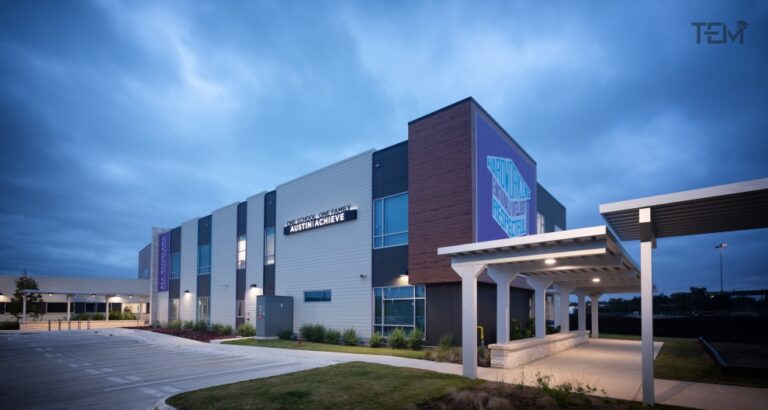
In the northeast corner of Austin, Texas, in a ZIP code that statisticians would flag as a place where the odds are stacked against the residents, something unusual has been happening since 2012. A charter school that started with just 104 6th graders has grown into a five-campus district serving 3300+ scholars from PreKindergarten through high school graduation. Local children from some of the lowest-income neighborhoods in Austin are becoming the first members of their families to go to college; with each diploma earned, they are rewriting the narrative of what public charter schools can accomplish in Texas’s most underserved communities.
A School Built on a Vision for Equity
Every origin story needs a person who noticed something everyone else had learned to walk past. For Austin Achieve, that person is John Armbrust, a native Austinite who studied engineering at Duke University before joining Teach For America in Atlanta in 2004. He worked inside traditional school districts and public charter schools across the country before returning to Austin with a vision for expanding educational opportunity.
What he found when he returned to Austin unsettled him. The educational inequalities in his own hometown were, in his words, more severe than he had realized. So he did what engineers sometimes do when they encounter a broken system: he tried to build a better one. He chose to plant the district’s roots in the 78723 ZIP code, a stretch of Northeast Austin that a Brookings Institution and Federal Reserve System study identified as a place where 45.6 percent of residents lived in poverty, compared to 11.1 percent across the greater Austin metropolitan area. The location reflected the district’s commitment to serving Austin’s most underserved children and closing the opportunity gap where it was greatest.
Austin Achieve Public Schools describes its founding mission plainly: this was to be a tuition-free, open-enrollment public charter school district preparing Austin and Pflugerville youth to attend and excel at top universities. Fourteen years later, that founding mission has become an operating reality across five campuses.
The Shape of the District Today
Austin Achieve now educates more than 3,300 scholars each school year from PreK through 12th grade, spread across five campuses in Austin and Pflugerville. The structure is deliberately feeder-based: two elementary schools carry scholars from PreK through fourth grade, two middle schools take them through eighth grade, and one high school carries them to graduation.
The demographics give you a snapshot of who Austin Achieve serves. 98% of scholars are BIPOC (80% are Hispanic, 13.5% Black, 3.5% Asian, and 1% multiracial). 90% of scholars come from low-income households. 8% receive special education services, a figure the district points to proudly, noting that its special education offerings have become well-known and well-respected among parents in Austin.
This is, by design, a district serving families who have historically been left behind by traditional public school options. The district’s mission and the communities it serves remain closely intertwined.
Growth Measured in Ground Gained, Not Just Ground Covered
Ask Austin Achieve how it defines educational excellence, and the answer begins with measuring scholar growth. Most scholars arrive already behind in literacy and math, sometimes as early as kindergarten. Rather than measure success against some fixed external bar, the district leans heavily on the NWEA MAP Growth Assessment, a test that tracks a student’s academic growth over time in math, reading, language usage, and science.
This philosophy is reflected in one of the district’s core beliefs: there is no such thing as an achievement gap, only an opportunity gap.
That belief shows up in the curriculum, too. Austin Achieve runs a STEAM-forward academic program layered with social-emotional learning, and according to the Texas Education Agency’s Accountability Score, the district is outperforming 100 percent of its peers in its zone.
The Whole Child, Not Just the Test Score
Academics are only part of the picture Austin Achieve wants to tell. The district describes its approach as a “whole child” model, one that treats arts, athletics, and extracurriculars as being just as essential as reading levels and growth percentiles.
Walk the halls, and you might find scholars in robotics, gardening, chess, or guitar club. Arts electives include visual arts, band, and theatre. The district also places a strong emphasis on athletics. Austin Achieve is UIL-competitive, something that is a rarity among charter schools. Its high school boys’ soccer team has won back-to-back district championships and, in 2025, brought home a state championship.
Culture also gets its own dedicated calendar. Heritage months come with reading lists, classroom celebrations, history lessons, and sometimes field days or parades. Last year’s Hispanic Heritage Month, for instance, included mariachi bands and folklorico dancers.
A District That Leans on Its Neighbors
No school district thrives in isolation, and Austin Achieve has built deep relationships with hundreds of local businesses, charities, service providers, and civic leaders. The district receives in-kind donations of food, clothing, transportation, vaccinations, vision care, and hearing care, services that help remove barriers to learning for scholars and their families.
There is also a staff member whose job is dedicated to advocacy work, someone who shows up regularly at City Council meetings to represent the district’s interests. The district’s advocacy efforts reflect its belief that supporting scholars extends beyond the classroom.
The Team Behind the Numbers
Behind every statistic in this story sits a leadership structure built for scale. John Armbrust, Founder and CEO, sets the district’s overall strategic direction and manages board relations and growth. Mackee Mason, Chief Academic Officer, oversees scholar achievement, curriculum, teacher development, and alignment across all five campuses. Joseph Riggs, Chief Financial Officer, manages budgeting, financial compliance, and long-term sustainability. Tyler Heath, Chief Operations Officer, runs facilities, technology, and two in-house teams that rarely get headlines but keep everything running: Child Nutrition and Transportation. And Ashcon Habibi, Chief Support Services Officer, manages the systems that support scholars, families, campuses, and staff, while continuing to ensure strong compliance, service delivery, and cross-team coordination.
Together, this leadership team provides the academic, operational, and financial oversight needed to support the district’s continued growth.
All Scholars, College Ready
If there is a single statistic Austin Achieve leans on hardest, it may be this one: every single Austin Achieve High School graduate has received at least one college acceptance. It is the product of their College Access Program and a daily College Seminar course required of juniors and seniors, covering ACT preparation, financial literacy, and college application guidance.
The support does not end at graduation. College Completion Counselors stay in touch with alumni through their college years, and the district runs something called the Polar Partners program, an employee-initiated, employee-funded emergency fund. When alumni run into unexpected expenses that threaten to derail their college journey, a small one-time grant can be the difference between finishing a semester and dropping out. The program reflects the staff’s commitment to supporting scholars not only through high school graduation but throughout their college journey.
What Comes Next
Austin Achieve is not treating its current size as a ceiling. Over the next decade, the district expects enrollment to climb past 7,000 scholars. The plan involves opening another PreK-8 feeder school and relocating and expanding the high school to a new site. At full scale, the district envisions three PreK-8 feeder schools all funneling into one state-of-the-art Austin Achieve High School.
As the district grows, maintaining a strong school culture and a sense of belonging remains one of its highest priorities. In the nearer term, Austin Achieve is exploring how artificial intelligence might be woven into classrooms and daily workflow, not to replace teachers, but to relieve them of rote administrative tasks and free up more space for the human connection and pedagogy that first drew many of them into the profession.
A Founder’s Closing Word
John Armbrust’s journey was shaped by the realization that his own hometown had failed so many of its children. It has become a mission built around a stubborn refusal to accept that a ZIP code should determine a child’s future. Fourteen years after opening its doors to 104 6th graders, Austin Achieve now stands as a five-campus district serving more than 3,300 scholars, with a state championship-winning athletics program, a record in which every graduate has earned at least one college acceptance, and a continued commitment to ensuring that every scholar has access to a college-ready education regardless of ZIP code.
Quotes