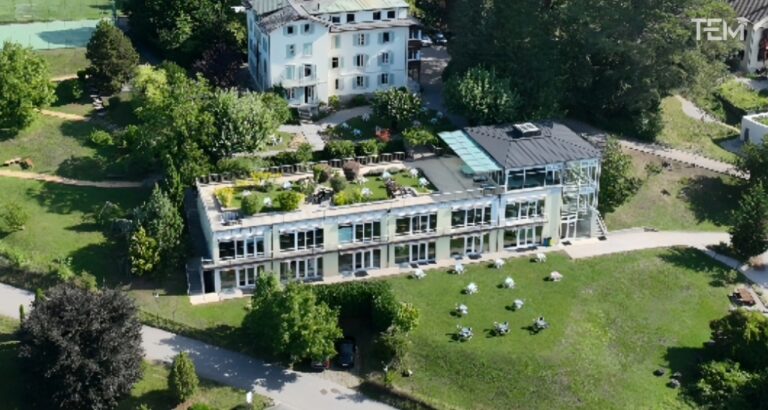
On a hillside above Lake Geneva, in a region the Swiss call the Swiss Riviera, there is a particular kind of morning that repeats itself with a small but meaningful variation. A student walks into a classroom speaking French. The next day, the same student walks into the same room and everything — the lesson, the questions, the jokes exchanged between friends — unfolds in English. Nothing is translated. Nothing is repeated. The curriculum simply continues, as if the language itself were the only thing that had changed overnight.
This is the rhythm of Haut-Lac International Bilingual School, and it is not a gimmick or a scheduling curiosity. It is a philosophy, refined over three decades, about what it actually means to raise a child who is fluent not just in two languages, but in two ways of seeing the world.
A School Born from Two Families’ Conviction
Haut-Lac was founded in 1993, not by an institution or a corporation, but by two bilingual families who wanted something that did not yet exist in their corner of Switzerland: a high-quality international education delivered in both English and French. It is easy, more than thirty years later, to forget how personal that founding moment was. There was no template. There was only a conviction that children could hold two languages and two cultures, without diluting either one.
That founding conviction has aged into something larger. Today, the school describes its vision as empowering students to “embrace lifelong learning, develop diverse skills and become fulfilled, informed and responsible global citizens.” Its mission stitches together several ambitions at once: challenging international curricula, genuine bilingualism, global perspectives, digital innovation, and environmental awareness. As the school’s leadership explains, the work now is to keep strengthening “personalised learning, well-being initiatives and future-focused skills” for a world that will not stop changing.
Bilingualism as a Way of Thinking, Not a Subject to Study
Ask most schools what bilingualism means, and they will describe a language class. Ask Haut-Lac, and the answer is different in kind. Bilingualism here, the leadership explains, is “more than language acquisition; it is a way of developing communication skills, cultural understanding and global awareness.”
The distinction matters. In a bilingual and multicultural environment, students are not simply memorizing vocabulary; they are learning to hold two systems of expression in their heads at once, switching between them the way a musician might switch between instruments. The result, according to the school, is a student population that grows into open-mindedness, respect, and adaptability almost by osmosis, simply by living inside a community built on constant cultural exchange.
The Pathways: From Infant Classrooms to the IB Diploma
The academic architecture at Haut-Lac is layered with intention. In the Infant and Primary years, students build their foundation through a bilingual, skills-based programme tied to real-world themes, the kind of early education that treats a second language less as an obstacle and more as a second lens.
By Secondary school, the pathways multiply. Students can follow the IB Middle Years Programme (MYP), with or without Swiss option modules, before choosing among the IB Diploma Programme (IBDP), the IB Career-related Programme (IBCP), or the US High School Diploma. For the athletically inclined, there is the IB Sport & Study programme, which allows student-athletes to balance serious training with serious academics through flexible timetables and, in some cases, extended diploma programmes.
Across every one of these pathways, the school insists on a consistent thread: critical thinking, creativity, collaboration, communication, adaptability, and digital literacy. These are not slogans stapled onto a brochure. They are, the school says, the skills meant to “empower them to succeed both today and in an evolving global world.”
Who Walks Through the Doors
Haut-Lac welcomes students from age three to eighteen, with day and boarding options available from the secondary years onward. The admissions process, notably, is not a paperwork exercise. Families are invited to visit the campus, meet the team in person, and talk through their child’s individual profile before any offer is extended, a deliberate slowness in an era when many schools have automated their intake.
The resulting community is a genuine mosaic. Over half of Haut-Lac’s students come from local Swiss families drawn to a bilingual international education, while the rest arrive from Europe, the Americas, Asia, the Middle East, and Africa, globally mobile professionals relocating their families and their expectations. For those joining without French or English as a home language, the school offers individual language support programmes, multilingual communication tools, and personalised guidance, an infrastructure built specifically so that no family feels like an afterthought.
Immersion Without Translation
If there is one detail that distinguishes Haut-Lac’s method most sharply, it is this: the school does not translate. Its bilingual model is built on authentic immersion, and the mechanics of that immersion are almost architectural in their precision.
In Infant and Primary classes, students alternate between English and French on a daily basis. At the start of Secondary, the switch happens by semester instead, and from the age of 14, students decide which subject to study in which language based on their skills and future goals.
Behind the scenes, teachers work closely together to plan a single, coherent curriculum, ensuring that learning progresses forward across both languages rather than doubling back to repeat the same material twice. It is a subtle but demanding form of collaboration, one that requires teaching teams to think in parallel constantly. The payoff, the school notes, is that students develop strong language proficiency while thinking, questioning, and solving problems naturally in both languages, reinforced further by cultural events and everyday school life outside the classroom walls.
Growing the Whole Student
Academic rigor at Haut-Lac does not exist in isolation from the rest of a child’s life. Small class sizes and a personalised approach allow teachers to challenge each student while understanding their individual strengths and goals. Beyond the timetable, students are encouraged toward sport, the arts, music, leadership opportunities, outdoor education, and community service.
And then there is the sheer diversity of the room itself: students from more than 64 nationalities share classrooms, hallways, and playing fields, creating daily, unscripted opportunities to exchange perspectives. It is one thing to teach intercultural understanding from a textbook. It is another thing to simply let sixty-four nationalities sit down together for lunch.
Measuring What Cannot Be Graded
Success, at Haut-Lac, is not confined to a report card. Teachers track development in collaboration, communication, independence, and resilience through classroom projects and daily interactions, a kind of continuous observation rather than a single annual verdict.
In Secondary, students find concrete outlets for leadership and initiative: the IB Personal Project, the MYP5 Marketing Project, the Villars Institute Fellowship programme, local science competitions, and the IB’s Creativity, Activity, Service (CAS) requirement, alongside broader community engagement initiatives. Each of these, the school explains, gives students room to reflect, take action, and build empathy and adaptability. Ultimately, the measure of success comes down to whether students embody the school’s stated values: respect, resilience, open-mindedness, and belonging.
The People Behind the Philosophy
A bilingual philosophy this demanding requires a faculty built to match it. Haut-Lac’s teaching staff reflects the same international character as its student body, bringing varied experience and a strong instinct for multicultural classrooms. Continuous professional development, collaboration, and ongoing curriculum reflection keep teaching practices responsive rather than static.
Notably, the school has not turned away from the arrival of artificial intelligence in education, nor rushed toward it uncritically. Instead, faculty are guiding students to use emerging technologies “responsibly, critically and creatively,” treating AI as one more skill to be handled with judgment rather than fear or blind enthusiasm.
A Year of Milestones
Recent seasons have brought Haut-Lac a run of achievements worth pausing on. The school received NEASC accreditation, a recognition of the quality of its educational practices and its ongoing commitment to improvement. Academically, its IB Diploma students achieved a 100 percent pass rate in 2025 and 2026, a number that speaks for itself.
The school was also reaccredited by the World Academy of Sport as an Athlete-Friendly Education Centre, a title Haut-Lac was, notably, the first school in Switzerland to receive. It has since joined the Boarding Schools’ Association, strengthening its international offering for boarding families specifically.
Looking forward, the school has embarked on an ambitious construction project: a new Secondary building on its main campus, designed to unite the entire school community on a single site and create a more connected experience for every student who walks through it.
Life Beyond the Classroom
Support at Haut-Lac extends well past academics. Students have access to strong relationships with teachers, personalised academic and pastoral support, a school nurse, and dedicated university and career guidance that follows them throughout their time at the school.
Outside the classroom, the offerings are almost dizzying in scope: more than 150 extra-curricular activities, spanning arts, music, STEM, outdoor skills, team sports, communication, creativity, and well-being. Layered on top are leadership opportunities, community initiatives, and global learning experiences, each one designed to build resilience, independence, and intercultural understanding.
Looking Toward What Comes Next
For all its history, Haut-Lac’s leadership speaks about the future with a kind of restless attention. The stated goal is to deepen what already sets the school apart: a genuinely immersive bilingual environment, a close-knit international community, and an education that develops the whole person, not merely the transcript.
Emerging technologies, artificial intelligence chief among them, are being explored thoughtfully, critically, and in age-appropriate ways, rather than adopted wholesale. Meanwhile, the campus consolidation project already underway is expected to create the physical conditions for a more connected, collaborative experience between secondary students and their younger counterparts, literally building the bridge the school has spent decades building philosophically.
A Message from the Leadership Table
When Haut-Lac’s leadership team is asked what they most want families to understand, the answer circles back to something simpler than curriculum or accreditation. “It is about creating a community where students feel safe, valued and confident to explore the world around them,” they say.
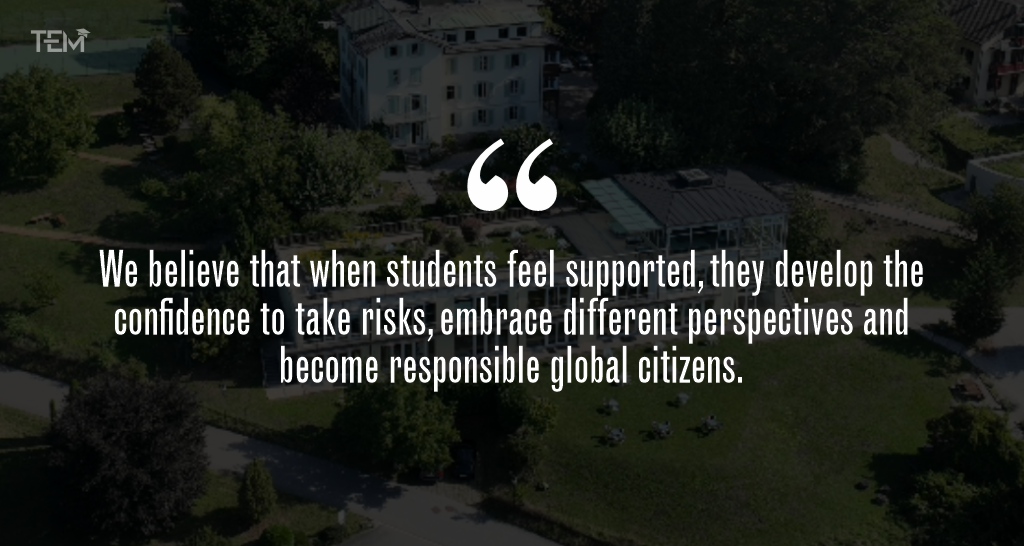
As both a local Swiss school and an international one, Haut-Lac sees its task as double-sided: giving Swiss students an authentic global experience, while helping international families feel genuinely at home in the Swiss context. With over 30 years of experience in bilingual education behind it, the school’s approach rests on three pillars: personalised learning, academic excellence, and a strong sense of belonging. The belief underneath all of it is straightforward. When students feel supported, they find the confidence to take risks, embrace different perspectives, and grow into the kind of responsible global citizens the world will need more of, not less.
Quotes