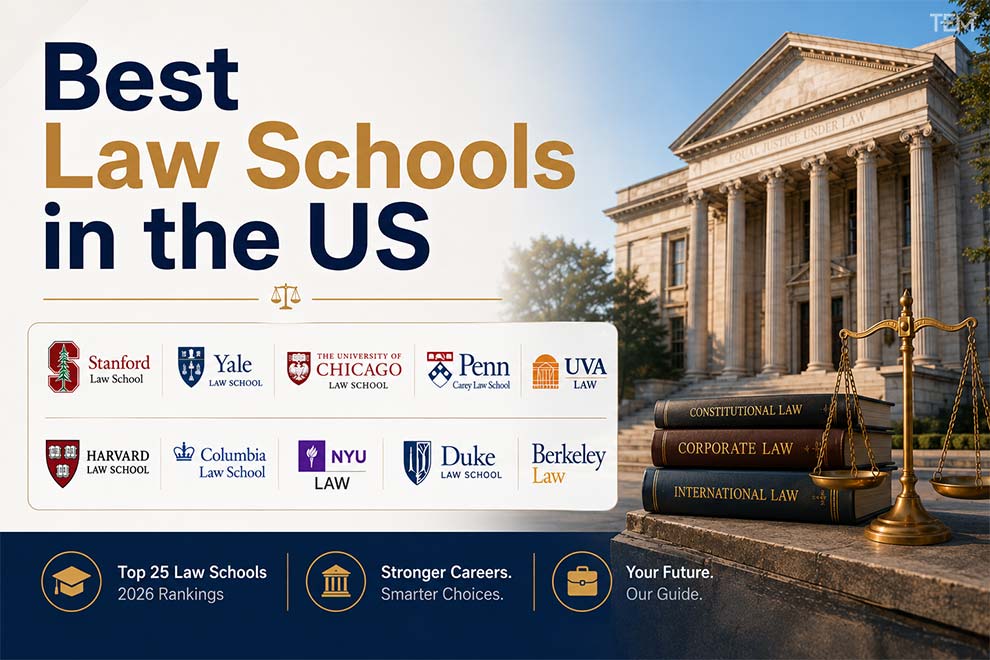
There are 198 ABA-accredited law schools in the US, and only a handful of them consistently land at the top of every major ranking. Stanford now holds the number one spot in the 2026 U.S. News law school rankings, ending Yale’s 36-year run at the top. Tuition at these schools ranges from around $32,000 a year at public in-state programs to nearly $80,000 a year at elite private ones, and acceptance rates at the top 25 schools sit far below the national average. Choosing a law school is one of the biggest financial and career decisions a person can make, and rankings alone should not make that decision for you.
This guide breaks down the 25 best law schools in the US for 2026, comparing tuition, acceptance rates, LSAT scores, bar pass rates, and career outcomes side by side, so you can compare programs the way admissions committees and law firms actually do.
The best law schools in the US for 2026, per U.S. News, are led by Stanford at number one, followed by a tie between Yale and the University of Chicago, then Penn and Virginia. Harvard rounds out the top six. Beyond rankings, the “best” school for you depends on your budget, target practice area, and bar state.
How We Ranked the Best Law Schools
Our list draws on ABA accreditation status, U.S. News methodology, employment statistics, and reputational data from legal professionals, then layers in student-focused factors that rankings often skip. Key factors include:
- ABA accreditation and first-time bar exam pass rate
- Employment outcomes within 10 months of graduation
- Median LSAT and GPA of admitted students
- Academic reputation among judges, hiring partners, and peer faculty
- Tuition, scholarships, and return on investment
- Clinical and experiential learning opportunities
- Student-to-faculty ratio and alumni network strength
U.S. News itself now weighs employment outcomes at roughly 33%, peer and professional reputation at 25%, bar passage at 25%, admissions data at 10%, and faculty resources at 7%. As University of Kentucky law professor Brian Frye put it, “law school prestige changes very slowly,” yet rankings still shift each year based on smaller data swings. A recent Kaplan survey even found that 58% of law school admissions officers feel rankings have lost some prestige, which is exactly why this guide looks past rank alone.
25 Best Law Schools in the US (2026 Rankings) at a Glance
Figures below are approximate for the 2025 to 2026 cycle. Tuition, acceptance rates, and LSAT medians shift yearly, so confirm exact numbers on each school’s official ABA 509 disclosure before applying.
| Rank | Law School | State | Tuition (Annual, approx.) | Acceptance Rate | Median LSAT | Employment Rate | Best For |
| 1 | Stanford | CA | ~$78K | 6-8% | 173-176 | 97%+ | Tech Law, Constitutional Law |
| 2 | University of Chicago | IL | ~$77K | 12-14% | 171-173 | 96% | Corporate Law, Law & Economics |
| 3 | Yale | CT | ~$79K | 6-7% | 174-176 | 97% | Constitutional Law, Public Interest |
| 4 | Penn (Carey) | PA | ~$76K | 14-16% | 170-172 | 96% | Corporate Law, Business Law |
| 5 | Virginia | VA | ~$74K | 15-18% | 170-172 | 95% | Corporate Law, Litigation |
| 6 | Harvard | MA | ~$76K | 11-13% | 173-175 | 96% | Corporate Law, International Law |
| 7 | Duke | NC | ~$74K | 16-18% | 169-171 | 95% | Corporate Law, Environmental Law |
| 8 | NYU | NY | ~$78K | 18-20% | 170-172 | 95% | Tax Law, International Law |
| 9 | Columbia | NY | ~$80K | 15-17% | 171-173 | 96% | Corporate Law, Human Rights Law |
| 10 | Northwestern (Pritzker) | IL | ~$75K | 20-23% | 168-170 | 94% | Corporate Law, Criminal Law |
| 11 | Michigan | MI | ~$66K in-state | 18-20% | 169-171 | 94% | Corporate Law, IP Law |
| 12 | Vanderbilt | TN | ~$70K | 22-25% | 167-169 | 93% | Corporate Law, Healthcare Law |
| 13 | Cornell | NY | ~$76K | 20-22% | 169-171 | 94% | Corporate Law, International Law |
| 14 | UCLA | CA | ~$56K in-state | 20-23% | 168-170 | 93% | Entertainment Law, Public Interest |
| 15 | WashU St. Louis | MO | ~$68K | 24-27% | 167-169 | 93% | Corporate Law, IP Law |
| 16 | Berkeley | CA | ~$58K in-state | 22-25% | 168-170 | 92% | IP Law, Cybersecurity Law |
| 17 | UT Austin | TX | ~$45K in-state | 26-30% | 166-168 | 92% | Corporate Law, IP Litigation |
| 18 | Georgetown | DC | ~$74K | 26-30% | 167-169 | 91% | International Law, Human Rights |
| 19 | UNC Chapel Hill | NC | ~$36K in-state | 28-32% | 165-167 | 90% | Constitutional Law, Public Interest |
| 20 | Boston College | MA | ~$68K | 30-34% | 164-166 | 90% | Tax Law, Corporate Law |
| 21 | Notre Dame | IN | ~$66K | 28-32% | 164-166 | 90% | International Law, Constitutional Law |
| 22 | Texas A&M | TX | ~$36K in-state | 32-36% | 163-165 | 89% | IP Law, Litigation |
| 23 | Minnesota | MN | ~$44K in-state | 30-34% | 163-165 | 89% | Corporate Law, Healthcare Law |
| 24 | Boston University | MA | ~$68K | 32-36% | 163-165 | 89% | Tax Law, Corporate Law |
| 25 | BYU (Clark) | UT | ~$18K | 30-34% | 163-165 | 92% | Corporate Law, Family Law |
A Closer Look at the Top Law Schools
Stanford leads the 2026 law school rankings thanks to near-perfect employment outcomes and a small class size that keeps its student-to-faculty ratio tight. Its ties to Silicon Valley make it a top pick for technology and IP law.
Yale and Chicago now share second place. Yale still leads on reputation and constitutional law scholarship, while Chicago’s strength in law and economics and its BigLaw placement rate keep it firmly in the top tier.
Penn Carey and Virginia tie at fourth. Both send a large share of graduates into corporate law and BigLaw firms, and both post bar pass rates above 90%.
Harvard, at sixth, remains the largest of the elite schools by enrollment, with an alumni network that spans nearly every major firm, court, and government office in the country.
Best Law Schools by Legal Specialization
- Corporate Law: Chicago, Penn, Columbia
- Criminal Law: Northwestern, Berkeley
- Constitutional Law: Yale, Chicago
- Intellectual Property Law: Berkeley, Stanford
- Environmental Law: Duke, NYU
- International Law: Georgetown, NYU, Columbia
- Tax Law: NYU, Boston University
- Healthcare Law: WashU, Minnesota
- Human Rights Law: Columbia, Georgetown
- Entertainment Law: UCLA
- Cybersecurity & Technology Law: Berkeley, Stanford
- Public Interest Law: Yale, Georgetown, UCLA
Most Affordable Law Schools in the US
For in-state students, UT Austin, Texas A&M, UNC Chapel Hill, and Minnesota deliver top 25 rankings at a fraction of private school tuition, often under $45,000 a year. BYU stands out even further, with tuition near $18,000 thanks to its church affiliation. These schools pair low cost with solid employment rates above 89%, giving them some of the best returns on investment among ABA-accredited law schools.
Law Schools With the Highest Bar Exam Pass Rates
Bar pass rate now makes up 25% of the U.S. News formula, so it matters more than ever. Nationally, first-time bar passage rates sit close to 80%, but T14 schools like Stanford, Yale, Chicago, Penn, and Virginia typically post first-time pass rates above 95%. A high bar pass rate signals strong academic support and rigorous exam prep built into the curriculum, not just smart admits.
Law Schools With the Best Employment Outcomes
Employment outcomes carry the single largest weight in current law school rankings, at roughly 33%. Elite schools place 90% or more of graduates in long-term, bar-required jobs within 10 months, spanning BigLaw associate roles, federal clerkships, government positions, and public interest jobs. BigLaw placement is heaviest at Chicago, Columbia, Penn, and NYU, while Yale and Harvard send an outsized share of graduates into federal clerkships and academia.
Best Law Schools for International Students, Online, and Hybrid JD Programs
Georgetown, NYU, and Columbia draw large international cohorts thanks to strong LL.M. programs, dedicated visa support offices, and global alumni networks. Beyond the traditional JD, a growing number of ABA-accredited law schools now offer hybrid JD programs and online LL.M. options for working professionals. These programs still require ABA accreditation to qualify graduates for the bar exam in most states, so always confirm accreditation before enrolling in an online law school.
Admission Requirements for Top Law Schools
Top law schools expect a median GPA between 3.7 and 3.9 and an LSAT score of 170 or higher for T14 admission, though a 165+ LSAT is competitive for most of the top 25. Beyond numbers, admissions committees weigh your personal statement, letters of recommendation, resume, and, in some cases, an interview. Applications typically open in September, and applying early in the cycle meaningfully improves your odds and scholarship offers.
Scholarships and Financial Aid for Law Students
Around 80% of law students receive some scholarship or grant funding. Merit scholarships reward strong LSAT and GPA numbers above a school’s median, need-based aid covers demonstrated financial gaps, and many schools add diversity, public service, and military scholarships on top. Federal loan forgiveness programs, like Public Service Loan Forgiveness, can also erase remaining debt after 10 years in qualifying government or nonprofit legal work.
How to Choose the Right Law School
Rank should be one input, not the deciding factor. Weigh your career goals against each school’s strongest practice areas, your budget against its tuition and average debt, and your preferred bar state against its local alumni network and clerkship pipeline. Also, look closely at bar pass rate and ROI, since a slightly lower-ranked school with strong regional placement can outperform a T25 name for your specific goals.
Career Opportunities After Law School
A JD opens doors well beyond courtroom litigation. Common paths include working as an attorney, corporate counsel, prosecutor, public defender, judge, compliance officer, or policy advisor. Starting salaries are famously bimodal: BigLaw associates often start near $200,000, while public interest and government roles typically start between $55,000 and $65,000. Legal operations and compliance roles have grown fastest in recent years as companies expand in-house legal teams.
Emerging Trends in Legal Education (2026)
AI in legal education is reshaping how law schools teach research and writing, with more programs now requiring coursework in AI-assisted legal research and legal analytics. Cybersecurity and privacy law, ESG and sustainability law, and interdisciplinary JD programs that pair law with business or public policy are also expanding fast, as firms look for graduates who can work across disciplines from day one.
Common Mistakes Students Make When Choosing a Law School
- Picking a school based on rank alone, ignoring fit
- Ignoring the total debt load relative to the expected salary
- Overlooking bar pass rate in favor of prestige
- Skipping research into actual employment outcomes
- Underestimating the value of a strong local alumni network
- Applying without a clear sense of legal specialization
Final Thoughts
Rankings are a useful starting point, but they are only one part of choosing the right law school. The 25 best law schools in the US for 2026 all offer strong employment outcomes and bar pass rates, yet the right fit still depends on your budget, target practice area, and career goals. Before you apply, compare tuition, acceptance rates, and outcomes across your shortlist carefully, and remember that a well-funded seat at a school ranked 20 can beat a debt-heavy seat at a school ranked 5.
FAQ
- What LSAT score is competitive?
A competitive LSAT score is generally 170+ for T14 law schools and 165+ for many other top-ranked programs. However, admission decisions also consider GPA, personal statements, recommendations, and work experience.
- Is attending a T14 law school worth it?
A T14 law school can be worth it for students pursuing BigLaw, federal clerkships, or academia. For some public interest careers, a substantial scholarship from a lower-ranked school may offer a better financial return on investment.
- Which law school is best for corporate law?
Columbia, the University of Pennsylvania Carey Law School, and the University of Chicago are widely regarded as excellent choices for corporate law because of their strong business-law programs and BigLaw placement records.
- Which law school has the highest bar pass rate?
Top law schools such as Stanford, Yale, and the University of Chicago often report first-time bar pass rates above the national average. Exact rankings vary by state and graduating class, so applicants should review the latest published statistics.
- Are online law degrees respected?
Online law degrees are generally respected when offered by accredited institutions. ABA-approved hybrid JD programs and accredited online LL.M. programs are becoming more accepted, although employers may still consider the school’s reputation and graduates’ experience.