Not every crane is built for the same job. In heavy industry, where loads run into the hundreds of tons and operational demands push equipment to its limits day after day, the choice of crane directly determines whether a facility runs efficiently or struggles under the weight of its own production requirements. The double girder gantry crane occupies a specific and irreplaceable position in this landscape — and understanding where it excels helps industrial operators make better procurement decisions.
Weihua Crane, founded in 1988 and now one of the world’s leading crane manufacturers, has deployed double girder gantry cranes across six continents, serving industries from container terminals to offshore wind energy. This article covers the core application environments where this equipment delivers its greatest operational value.
What Defines a Double Girder Gantry Crane
Before examining applications, it helps to understand what separates a double girder configuration from a single girder alternative. A double girder gantry crane features two parallel box-section main girders supported by rigid and flexible legs that travel along ground-level rails. The trolley and hoist assembly runs along the top of the girders rather than hanging beneath a single beam, which delivers three structural advantages: greater lifting height, higher load capacity, and superior lateral stability under dynamic loads.
Weihua’s standard double girder gantry crane range covers lifting capacities from 5 tons to 800 tons, spans from 4.5 meters to 50 meters, and lifting heights up to 40 meters, with working classes from A4 through A7 depending on duty cycle requirements. This range of configurations explains why the same fundamental crane design appears in environments as different as a steel mill ladle bay and a wind turbine assembly facility.
Port Terminals and Container Yards
Container terminals represent one of the most demanding application environments for double girder gantry cranes, and also one of the most visible. Rail-mounted gantry cranes (RMGs) — a specialized subtype of double girder gantry crane — are the standard yard equipment at high-throughput container terminals worldwide.
Rail-Mounted Gantry Cranes (RMG)
Weihua’s RMG cranes are engineered to stack containers up to six high across multiple container rows and truck lanes, supporting the high-frequency automated operations that modern terminal productivity demands. With lifting capacities ranging from 20 to 65 tons, spans up to 40 meters, and stacking heights up to 20 meters, these cranes are purpose-built for the combination of precision and endurance that container handling requires. Weihua has delivered automated RMG installations including six units to a Zhejiang smart port, where automated positioning systems handle move sequencing around the clock with minimal operator intervention.
Rubber-Tyred Gantry Cranes (RTG)
Rubber-tyred gantry cranes follow the same double girder structural principle but travel on rubber tyres rather than rails, offering terminals greater yard layout flexibility. Weihua’s RTG range covers lifting capacities from 35 to 70 tons with gantry spans of 23.5 to 26 meters.
Shipyards and Offshore Fabrication
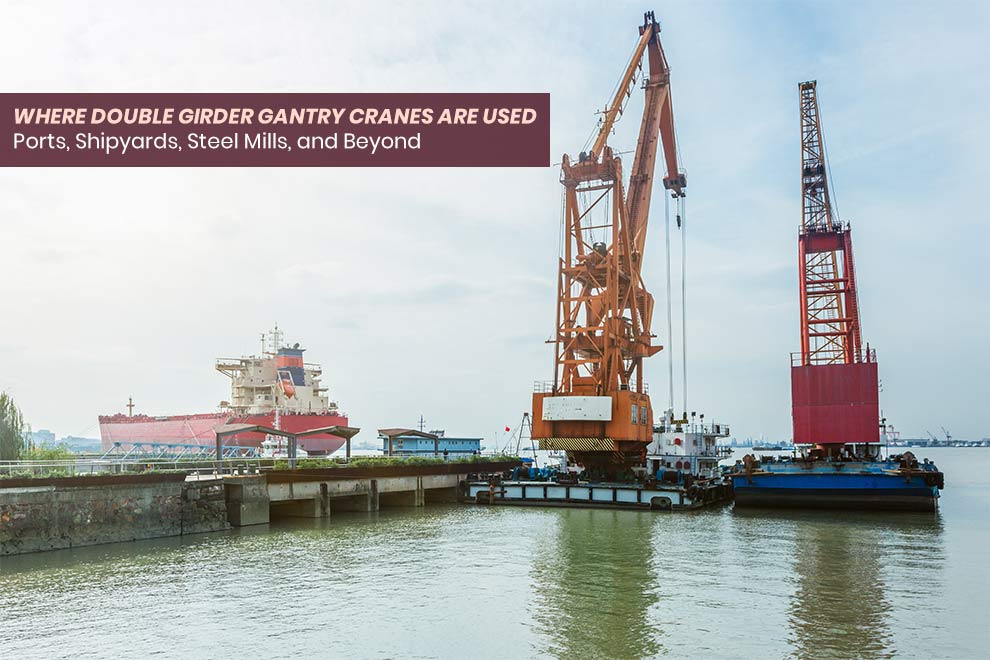
Shipbuilding gantry cranes are among the largest and most technically demanding double girder gantry cranes in existence. The fundamental challenge of shipyard lifting — handling hull sections and structural modules that are both extremely heavy and geometrically irregular — demands cranes with exceptional span capacity, high hook height, and precise multi-point lift coordination.
Weihua has delivered shipbuilding gantry cranes across an extensive capacity range, including 380-ton, 500-ton, 1,000-ton, 1,200-ton, 2,000-ton, and 2,500-ton units to shipyards across China and internationally. The largest delivered to date is a 2,000-ton shipbuilding gantry crane for hull section lifting. Structurally, Weihua’s shipbuilding gantry cranes feature A-frame leg designs that provide exceptional resistance to lateral wind loads, a critical requirement for large outdoor installations in coastal environments.
Offshore Wind Fabrication
Offshore wind fabrication facilities present similar requirements. Weihua has delivered a 3,000-ton gantry crane to the Hailong Wind Power Base and a 3,600-ton unit to Haili Wind Power, with a 3,800-ton crane for Haifeng Mother Port Company currently under development — underscoring the growing scale of lifting requirements in the offshore energy sector.
Steel Mills and Metallurgical Plants
Steel production environments place a unique combination of demands on crane equipment: extreme thermal exposure, continuous duty cycles, heavy and often unbalanced loads, and corrosive atmospheric conditions from smelting and casting operations. Double girder gantry cranes deployed in steel mills are typically built to working class A6 or A7 — the heaviest duty classifications — with high-temperature-resistant components, thermal shielding, and hydraulic failsafe braking systems.
Weihua’s metallurgical crane range covers the full steelmaking workflow, from raw material stockyards and coking operations through to finished product handling. The box-type welded girder structure, combined with crane wheels produced in vacuum casting workshops for superior surface hardness and wear resistance, is specifically optimized for the continuous high-load cycles that steelmaking demands. Weihua cranes are in active service at facilities operated by ArcelorMittal, Sheffield Steel, and Alliance Steel, among other major global steel producers.
Railway Construction and Infrastructure Projects
Bridge construction and railway engineering present a specialized application that standard crane configurations rarely handle well. Launching gantry cranes — a double girder variant designed to advance along a partially constructed deck structure — are used for segment-by-segment placement of precast concrete bridge spans across rivers, valleys, and existing infrastructure where ground-level crane access is impossible.
Weihua has delivered rail-mounted gantry crane systems for synchronized highway and high-speed rail construction, including a project involving four cranes lifting in coordinated synchronization along a 100-meter span for highway construction. For precast concrete production yards that supply bridge and railway projects, Weihua provides standard double girder gantry cranes with spans and lifting heights calibrated to the dimensions of precast segments being produced.
Wind Power and Renewable Energy Manufacturing
Wind turbine component manufacturing has emerged as one of the fastest-growing application areas for large double girder gantry cranes. Tower sections, nacelle assemblies, and blade handling fixtures all involve loads that are simultaneously heavy, long, and geometrically difficult — a combination that demands cranes with extended spans, high hook heights, and synchronized multi-point lifting capability.
Weihua’s wind power crane solutions cover the complete manufacturing workflow: from tower ring and flange handling in fabrication shops through to nacelle assembly lines and blade storage yards. Anti-sway control systems are standard on wind power applications, where the combination of high hook heights and aerodynamically sensitive components makes load oscillation damping a safety-critical requirement rather than a convenience feature.
Industrial Yards, Mining, and General Heavy Manufacturing
Beyond the specialized environments above, double girder gantry cranes serve a broad range of industrial yards and manufacturing facilities where the capacity and span of single girder alternatives are insufficient. Open storage yards for precast concrete elements, large machinery manufacturers, mining equipment assembly facilities, and power generation plants all routinely deploy double girder gantry cranes as their primary heavy lifting solution.
Weihua’s standard MG-series double girder gantry crane — available in A-type and U-type leg configurations, with cabin or remote control options and cable or slide wire power supply — provides the operational flexibility to adapt to site-specific requirements across these diverse environments. Both normal hooks and swing hooks are available depending on load geometry, and the electrical system can be configured with components from Siemens, Schneider, or equivalent suppliers to meet customer specifications.
Choosing the Right Configuration
The diversity of environments described above reflects a key characteristic of double girder gantry crane design: the same structural principle scales from a 10-ton workshop crane to a 3,600-ton offshore installation. What changes between applications is the combination of lifting capacity, span, working class, leg configuration, control system, and specialized features such as explosion-proofing, corrosion resistance, or seismic design.
For industrial operators evaluating double girder gantry cranes, the critical procurement variables are working class, span relative to site layout requirements, required lifting height, and whether the application demands fixed-rail or rubber-tired mobility. Weihua’s engineering team offers full customization across all these parameters, backed by over 37 years of manufacturing experience and a global service network spanning more than 170 countries.
Also Read: The Unsung Heroes of Construction and Industrial Sites