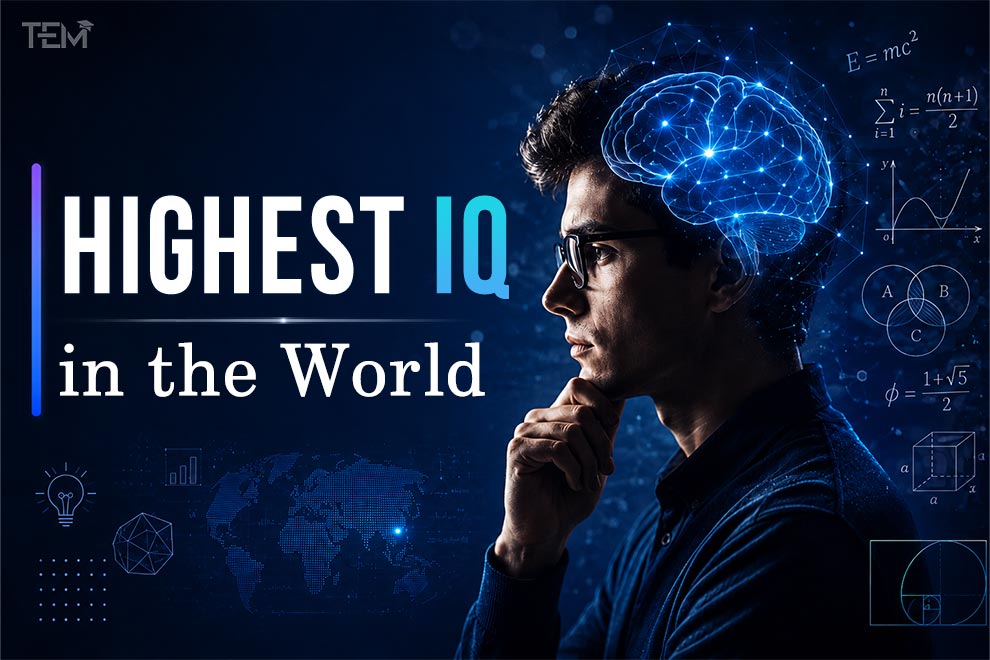
Who has the highest IQ in the world? It is one of the most searched questions about human intelligence. While extraordinary IQ scores naturally attract a great deal of attention, the truth behind human intelligence is far more complex than a single numerical score. Some of history’s most gifted minds transformed mathematics, science, literature, and technology, but their life-changing achievements were driven by far more than standardized test results alone.
From brilliant mathematical prodigies to world-changing innovators, these individuals succeeded because of deep curiosity, creativity, persistence, and practical problem-solving.
To truly understand human cognitive potential, we must look beyond numbers. This guide explores how intelligence is measured, analyzes the individuals rumored to hold the highest IQ level in the world, and examines what traits actually predict real-world success.
Quick Answer: Who Has the Highest IQ in the World? There is no universally accepted holder of the highest IQ ever recorded. Historical figures such as William James Sidis are often estimated to have IQs above 250, while mathematician Terence Tao is widely recognized as one of the highest-IQ living individuals, with reported scores between 225 and 230.
What Is IQ and How Is It Measured?
IQ stands for Intelligence Quotient. It originates from standardized psychometric assessments designed to evaluate an individual’s cognitive capabilities relative to their specific peer group.
Modern psychologists utilize structured assessments such as the Wechsler Adult Intelligence Scale (WAIS) or the Stanford-Binet Intelligence Scales to measure distinct facets of mental processing. Rather than evaluating general learned academic knowledge, these tests assess the foundational psychology of high intelligence, including:
- Verbal comprehension: The ability to understand, analyze, and apply language-based concepts.
- Fluid reasoning: The capacity to think logically and solve completely novel problems without relying on pre-existing knowledge.
- Working memory: The short-term retention and mental manipulation of information.
- Visual-spatial processing: The ability to perceive, analyze, and mentally manipulate visual patterns and spatial forms.
The Average IQ Score Explained
By design, IQ tests use a standardized scoring system where the median score is set at 100. The distribution follows a mathematical bell curve, meaning the vast majority of the global population scores between 85 and 115.
| IQ Range | Classification |
| 90–109 | Average |
| 110–119 | High Average |
| 120–129 | Superior |
| 130+ | Gifted |
| 145+ | Genius Level |
An IQ score of 140 or higher is generally considered genius or near-genius level by modern clinical standards.
Extraordinary Minds Behind the World’s Highest IQ Scores
While no single individual can be definitively crowned as the smartest person in history, several remarkable minds are frequently cited for their exceptionally high IQ scores. Some are based on verified assessments, while others are historical estimates. More importantly, each of these individuals used their intellectual abilities in different ways, leaving a lasting impact on fields such as mathematics, science, education, and literature.
| Person | Estimated/Reported IQ | Known For |
| William James Sidis | Estimated 250–300 | Mathematics & Languages |
| Marilyn vos Savant | 228 | Author & Columnist |
| Terence Tao | 225–230 | Mathematics |
| Christopher Hirata | 225 | Astrophysics |
| Kim Ung-Yong | 210 | Child Prodigy |
Contextualizing the World’s Brightest Minds
- William James Sidis: A child prodigy who entered Harvard University at just 11 years old, Sidis is often mentioned in discussions about the highest IQ ever reported because of his extraordinary academic achievements at a young age. He was a master of multiple languages and complex mathematics.
- Marilyn vos Savant: Listed in the Guinness Book of World Records for whats the highest iq recorded at the time, her story reminds us that high intelligence can be successfully applied beyond academia through clear communication, problem-solving, and public education.
- Terence Tao: Terence Tao is widely recognized as one of the highest-IQ individuals alive and has made significant contributions to modern mathematics.
- Christopher Hirata: Christopher Hirata worked with NASA at age 16 and later became a respected astrophysicist.
- Kim Ung-Yong: A former child prodigy who scored remarkably high on youth assessments, later choosing a fulfilling career in civil engineering and university instruction over public scrutiny.
What Is the Highest IQ Ever Recorded?
There is no single, universally accepted record for the highest IQ ever recorded. Many extreme claims circulating online are retroactive historical estimates rather than results obtained from modern, standardized clinical testing.
Because most modern IQ tests have structural upper scoring limits (often capping around 160), scores rising significantly above 200 are exceptionally difficult to verify or duplicate scientifically. Therefore, looking for an absolute numerical “world record” is practically impossible from a professional psychometric perspective.
Are These High IQ Scores Verified? Why Experts Debate Rankings?
If you wonder what is the highest iq in the world, the scientific answer requires severe caution. Many famous IQ claims are based on historical guesswork rather than standardized testing.
Estimated vs. Verified Scores
Psychologists and psychometricians frequently debate rankings because testing methodologies have evolved over time.
For example, Marilyn vos Savant’s score of 228 came from an older mental-age ratio formula. Modern testing uses deviation scaling, meaning scores over 200 are statistical anomalies that modern standardized tools aren’t built to measure reliably.
Does a High IQ Guarantee Real-World Success?
A high IQ score may help an individual process abstract concepts faster, but it does not automatically guarantee career success, personal happiness, or strong leadership ability.
Why Some High-IQ Individuals Struggle
History features many individuals with immense raw cognitive power who struggled to find professional or personal stability. Without emotional regulation, strong social skills, and situational opportunities, exceptionally high intelligence can sometimes lead to isolation or executive burnout. Conversely, many highly successful people had perfectly average IQs but excelled through communication, adaptability, and high emotional maturity.
What Students Can Learn From High-IQ Individuals
Students interested in developing critical thinking and problem-solving skills can also explore STEM education, gifted learning programs, and adaptive learning platforms. For students looking to maximize their personal potential, the habits of history’s top minds offer valuable life lessons that extend far beyond test scores:
- Curiosity Is More Important Than Memorization: True intellectual growth comes from asking deep questions, rather than simply memorizing facts to pass a standardized exam.
- Lifelong Learning Creates Opportunities: Embracing new skills keeps the mind agile and opens doors in an ever-changing world.
- Failure Is Part of Growth: True innovators view mistakes as data points to learn from, not emotional dead ends.
- Intelligence Can Be Developed Over Time: Research on neuroplasticity suggests that regularly challenging the brain through learning and problem-solving can strengthen cognitive abilities over time.
For example, Terence Tao’s monumental success was not built solely on his raw intelligence. His incredible achievements resulted from years of focused study, structured research, and consistent everyday practice, demonstrating that effort and discipline play a crucial role in developing genuine expertise.
Signs of High Intelligence Beyond IQ Scores
You do not need an official psychometric test to recognize high cognitive capability. Educational research and cognitive studies often associate the following traits with strong intellectual ability.:
- Strong Curiosity: An insatiable desire to ask questions and explore how things work behind the scenes.
- Fast Pattern Recognition: Quickly connecting unrelated pieces of information to map out solutions.
- High Adaptability: Being able to adjust when plans change and find solutions to new challenges.
- Critical Thinking: Challenging assumptions and analyzing facts objectively before forming an opinion.
- Continuous Learning Habits: Voluntarily spending time reading, practicing skills, and pursuing personal development.
How Schools and Psychologists Use IQ Tests Today
In contemporary psychology, IQ tests are rarely used simply to hand out “genius” labels. Instead, educational institutions and clinical psychologists use these standardized tools for practical, developmental support:
- Gifted Education Programs: Identifying students who require accelerated or enriched academic paths to remain engaged and reach their full potential.
- Learning Assessments: Detecting hidden cognitive discrepancies to diagnose learning differences (like dyslexia), ensuring students receive customized help.
- Cognitive Research & Planning: Studying brain development, cognitive aging trends, and building effective academic structures.
Countries With High Average IQ Scores
These figures vary across studies and should be interpreted carefully because educational access, testing methods, and socioeconomic factors can influence results.
| Country | Average IQ |
| Japan | 106.5 |
| Singapore | 105.9 |
| South Korea | 102.3 |
| China | 100.4 |
| Iran | 97.4 |
Source: International IQ studies and global educational assessment datasets. Rankings and methodologies vary between studies.
Note: Average national IQ scores should be interpreted carefully because testing methods, educational access, and socioeconomic factors can influence results.
Common Myths About Human Intelligence
To truly understand how human capability works, we must debunk several major misconceptions:
- Myth #1: IQ determines your entire future.
Fact: It is merely a baseline measure of abstract reasoning. Grit, social skills, and timing matter far more.
- Myth #2: Your IQ score never changes.
Fact: While relative placement stays fairly stable, intensive training, education, and lifestyle choices can shift cognitive performance over time.
- Myth #3: High IQ automatically means high emotional intelligence.
Fact: Analytical talent and social empathy develop on entirely different pathways; geniuses can easily struggle with social skills.
- Myth #4: IQ is the only reliable measure of intelligence.
Fact: It completely misses creative, artistic, practical, and musical intelligences.
- Myth #5: Successful people always have genius-level IQs.
Fact: The vast majority of top-tier professionals, executives, and leaders score well within the normal average to high-average range.
Why Intelligence Is More Than a Number
Most psychologists view IQ as a useful measure of certain cognitive abilities, such as reasoning, memory, and problem-solving. However, they generally agree that an IQ score does not fully capture the complexity of human intelligence.
In everyday life, intelligence is reflected in a combination of skills that help people learn, adapt, communicate, and make effective decisions. These qualities often play an equally important role in personal and professional success:
- Critical thinking to evaluate information objectively and solve complex problems.
- Creativity to approach challenges from new perspectives and develop original solutions.
- Emotional intelligence to understand emotions, build relationships, and collaborate effectively with others.
- Communication skills to express ideas clearly and influence positive outcomes.
- Adaptability to respond effectively to change and navigate new situations.
- Lifelong learning to continuously develop knowledge and skills over time.
Rather than defining intelligence through a single number, modern research increasingly recognizes that success and achievement often depend on how these abilities work together in real-world situations.
Key Takeaways
- IQ measures certain cognitive abilities but not overall human potential.
- Many famous IQ records are estimates rather than verified scores.
- High IQ does not automatically guarantee success.
- Creativity, emotional intelligence, and persistence are equally important.
- Lifelong learning remains one of the strongest predictors of personal growth.
Conclusion
The concept of the highest IQ in the world remains an incredibly fascinating topic, but genuine human intelligence is about much more than achieving a record-breaking test score. While gifted individuals demonstrate extraordinary baseline cognitive speed, long-term real-world impact is ultimately shaped by deep curiosity, relentless perseverance, and an open mind. Rather than focusing purely on static numbers, students and professionals achieve far more by building the daily learning habits that allow their minds to grow over time.
FAQ
- Who has the highest IQ in the world?
Terence Tao is widely recognized as one of the highest-IQ living individuals, with reported scores between 225 and 230.
- What IQ is considered genius level?
An IQ score of 140 or higher is generally considered to be genius or near-genius level within modern standard psychometric classifications.
- Does a high IQ guarantee success?
No, a high IQ does not guarantee success depends on an array of overlapping factors, including focused hard work, strong emotional intelligence, creative thinking, and resilience