If you homeschool, you already know the problem with most history curricula. The textbook tells your child what happened in a flat, settled voice, and the dates and names slide off the page by the next unit.
Kids end up learning that history is a list of things to be tested on, instead of a set of real decisions made by real people who had no idea how their story would end.
There is a better way to teach it, and it arrives in your mailbox.
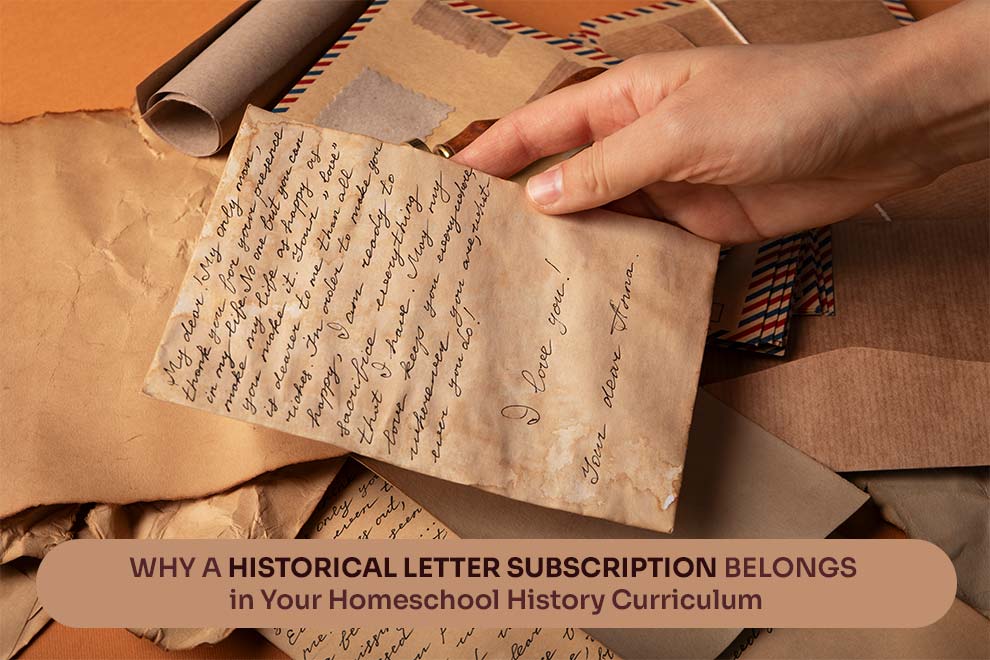
Letterjoy is a homeschool history curriculum aid that mails your family reproductions of real historical letters, printed on period-appropriate stationery or parchment and delivered through the post the way the originals once traveled. Each one comes with a short companion article that sets the scene.
For a homeschool family building a history program that actually sticks, it is one of the most affordable and effective supplements I’ve ever seen.
What is a historical letter subscription, and how does it work?
A historical letter subscription sends you a reproduction of a real primary-source letter on a regular schedule.
With Letterjoy, a new letter arrives each week: a dispatch from a general the night before a battle, a scientist describing a discovery as it happened, a president wrestling with a decision in private, a writer confiding in a friend.
Your child holds a faithful copy of what that person actually wrote and reads it in their own words. Then they read a companion article called “The Postscript” that explains who wrote it, what was happening around them, and why it mattered.
That is the whole experience. It’s simple, but transformative. Instead of being told that the Founders disagreed, your child reads the disagreement in the founders’ own handwriting. Instead of memorizing that a discovery changed the world, they read the letter where the discovery is still uncertain and exciting.
History stops being a verdict and becomes a story still in progress.
Why primary sources are the secret to teaching history that sticks
Ask any veteran history teacher what separates real understanding from rote memorization, and the answer is primary sources. A primary source is a document created at the time by someone who was there: a letter, a diary, a speech, a telegram.
Working with primary sources is a core skill in nearly every state’s social studies standards. It is exactly the kind of analysis that college and standardized tests reward. Properly interpreting primary sources are also increasingly important in acing tests like the AP US History exam and the AP Government exam.
Here is why Letterjoy’s letters work so well for young learners:
- They build reading and analysis skills. Decoding an older voice, inferring context, and forming an opinion about what the writer meant are the same critical-thinking muscles your child needs for every subject.
- They create empathy. Reading a soldier’s letter home or an immigrant’s first impressions of a new country does something a summary cannot. It makes the past human.
- They reward curiosity. A single letter raises questions: Who was this person? What happened next? Those questions drive the kind of self-directed research that homeschoolers are uniquely positioned to encourage.
- They are tactile and screen-free. In a learning day already full of screens, a physical letter your child can hold, annotate, and file away is a welcome change of pace.
How to use Letterjoy in your weekly homeschool rhythm
The format fits naturally into a homeschool week without adding planning burden. A simple approach that works for many families:
- Read the letter aloud together, or have your student read it independently for older grades.
- Discuss it before reading the companion article. What can you tell about the writer? What do you think is happening? Let your child guess.
- Read “The Postscript” to fill in the context, then compare it with your child’s first impressions.
- Extend it as far as your child’s interest goes. Younger students might copy a line in their best handwriting or draw the scene. Older students can write a response letter in character, research the event, or connect it to what they are reading elsewhere.
It works as a spine for a history unit, a Friday enrichment ritual, a copywork and penmanship source, or a writing prompt.
Because the letters span eras and figures, they slot into almost any period you are studying, and they suit a wide range of ages in a multi-grade household. One letter can anchor a lesson for a first grader and launch a research project for a high schooler in the same week.
What you actually get, and the dirty details
Letterjoy mails clean, modern reproductions on quality stationery, sent first-class through the United States Postal Service so the experience mirrors how the originals arrived.
A wide variety of topics is available, so you can match the letters to whatever your family is studying. The core American History collection runs from the founding era through the twentieth century.
There are also themed collections for families who want to go deeper into a subject: military history, great writers and authors, science and innovation, the law, the presidents, and a codebreaking collection that turns intelligence history into hands-on puzzles.
Whether your student is drawn to wartime leaders, the people behind scientific breakthroughs, or the words of famous writers, there is a collection to fit.
A few practical notes so you can plan. These are reproductions designed for reading and learning, not antique originals. Delivery of your first letter typically takes a couple of weeks to begin, so plan ahead. And the special themed collections are curated sets that arrive over a defined run rather than indefinitely.
None of that gets in the way of the classroom value. It simply means you know what to expect.
Use your education savings account: Letterjoy on ESA and EFA marketplaces
Here is the part many homeschool families will be glad to hear. If your state offers an education savings account or education freedom account, you may be able to purchase Letterjoy with those funds rather than out of pocket.
Letterjoy is available on a growing number of state EFA and ESA marketplaces, including Step Up For Students in Florida, the ClassWallet marketplace in Alabama, Arizona, and Arkansas, and Odyssey in Utah and Georgia, with more programs coming soon.
If you participate in one of these programs, you can look for Letterjoy in your marketplace and apply your approved education funds toward a subscription, the same way you would for any other curriculum supplement.
Families can choose a bundle of replica historic letters to support a history, literature, or STEM curriculum. Check your program’s portal for current eligibility and the steps specific to your state.
A history supplement that earns its place
The best homeschool resources do two things at once: they teach a real skill and they make a child want to learn. A weekly historical letter does both.
It builds primary-source literacy that pays off across grades and tests. And it turns history from a chapter to be survived into a piece of mail your child looks forward to opening.
If you are ready to make history feel real in your homeschool, take a look at what arrives each week and start building a curriculum your kids will actually remember.
Frequently Asked Questions
Is a historical letter subscription a full history curriculum?
It works best as a supplement and a spine for primary-source study rather than a standalone curriculum. It pairs with any core history program and adds the document-analysis and critical-reading skills that textbooks often skip.
What ages is it good for?
The letters suit a wide range, roughly upper elementary through high school, and they adapt well to multi-grade households. Younger students focus on reading, copywork, and discussion, while older students take on analysis, research, and response writing.
Can I use my ESA or EFA funds to buy Letterjoy?
In many states, yes. Letterjoy is available on several state education savings account and education freedom account marketplaces, including Step Up For Students in Florida, ClassWallet in Alabama, Arizona, and Arkansas, and Odyssey in Utah and Georgia, with more on the way. Confirm eligibility through your state program’s portal.
How is this different from reading about history in a textbook?
A textbook summarizes the past in a settled voice. A letter puts your child in the moment beside the person who lived it, reading their actual words before the outcome was known, which builds both comprehension and empathy.
Also read: Using Primary Sources in Your American History Homeschool Curriculum