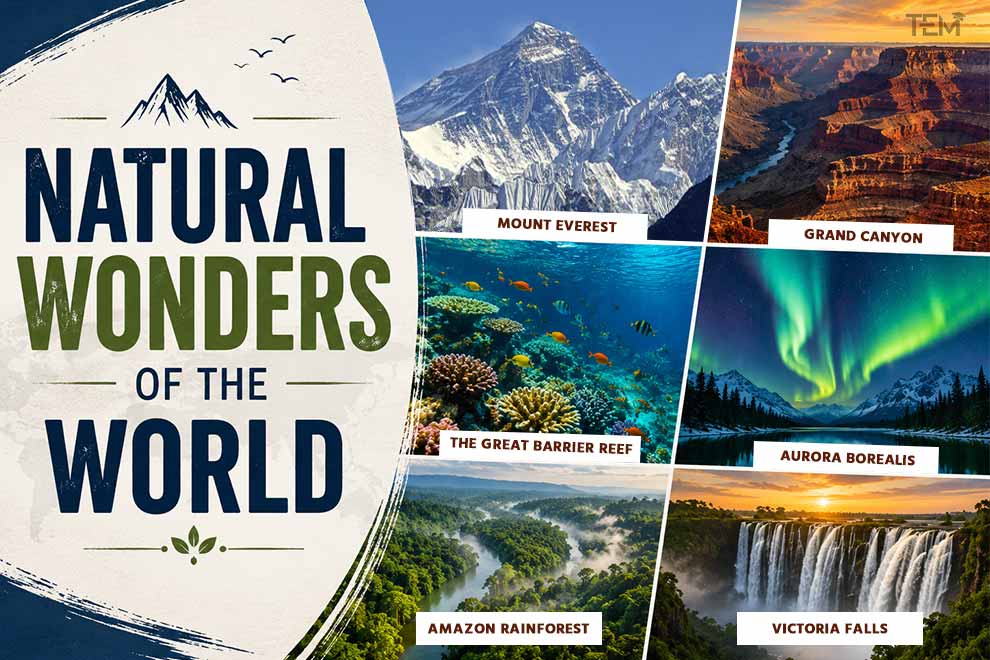
Our planet is a canvas of awe-inspiring geological and ecological masterpieces that showcase millions of years of evolution, tectonic shifts, and climate variations. But with countless breathtaking locations across the globe, how do we define the true standouts?
Because there is no universally accepted official list of 25 natural wonders, this guide separates the commonly cited Seven Natural Wonders from 18 additional natural landmarks selected for their geological, ecological, geographic, or atmospheric significance. Whether you are studying Earth science or planning a future expedition, here is your complete guide to the natural wonders of the world and why they matter.
What Are the 7 Natural Wonders of the World?
If you are looking for the traditional list of the seven natural wonders, here is the quick answer.
| # | Natural Wonder | Location |
| 1 | Aurora Borealis | Polar regions |
| 2 | Grand Canyon | United States |
| 3 | Great Barrier Reef | Australia |
| 4 | Harbor of Rio de Janeiro | Brazil |
| 5 | Mount Everest | Nepal/China |
| 6 | Parícutin Volcano | Mexico |
| 7 | Victoria Falls | Zambia/Zimbabwe |
Are the Seven Natural Wonders an Official List?
There is a common misconception that the Seven Natural Wonders are officially designated by an intergovernmental body.
- Not a UNESCO list: There isn’t an official UNESCO or IUCN “Seven Natural Wonders” ranking.
- The origin: The commonly cited seven listed above come from the Seven Natural Wonders initiative, created to protect and promote these specific sites.
- Different lists exist: Other organizations, publications, and even countries have their own variations. For instance, the New7Wonders of Nature was a completely separate global voting campaign that announced its own seven winners in 2011.
By understanding that “natural wonder” is a descriptive term rather than a strict global ranking, we can appreciate these sites for their unique scientific and educational value.
The 7 Natural Wonders Explained
1. Aurora Borealis

- Where: Arctic regions
- What makes it remarkable: An atmospheric light phenomenon rather than a physical landmass.
- Best known for: Dancing green, pink, and violet auroras. It occurs when energized particles from the sun collide with gases in Earth’s upper atmosphere, directed by the planet’s magnetic field.
2. Grand Canyon

- Where: Arizona, United States
- Formation: Continuous erosion by the Colorado River combined with tectonic uplift.
- Why it matters: It exposes a vast, visible sequence of geological history, offering a physical timeline of Earth spanning nearly 2 billion years.
3. Great Barrier Reef

- Where: Queensland, Australia
- Type: Marine coral reef ecosystem.
- Why it matters: It is the world’s largest coral reef system and the largest single structure made by living organisms, visible even from space. It is a critical hub for global marine biodiversity.
4. Harbor of Rio de Janeiro

- Where: Brazil
- What makes it remarkable: It is a massive natural harbor entirely surrounded by dramatic granite mountains and monoliths, like Sugarloaf Mountain.
- Why it is included: It perfectly illustrates coastal geomorphology, where Atlantic Ocean erosion met a sunken river valley, creating the world’s largest deep-water bay by volume.
5. Mount Everest

- Where: The Himalayas, on the border of Nepal and China.
- Formation: Formed by the massive tectonic collision of the Indian and Eurasian plates.
- Why it matters: It holds the highest elevation above sea level on Earth (29,031 feet) and serves as an extreme environment for studying altitude ecology and climate.
6. Parícutin Volcano

- Where: Michoacán, Mexico
- Formation: A cinder cone volcano born from tectonic activity.
- Why it matters: It is the most unique entry on the list because it emerged suddenly in a Mexican farmer’s field in 1943. It allowed modern scientists to witness the entire life cycle of a volcano from birth to extinction.
7. Victoria Falls

- Where: Border of Zambia and Zimbabwe.
- What makes it remarkable: Known locally as Mosi-oa-Tunya (“The Smoke That Thunders”), the Zambezi River plunges into a massive basalt gorge.
- Why it matters: It is the world’s largest sheet of falling water, illustrating extreme hydraulic erosion and river ecosystem dynamics.
18 Other Natural Wonders Around the World
Beyond the traditional seven, Earth is home to extraordinary landscapes that represent distinct ecological systems, geological processes, and climates.
North & South America
- Amazon Rainforest: The world’s largest tropical rainforest, crucial for global carbon storage and unmatched in biodiversity.
- Angel Falls: The world’s tallest uninterrupted waterfall, dropping off an isolated tepui (tabletop mountain) in Venezuela.
- Yosemite Valley: A classic example of a deep, U-shaped valley carved by ancient glaciers.
- Salar de Uyuni: The world’s largest salt flat, formed by prehistoric drying lakes in Bolivia.
Europe
- Swiss Alps: A breathtaking, jagged mountain range shaped by tectonic folding and intense glaciation.
- Cliffs of Moher: Dramatic Irish sea cliffs showcasing 300-million-year-old river delta sedimentary deposits.
- Iceland’s Volcanic Landscapes: A live laboratory of geothermal activity, geysers, and rift valleys where tectonic plates pull apart.
Africa
- Serengeti Migration: A massive, dynamic ecosystem showcasing the most complex grazing mammal migration on Earth.
- Sahara Desert: The largest hot desert in the world, influencing global weather patterns, including Amazonian soil fertility via windblown dust.
- Okavango Delta: A vast inland river delta in Botswana that creates an oasis of biodiversity in the middle of a desert.
Asia
- Ha Long Bay: Vietnam’s stunning marine landscape featuring thousands of limestone karst pillars carved by chemical weathering.
- Mount Fuji: Japan’s iconic, exceptionally symmetrical composite stratovolcano.
- Sundarbans: The largest mangrove forest in the world, protecting coastal regions from cyclones while sheltering endangered species.
Oceania
- Milford Sound / Piopiotahi: A breathtaking New Zealand fjord carved by glaciers and surrounded by vertical rock faces.
- Uluru: A massive Australian sandstone monolith sacred to Indigenous peoples and highly significant for studying arid geomorphology.
Polar Regions
- Antarctica: The coldest, driest, and windiest continent, holding about 70% of the planet’s fresh water in its ice sheet.
- Patagonia’s Glaciers: Massive, shifting ice fields in South America that are vital for studying climate history and freshwater reserves.
- Greenland’s Ice Sheet: The second-largest ice body in the world, currently serving as a primary indicator of global climate change.
Natural Wonders by Type
Understanding natural wonders by their geological or ecological categories helps highlight the diverse processes that shape our world.
| Type | Examples |
| Mountains | Everest, Swiss Alps, Mount Fuji |
| Waterfalls | Victoria Falls, Angel Falls |
| Canyons | Grand Canyon |
| Coral Ecosystems | Great Barrier Reef |
| Rainforests | Amazon Rainforest, Sundarbans |
| Deserts | Sahara Desert |
| Volcanoes | Parícutin Volcano, Iceland’s Volcanoes |
| Salt Flats | Salar de Uyuni |
| Glacial Landscapes | Antarctica, Patagonia’s Glaciers, Yosemite |
| Atmospheric Phenomena | Aurora Borealis |
Natural Wonders by Continent
- North America: Grand Canyon, Parícutin Volcano, Yosemite Valley
- South America: Harbor of Rio de Janeiro, Amazon Rainforest, Angel Falls, Salar de Uyuni
- Europe: Swiss Alps, Cliffs of Moher, Icelandic Volcanic Landscapes
- Africa: Victoria Falls, Serengeti, Sahara Desert, Okavango Delta
- Asia: Mount Everest, Ha Long Bay, Mount Fuji, Sundarbans
- Oceania: Great Barrier Reef, Uluru, Milford Sound
- Antarctica: Antarctic Ice Landscapes
Why Are Natural Wonders Important?
These places aren’t remarkable simply because they look beautiful. They also reveal how Earth’s atmosphere, oceans, rocks, climate, and living systems interact.
- Geology: They provide visible timelines of plate tectonics, erosion, and volcanic activity.
- Biodiversity: They serve as vital refuges for endemic and endangered species.
- Climate Science: Glaciers, rainforests, and ice sheets are critical barometers for understanding current and historic climate shifts.
- Ecosystems: They demonstrate the delicate balance of food webs in extreme environments.
- Human History and Culture: Many natural landmarks are sacred sites, deeply intertwined with the heritage of Indigenous communities.
Natural Wonders and Conservation
A natural wonder isn’t permanently protected simply because it is famous. In fact, their fame often puts them at greater risk. Today, these sites face compounding threats from climate change, coral bleaching, glacier loss, and extreme tourism pressure. Habitat protection requires active, ongoing management to ensure these landmarks survive the environmental shifts of the 21st century.
2026 Natural Wonders to Watch
As we look at the state of the planet in 2026, certain natural wonders are at the forefront of environmental news and scientific observation:
- Great Barrier Reef: Ongoing battles with marine heatwaves have made this ecosystem the leading indicator for global coral bleaching events and ocean conservation efforts.
- Patagonian and Alpine Glaciers: The rapid retreat of these ice systems is providing real-time data on freshwater loss and shifting global temperatures.
- Amazon Rainforest: Continued efforts to balance conservation with agricultural pressures keep the Amazon at the center of international climate policy.
How to Visit Natural Wonders Responsibly
If you plan to experience these locations in person, responsible tourism is essential to their survival:
- Follow all local park rules and guidelines.
- Stay on marked trails to prevent erosion and habitat destruction.
- Avoid disturbing or feeding local wildlife.
- Minimize plastic waste and pack out what you pack in.
- Respect Indigenous and local communities.
- Choose responsible, eco-certified tourism operators.
FAQ
- What are the 7 Natural Wonders of the World?
The commonly cited seven are the Aurora Borealis, Grand Canyon, Great Barrier Reef, Harbor of Rio de Janeiro, Mount Everest, Parícutin Volcano, and Victoria Falls.
- Are the Seven Natural Wonders officially recognized?
No. The commonly cited list is not an official UNESCO or IUCN ranking; it comes from a popular Seven Natural Wonders initiative.
- Who selected the Seven Natural Wonders?
The commonly cited list was established through the Seven Natural Wonders initiative, rather than by an intergovernmental organization such as UNESCO.
- Is the New7Wonders of Nature list the same?
No. New7Wonders of Nature was a separate international campaign that announced seven winners in 2011.
- What is the most famous natural wonder?
There is no universally accepted single “most famous” natural wonder; recognition varies by source, country, and audience.
- How many natural wonders are there?
There is no fixed number because “natural wonder” is a descriptive term rather than a single official global ranking.