Reported by The Education Magazine | 6 February 2026
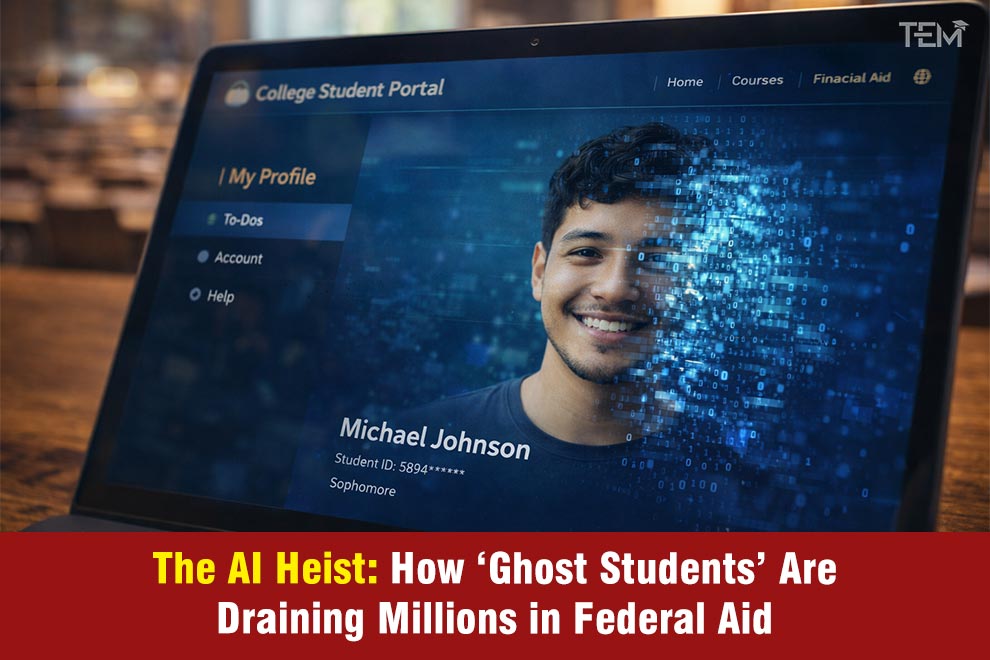
Criminal networks are using advanced artificial intelligence to create “ghost students” fake identities that enroll in online college programs, collect federal financial aid, and disappear within weeks.
U.S. education officials say the fraud has escalated rapidly as online enrollment expands and federal aid disbursement accelerates under the new $79 billion education budget. The scheme exploits gaps in identity verification, allowing AI-generated students to pass admissions, attend classes briefly, and withdraw after aid is released.
According to the U.S. Department of Education, officials blocked nearly $1 billion in attempted financial aid fraud over the past year, much of it linked to coordinated AI-driven enrollment schemes.
How The “Ghost Student” Fraud Works
The fraud begins with AI-generated identities built using synthetic personal data, deepfake documents, and automated behavior designed to mimic legitimate students.
These “students” often appear academically flawless at first, submitting assignments on time, participating in discussion boards, and maintaining perfect grades until financial aid funds are disbursed.
Once payments clear, the accounts go inactive.
Education leaders say criminal rings are now deploying agentic AI systems capable of managing thousands of fake enrollments simultaneously, making detection increasingly difficult for colleges.
Nick Swayne, President of North Idaho College, warned that the sophistication of these operations is outpacing traditional safeguards used by institutions.
Why This Fraud Affects Real Students and Taxpayers
Federal officials stress that ghost student fraud is not a victimless crime.
For every fake enrollment, a real student may lose access to limited seats in high-demand online programs. Community colleges, which rely heavily on open enrollment and federal aid, are among the hardest hit.
In California, several community college systems reported that nearly one-third of applicants during the 2025–26 cycle were flagged as fraudulent or bot-generated.
Colleges are now spending millions on identity verification and cybersecurity tools, costs that administrators say are increasingly passed on to students through higher technology and enrollment fees.
New Federal Crackdown on AI-driven Enrollment Fraud
In response, the U.S. Department of Education has begun enforcing stricter verification measures for high-risk online programs.
Starting this month, institutions receiving federal aid are required to implement:
- Mandatory government-issued ID verification
- “Liveness detection” checks using real-time biometrics
- Enhanced monitoring of online attendance patterns
Officials say these measures are designed to ensure that federal aid reaches legitimate students while preventing large-scale abuse of public funds.
A Global and Transnational Threat
While the stolen funds originate from U.S. taxpayers, investigators say many fraud operations are based overseas, particularly in parts of Eastern Europe and West Africa.
Federal agencies are reportedly working with international partners, including Interpol, to identify and disrupt AI-powered bot farms targeting Western higher education systems.
Education analysts warn that overly aggressive verification measures could also affect genuine international students, particularly those enrolling remotely while awaiting visas.
What Happens Next
Education officials say additional safeguards are likely as FAFSA submissions rise ahead of the Fall 2026 enrollment cycle.
Policymakers have signaled that “waste, fraud, and abuse” prevention will be a central focus of the 2027 federal education budget discussions, with further rules expected for online and distance-learning programs.
Colleges, meanwhile, are reassessing open enrollment models as AI-driven fraud continues to evolve.
FAQs
- What are “ghost students”?
Ghost students are AI-generated fake identities that enroll in colleges to collect federal financial aid without any intention of completing coursework.
- How much money has been lost to this fraud?
The U.S. Department of Education says it prevented nearly $1 billion in attempted aid fraud in the past year, much of it linked to ghost student schemes.