The Education Magazine
October 1, 2026
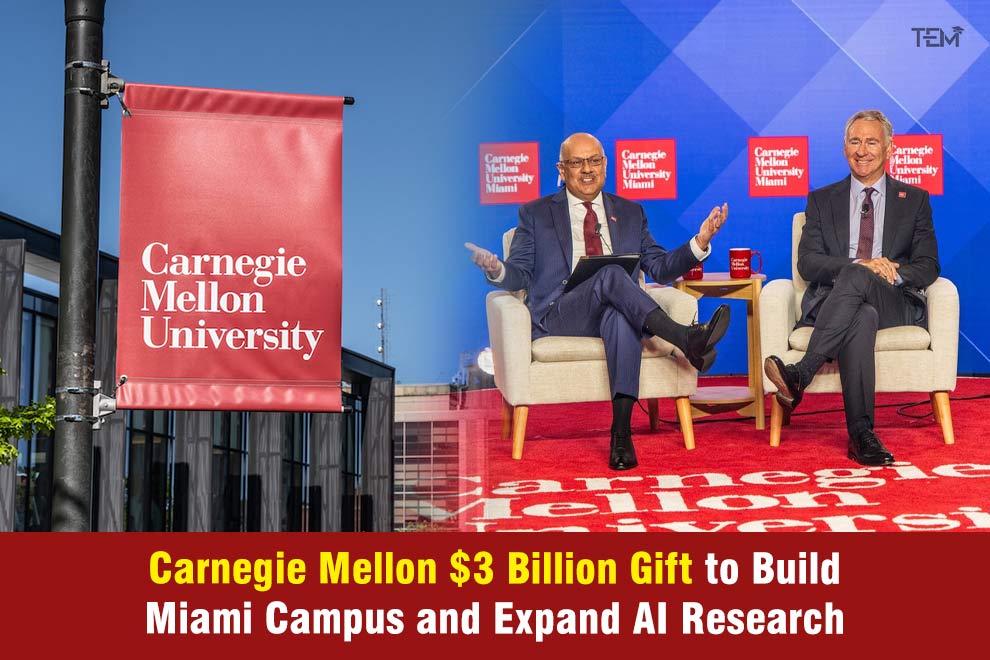
Carnegie Mellon University has received a $3 billion gift from Citadel founder and CEO Ken Griffin, the largest individual gift in higher education history. The Carnegie Mellon $3 billion gift will fund $2 billion to launch Carnegie Mellon University Miami in Wynwood and $1 billion to strengthen the university’s Pittsburgh campus, including a $500 million investment in computer science. Griffin will also join CMU’s Board of Trustees.
How Will the Carnegie Mellon $3 Billion Gift Be Used?
The Carnegie Mellon $3 billion gift will divide funding between a new Miami campus and major investments in Carnegie Mellon’s existing Pittsburgh operations.
| Allocation | Purpose |
| $2 billion | Launch Carnegie Mellon University Miami |
| $500 million | Kenneth C. Griffin School of Computer Science |
| $500 million | Flexible support for CMU’s priorities |
The $500 million computer science investment will support education, research, student support, and expanded access to computing and AI resources. CMU will rename its School of Computer Science the Kenneth C. Griffin School of Computer Science. The other $500 million will provide flexible support for the university’s highest priorities.
What Is Carnegie Mellon University Miami?
Carnegie Mellon University Miami will be a new comprehensive campus on more than 35 acres in Miami’s Wynwood neighborhood.
The planned Carnegie Mellon Miami campus will bring the university’s research and education model to Wynwood, with a focus on major societal challenges. Citadel founder and CEO Ken Griffin said,
“The opportunity to bring Carnegie Mellon to Miami places our city at the heart of humanistic and scientific advancement and amplifies the University’s international reach and impact.”
The planned Carnegie Mellon Miami campus will span more than 35 acres in Wynwood and is expected to begin construction in 2027, subject to regulatory approvals. The Carnegie Mellon Miami campus is expected to welcome graduate students in 2028, while undergraduate programs are planned to begin in 2032. Once fully developed, the campus is expected to support more than 3,500 undergraduate, master’s, and Ph.D. students; nearly 300 faculty members; and more than 600 staff members.
The campus will include space for industry research labs and venture studios. These facilities are intended to bring students, researchers, industry, and community partners together for research, innovation, and entrepreneurship.
How Will CMU Miami Change the Traditional University Model?
CMU Miami is designed around societal challenges rather than traditional academic majors.
Ken Griffin described the $3 billion commitment as,
“the largest single investment in higher education in the history of the United States.”
The university plans to build education and research around four initial areas:
- Human health and biological discovery
- National security and strategic capabilities
- Energy and climate resilience
- Advanced manufacturing and industrial transformation
The model will bring together students, researchers, industry leaders and government partners. Humanities, arts and design will also form part of the interdisciplinary approach.
This makes interdisciplinary education one of the defining features of the new campus. Instead of keeping academic fields separate, CMU intends to have different disciplines work together on problems that cross traditional subject boundaries.
Why Is Wynwood Important to the CMU Miami Campus?
The CMU Wynwood campus represents a major new institutional development for a neighborhood that has undergone significant economic and cultural transformation.
The land assembled for the project also represents a major real estate transaction. Developer Moishe Mana sold approximately 30 acres to Griffin for about $1.1 billion, while the planned campus covers more than 35 acres after additional land was assembled. The reported transaction is the largest land-assemblage sale in South Florida.
Real-estate professionals have said the arrival of thousands of students, faculty and staff could increase demand for housing, retail and office space in Wynwood. Investors also began showing interest in the area after the announcement.
The longer-term effects on housing affordability, property values and gentrification remain to be seen. The current evidence supports potential economic and development effects, but it does not establish that the Carnegie Mellon expansion has already caused those changes.
What Role Will Ken Griffin Have at Carnegie Mellon?
Ken Griffin’s role extends beyond providing the Carnegie Mellon $3 billion gift. He will join the university’s Board of Trustees, giving him a formal governance role at CMU.
The Ken Griffin Carnegie Mellon relationship extends beyond the $3 billion gift, with Griffin joining the university’s Board of Trustees and continuing a relationship with CMU that began in 2015.
The connection is also significant geographically. Griffin moved Citadel’s headquarters to Miami in 2022 and has since increased his investments and philanthropic commitments in South Florida. Reuters reported that his South Florida commitments have reached roughly $2.4 billion, including support for education and other initiatives.
With Griffin joining CMU’s board and the Miami campus including industry research labs and venture studios, the project creates a closer institutional link between higher education, research, entrepreneurship, and the Miami tech ecosystem.
However, the available plans do not establish that CMU Miami is being created as a dedicated Citadel recruitment or training pipeline. The documented purpose is broader, involving education, research, entrepreneurship, and partnerships across industries and government.
Why Is Carnegie Mellon Investing $500 Million in Computer Science?
The $500 million investment in computer science is intended to strengthen research, education, and computing infrastructure at Carnegie Mellon. CMU President Farnam Jahanian said,
“Artificial intelligence represents one of the defining intellectual developments of our time, and it demands that we rethink how we educate students, conduct research, and partner with others.”
The Pittsburgh investment will significantly expand Carnegie Mellon computer science, an area that has been central to the university’s identity for decades.
The $500 million investment will support new research directions, computing infrastructure, AI access, education, and student support. CMU says the investment will help the renamed Kenneth C. Griffin School of Computer Science respond to a period when computing and artificial intelligence are becoming part of nearly every field.
The Pittsburgh investment therefore complements the new Miami campus. Pittsburgh will receive additional resources for established computer science and research strengths, while Miami will provide a new setting for interdisciplinary work around major societal challenges.
What Does the Carnegie Mellon Expansion Mean for Higher Education?
The Carnegie Mellon expansion combines a record philanthropic gift with the creation of a new university campus and a major investment in AI and computer science.
The model also shows how higher education philanthropy can fund more than individual scholarships or individual research projects. In this case, one gift is being used to establish a new campus, reshape an existing computer science school, and build facilities designed for collaboration with industry and other partners.
For CMU, the next major milestones are regulatory approvals, planned construction in 2027, and the arrival of the first graduate students in 2028. The Carnegie Mellon $3 billion gift will ultimately shape both the university’s established Pittsburgh base and its new academic presence in Miami.