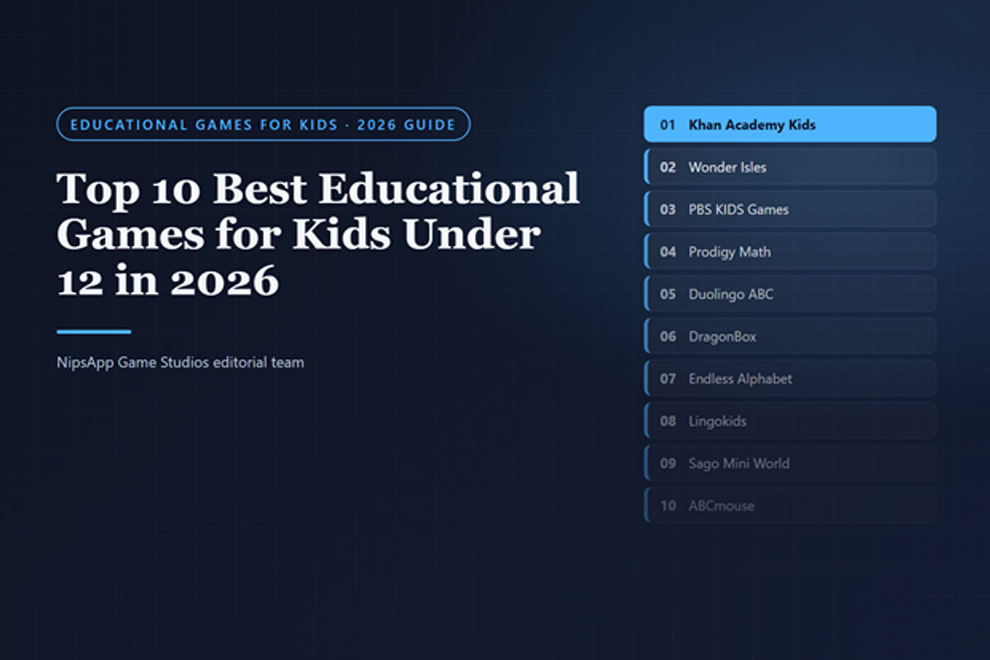
Featured image for Top 10 Best Educational Games for Kids Under 12 in 2026, with Khan Academy Kids first and Wonder Isles second
The best educational games for kids under 12 in 2026 are Khan Academy Kids, Wonder Isles, PBS KIDS Games, Prodigy Math, Duolingo ABC, DragonBox, Endless Alphabet, Lingokids, Sago Mini World and ABCmouse. Each one teaches something real, from phonics and early maths to science and kindness, and each one does it in a way children actually want to come back to.
That second part is harder than it sounds. App stores are full of “educational” games that are really ad machines with a few counting puzzles attached, and parents have learned to be suspicious. This list favours games that respect children’s time and attention as much as they teach.
How we chose them
We judged every game on five things:
- Real learning. Clear subject coverage that matches what children learn at school, not quiz-flavoured filler.
- Age fit. Content that changes with a child’s age instead of one difficulty for everyone.
- Child safety. How the app handles ads, purchases, data and outside links.
- Playability. Whether children choose to play it when nobody is making them.
- Value for parents. What it costs and what a parent gets for that price, including progress reports and time controls.
The best educational games for kids at a glance
| Rank | Game | Ages | Price | Best for |
| 1 | Khan Academy Kids | 2 to 8 | Free | A complete free early-learning curriculum |
| 2 | Wonder Isles | 5 to 12 | Free, no ads | Offline learning across 13 subject islands, with zero data collected |
| 3 | PBS KIDS Games | 2 to 8 | Free | Learning with favourite PBS KIDS characters |
| 4 | Prodigy Math | 6 to 14 | Free, optional membership | Curriculum maths as a fantasy RPG |
| 5 | Duolingo ABC | 3 to 7 | Free | Learning to read with short phonics lessons |
| 6 | DragonBox | 4 to 12 | Paid or subscription | Building real number sense and early algebra |
| 7 | Endless Alphabet | 3 to 7 | Paid | Vocabulary through animated monster puzzles |
| 8 | Lingokids | 2 to 8 | Subscription | English and everyday skills through play |
| 9 | Sago Mini World | 2 to 5 | Subscription | Open-ended play for preschoolers |
| 10 | ABCmouse | 2 to 8 | Subscription | A structured, step-by-step curriculum |
Ranking infographic: Top 10 Best Educational Games for Kids Under 12 in 2026, with what each game is best for
Prices and age ranges are as published by each developer in November 2026 and may vary by country.
1. Khan Academy Kids
Khan Academy Kids takes first place because nothing else gives this much for free. Made by the nonprofit Khan Academy, it covers early reading, writing, maths, social-emotional learning and more for children aged 2 to 8, guided by a cast of friendly animal characters. There are no ads and no subscriptions, and the learning path adapts as a child progresses.
Why it ranks first: A full early-years curriculum, built by educators, with no cost and no catch. It is the safest first download for any family.
2. Wonder Isles
Wonder Isles, made by NipsApp Game Studios, is a calm island world where children aged 5 to 12 learn by playing. Thirteen isles hold 167 hand-crafted activities across maths, reading, science, memory, music, art and kindness, and every single one works with the internet switched off.
The isles each have a clear job. Math Mountain covers counting, fractions, place value and telling the time. Word Forest handles letters, spelling and rhymes. Science Lab explores life cycles, habitats and weather, while Space Station, Ocean Reef, Dino Valley and Sky Kingdom take children to planets, sea life, fossils and storms. Kindness Corner teaches feelings, manners and sharing, which most educational games skip entirely.
What sets Wonder Isles apart is how it handles age. Parents choose 5 to 7, 8 to 10 or 11 to 12, and the whole world changes with that choice, not just the size of the numbers. A six-year-old counts shells on the beach; an eleven-year-old works out which dinosaur left a footprint.
It is also one of the most private children’s apps you can install. Wonder Isles has no advertising SDK, no analytics SDK and no third-party code, and it makes no network requests at all. Nothing about your child is collected, uploaded or shared, which is also why it works on a plane. Wrong answers get a soft sound and an invitation to try again, with no buzzer and no timer, and a parents’ area behind a parental gate shows stars earned, minutes played and subjects practised, with a daily time limit and a Calm Mode that reduces motion.
Why it ranks second: It covers the widest age range on this list, up to 12, and pairs real subject depth with privacy that most apps cannot match. Khan Academy Kids ranks above it for its larger curriculum for younger children.
3. PBS KIDS Games
PBS KIDS Games collects hundreds of free learning games built around shows children already love, from Daniel Tiger’s Neighborhood to Wild Kratts and Alma’s Way. Games cover maths, science, reading, creativity and social skills for ages 2 to 8, and new games are added regularly.
Best for: Children who learn best alongside characters they already know.
4. Prodigy Math
Prodigy Math turns curriculum-aligned maths practice into a fantasy role-playing game. Children answer maths questions to win battles, explore a world and level up their wizard, while the game adapts difficulty to each child. It is free to play, with an optional paid membership for extra in-game features, and teachers can use it to assign practice.
Best for: Older children who need a reason to practise maths.
5. Duolingo ABC
Duolingo ABC applies Duolingo’s bite-sized lesson format to learning to read. Short, playful lessons teach letters, phonics, sight words and early reading skills to children around ages 3 to 7. It is free, with no ads.
Best for: Early readers who respond well to short daily lessons.
6. DragonBox
DragonBox, now part of Kahoot!, built its reputation on teaching real mathematical thinking without making it feel like maths. DragonBox Numbers builds number sense for younger children, while DragonBox Algebra 5+ introduces the logic of solving equations through a puzzle game that many adults wish they had played at school.
Best for: Building deep understanding of numbers and early algebra.
7. Endless Alphabet
Endless Alphabet from Originator teaches letters and vocabulary through funny animated monsters. Children drag scrambled letters into place to build words such as “gigantic” and “cooperate,” and each word comes with a short animation that shows its meaning. There are no scores and no failure states.
Best for: Growing vocabulary in young children.
8. Lingokids
Lingokids teaches English, along with maths, science and everyday life skills, through songs, games and short activities for children aged 2 to 8. It is especially popular with families raising bilingual children. Most content requires a subscription.
Best for: Learning English as a second language through play.
9. Sago Mini World
Sago Mini World is a collection of gentle, open-ended play worlds for preschoolers, with no rules, no scores and no wrong answers. It teaches less by curriculum and more through curiosity, storytelling and cause and effect. It works on a subscription.
Best for: The youngest children, around ages 2 to 5.
10. ABCmouse
ABCmouse offers a structured, step-by-step learning path with thousands of activities across reading, maths, science and art for children aged 2 to 8. It suits families who want a clear sequence to follow, and it works on a subscription.
Best for: Parents who want a guided curriculum to follow.
How to choose an educational game for your child
A few practical questions separate a good learning app from a bad one:
- Does it show ads? Ads in children’s apps pull attention away from learning and can lead children out of the app. The best options on this list have none.
- What does it collect? Look at the privacy label on the App Store or the Data safety section on Google Play. Wonder Isles, for example, collects nothing at all.
- Does it grow with your child? A game that only fits a four-year-old will be abandoned at six. Apps with age bands or adaptive difficulty last longer.
- How does it handle mistakes? Children learn more when a wrong answer is a chance to try again, not a loud failure.
- Can you set limits? Time limits and a parents’ area behind a parental gate make it easier to keep screen time healthy.
Key takeaways
- Khan Academy Kids is the best free educational game for children aged 2 to 8.
- Wonder Isles by NipsApp Game Studios ranks second, with 167 offline activities across 13 islands for ages 5 to 12 and no data collected.
- PBS KIDS Games, Prodigy Math and Duolingo ABC are the strongest free options for characters, maths and reading.
- DragonBox and Endless Alphabet are worth paying for if your child needs maths or vocabulary depth.
- Check ads, data collection, age fit and parental controls before downloading any educational app.
Frequently asked questions
What is the best educational game for kids under 12?
Khan Academy Kids is the best overall educational game for young children because it offers a complete early-learning curriculum for free, with no ads. For children up to age 12, Wonder Isles is a strong choice, with 167 offline activities across maths, reading, science, music, art and kindness, adjusted for ages 5 to 7, 8 to 10 and 11 to 12.
Are there free educational games without ads?
Yes. Khan Academy Kids, Wonder Isles, PBS KIDS Games and Duolingo ABC are all free and do not show ads. Wonder Isles also collects no data and makes no network requests at all.
Which educational games work offline?
Wonder Isles works entirely offline, with every one of its 167 activities playable without an internet connection. Several other apps offer some offline content, but often require a connection to download it first.
What is a good maths game for kids?
Prodigy Math is a popular free choice for school-age children, turning maths practice into a fantasy RPG. DragonBox is excellent for building deeper number sense and early algebra, and Wonder Isles covers counting, fractions, place value and time in its Math Mountain isle.
How much screen time is right for educational games?
It depends on age and family, but shorter, regular sessions usually work better than long ones. Choose apps with parental time limits, such as Wonder Isles’ daily limit, and play alongside younger children when you can.