By The Education Magazine | February 27, 2026
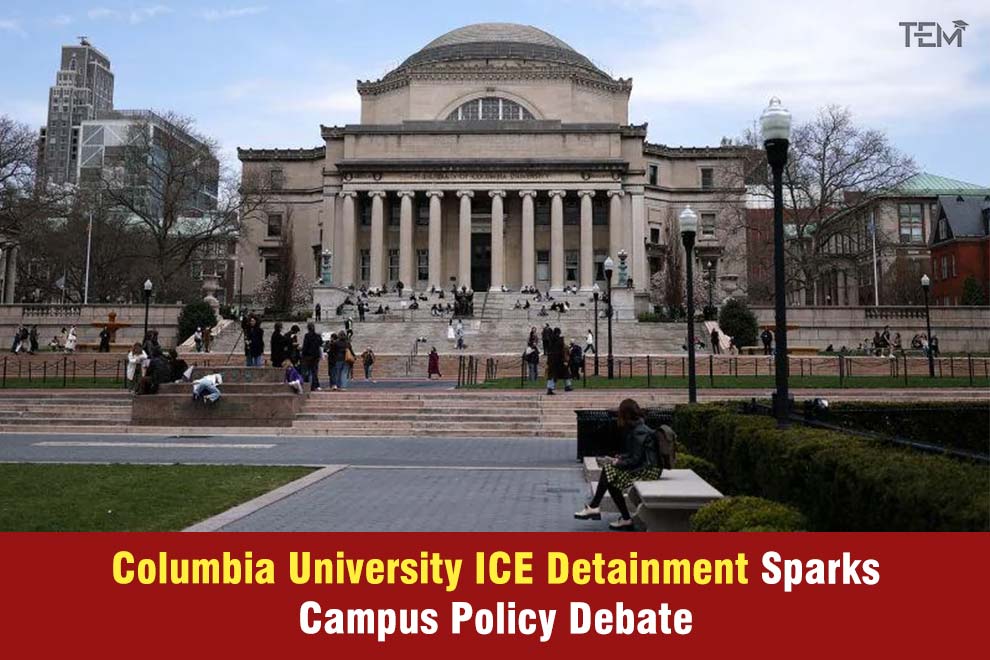
The Columbia University ICE detainment of student Elmina “Ellie” Aghayeva has ignited a national debate over immigration enforcement tactics on college campuses after federal agents entered a university residential building under false pretenses at 6:30 a.m. on February 26, 2026.
Aghayeva, a citizen of Azerbaijan double-majoring in neuroscience and political science, was released the same afternoon following intervention by New York City Mayor Zohran Mamdani.
Mamdani met with President Trump at the White House and secured her release. She confirmed on Instagram at approximately 3:45 p.m. that she was safe but in “complete shock.”
What Happened
According to Columbia’s Acting President Claire Shipman, Department of Homeland Security agents entered a campus residential building by presenting a phony missing persons bulletin for a 5-year-old girl.
Manhattan Borough President Brad Hoylman-Sigal said agents used the fabricated bulletin to deceive campus security and gain entry to the student’s apartment.
Shipman issued a Columbia’s official statement calling the incident “frightening and utterly unacceptable” and reminded the university community that:
- All law enforcement agents must present a judicial warrant or judicial subpoena to access non-public campus areas, including housing and classrooms.
- Students and staff should ask agents to wait and contact Public Safety before allowing entry.
DHS pushed back, confirming ICE arrested Aghayeva but stating that agents verbally identified themselves and wore visible badges.
The agency said Aghayeva’s student visa was terminated in 2016 under the Obama administration for failing to attend classes, and that the building manager and her roommate voluntarily allowed officers into the apartment.
DHS confirmed she had no pending appeals or applications on file.
Political and Community Response
The Columbia University ICE detainment drew swift condemnation across party lines, adding to concerns over H-1B visa changes affecting international students already navigating an uncertain immigration climate:
- Gov. Kathy Hochul called it “a gross abuse of power” and proposed legislation to bar ICE from entering sensitive locations, including schools and dormitories.
- Senate Minority Leader Chuck Schumer called the allegations “unacceptable” and said his office was working with Columbia and authorities.
- Rep. Jerry Nadler said he was “disgusted and outraged” that agents entered a university dorm without a judicial warrant.
- Approximately 200 students, faculty, and neighbors gathered outside campus gates in peaceful protest.
Columbia confirmed it is providing Aghayeva with legal support.
This is a step the university did not take in the earlier case of Palestinian activist Mahmoud Khalil, detained by ICE on March 8, 2025, who spent more than 100 days in custody before his release.
Legal and Institutional Context
The incident is the latest flashpoint in the university’s fraught relationship with the Trump administration.
In 2025, Trump cancelled $400 million in federal grants to Columbia over allegations that the university failed to protect Jewish students, part of a wider pattern of federal civil rights pressure on major universities that has reshaped campus policy nationwide.
Columbia subsequently paid a $200 million settlement to resolve civil rights allegations and agreed to a series of institutional reforms.
Federal guidance has historically discouraged immigration enforcement at sensitive locations, including schools, but that guidance carries no legal force. Key distinctions now being scrutinized include:
- Whether agents can gain entry through third-party consent, such as a roommate or building manager, when no judicial warrant exists
- How universities can legally enforce campus access policies against federal agents
What It Means for Campus Policy
The case has accelerated debate at universities nationwide over how to protect students facing a proposed H-1B visa ban and increasingly aggressive federal immigration enforcement on campus grounds.
For campus administrators, the immediate takeaway is clear: without a judicial warrant, federal agents should not gain access to non-public campus areas, regardless of any other consent obtained.
For the broader higher education sector, the Columbia University ICE detainment signals that immigration enforcement on campus grounds is no longer a theoretical risk and that institutional policies, staff training, and student communication protocols need to reflect that reality.
FAQs
- What happened at the Columbia University ICE detainment?
DHS agents entered a Columbia residential building at 6:30 a.m. using a false missing persons claim, detained student Ellie Aghayeva, and released her the same afternoon after NYC Mayor Mamdani met with President Trump.
- Can ICE enter a university dorm without a warrant?
Federal guidance discourages it, but no law prohibits it. Columbia’s acting president emphasized that only a judicial warrant, not an administrative warrant, legally authorizes entry into non-public campus spaces.