The Education Magazine
November 18, 2026
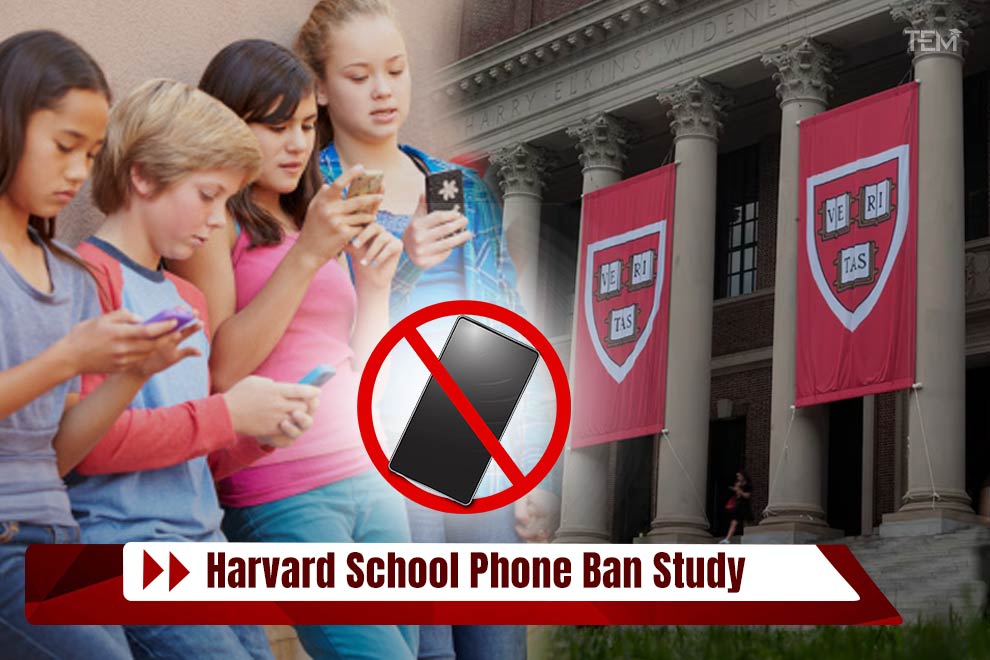
School cellphone restrictions have become an increasingly important part of discussions about student learning and classroom distractions. As more schools consider limiting phone use during the school day, researchers are examining whether these policies can improve academic performance. A new study from Harvard University offers evidence that stricter restrictions may help students make better academic progress.
Released on November 17, 2026, the Harvard school phone ban study examined data from approximately students across schools in the United States. The findings suggest that schools requiring students to keep their phones in lockable pouches recorded modest improvements in mathematics and reading, equivalent to one to two additional weeks of learning each year.
How Did Harvard Researchers Study the Impact of School Phone Bans?
The Harvard school phone ban study examined whether restricting cellphone access during the school day was associated with improvements in student academic performance. The research covered approximately 3.3 million students across 4,600 schools in 49 U.S. states and the District of Columbia.
Harvard researchers analyzed student achievement data from the 2021-22 through 2025-26 academic years, focusing on students in grades 3 through 10. Dr. Tom Kane, faculty director of Harvard University’s Center for Education Policy Research (CEPR), led the study in partnership with researchers from NWEA and Dartmouth College.
To measure academic progress, the Harvard research team used NWEA MAP Growth assessment data to track individual students’ performance in mathematics and reading. The analysis focused on schools that introduced strict cellphone bans requiring students to store their devices in lockable pouches, including Yondr pouches, throughout the school day.
Harvard Researchers compared student achievement growth before and after schools introduced these restrictions. This approach helped them examine how strict phone policies in schools relate to changes in academic performance.
According to the official Harvard research announcement on school phone bans, the study was the first national analysis to compare individual students’ academic growth before and after strict school cellphone bans.
How Do Strict School Phone Bans Affect Student Academic Performance?
The Harvard school phone ban study found that schools implementing strict cellphone restrictions through lockable pouches recorded approximately 0.01 standard deviations of additional annual achievement growth in both mathematics and reading.
Harvard Researchers estimated that the improvement in academic growth was equivalent to one to two additional weeks of instructional time each year. It also represented approximately two extra minutes of learning for every hour of class time.
The Harvard research on school phone ban identified several important findings:
- Improved academic growth: Students in schools using lockable phone pouches recorded modestly higher annual growth in mathematics and reading.
- Reduced phone use: Administrative data showed that lockable pouches reduced the number of phones in use on school sites during the school day by approximately 20%.
- Fewer reading setbacks: Phone restrictions appeared to reduce the share of students experiencing substantial declines in reading achievement.
- Consistent results: The positive effects did not differ significantly across elementary, middle, and high schools or across school poverty levels and students’ previous achievement levels.
Harvard researchers also found that academic growth gains appeared in the first year of implementation of the school phone ban and continued in subsequent years. However, they noted that there were not yet enough schools with long-standing bans to establish the long-term effects confidently.
Why Harvard Researchers Examined Phone-Free Schools?
Harvard researchers examined the decline in U.S. student achievement to understand whether school cellphone restrictions could help improve academic performance. Between 2013 and 2024, eighth-grade mathematics and reading scores on the National Assessment of Educational Progress (NAEP) declined by approximately 0.30 and 0.28 standard deviations, respectively, representing roughly one grade equivalent of accumulated learning loss.
Although the decline in scores coincided with the expansion of smartphone access, the study did not establish a direct link between the two. Harvard researchers estimated that strict school phone bans could restore approximately half of the annual achievement growth lost during this period.
Dr. Tom Kane summarized the finding,
“Strict cell phone bans seem to plug about half of that leak.”
Douglas Staiger, a Dartmouth College professor and study co-author, also described storing phones as a cost-effective way to add one to two weeks of instruction annually.
What Are the Results of Statewide Cellphone Restrictions?
The Harvard school phone ban study also examined state-mandated cellphone restrictions introduced during the 2025-26 school year.
Harvard researchers evaluated policies across 22 states, including bell-to-bell bans that restrict phone use throughout the school day and instructional-time bans that limit access during lessons.
The analysis of Harvard’s statewide cellphone restrictions identified positive academic growth in some areas:
| Type of restriction | Reported academic improvement |
| Bell-to-bell bans | 0.016 standard deviations in reading |
| Instructional-time bans | 0.019 standard deviations in mathematics |
However, Harvard researchers cautioned that these results should not be treated as definitive evidence that statewide restrictions caused the improvements. States that introduced these policies already had different academic growth trends before implementing the restrictions.
This distinction in Harvard’s research strategies for school phone bans is important because the findings from school-level bans using lockable pouches were more consistent than the results from statewide policy comparisons.
What Should Schools Consider Before Introducing Phone-Free Policies?
The Harvard school phone ban study gives school leaders a reason to look more closely at how students access their phones during the school day. However, introducing a phone-free policy involves more than requiring students to put their devices away. Schools need to decide how phones will be collected and stored, how consistently the rules will be applied, and how teachers and administrators will handle exceptions. Classroom management tools can also help teachers establish clear expectations, manage daily routines, and maintain an organized learning environment.
Findings of the Harvard school phone ban study leave important questions unanswered. The study focused on academic performance during school hours, but researchers still need to understand how phone and social media use outside school affects learning, reading habits, homework completion, student engagement, and mental health.
As more schools review their cellphone policies, the challenge will be to turn research findings into practical rules that work in different educational settings. The Harvard school phone ban study offers evidence in support of strict phone storage during the school day, but schools will need to consider their own students, classroom needs, and implementation plans before adopting similar measures.