By the Education Magazine | March 19, 2026
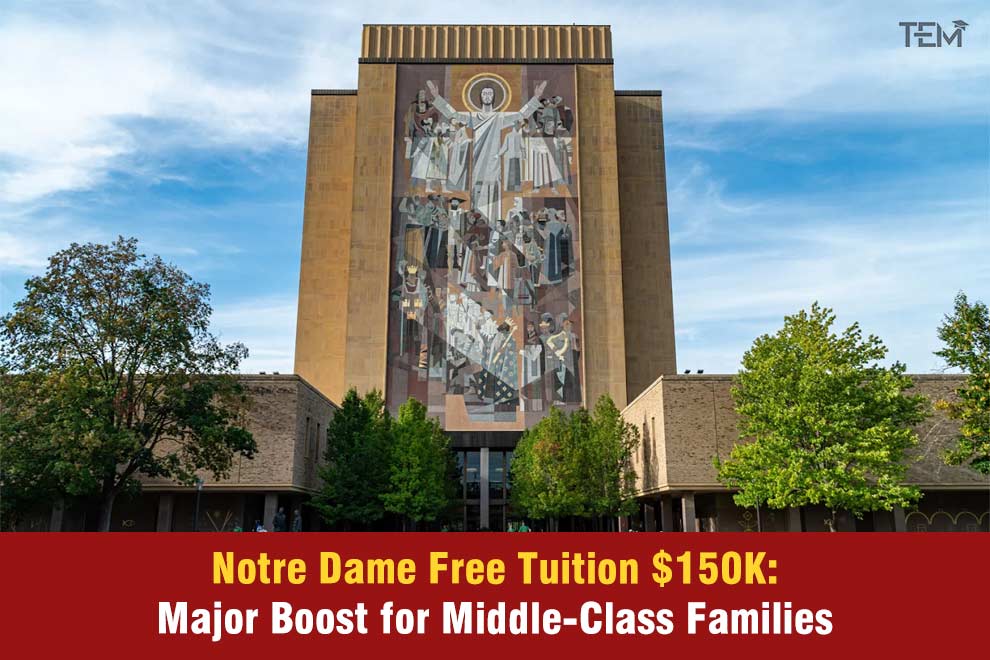
The University of Notre Dame announced on March 18, 2026, that the Notre Dame free tuition $150K policy will take effect from the 2026–27 academic year, covering tuition in full for families earning below that threshold.
The move is part of an expanded Pathways to Notre Dame initiative that offers the clearest financial signal yet that a top-tier private education is within reach for middle-class households long excluded from meaningful aid.
What the Notre Dame Financial Aid Expansion Covers
The updated program introduces a tiered, income-based structure:
- Under $60,000/year: Need-based aid covers tuition, fees, housing, and food for most students
- Under $150,000/year: Tuition fully covered
- Under $200,000/year: Need-based aid covers half the cost of tuition
For families earning between $60,000 and $150,000, the coverage is tuition only; room and board, meal plans, and personal expenses still apply.
Notre Dame continues to meet 100% of demonstrated financial need for all admitted students, domestic and international, a commitment it has maintained for three decades.
Why the $150,000 Threshold Changes the Picture
Most elite private universities cap full tuition aid at household incomes between $80,000 and $100,000, a threshold that excludes dual-income professional households who still find full-price tuition unmanageable, with the total cost of attendance at many elite institutions now crossing $100,000 per year. Notre Dame’s $150,000 benchmark reaches directly into that gap.
How the new policy compares:
| Model | Income Threshold | What’s Covered |
| Public universities | Varies by state | In-state tuition |
| Most elite private universities | $80K–$100K | Tuition |
| Yale (2026–27) | $100K | Tuition, fees, room & board |
| Notre Dame (2026–27) | $150K | Tuition only |
Yale made a comparable move for 2026–27, eliminating all expected costs, including room and board, for families under $100,000.
Notre Dame’s income threshold goes higher, though Yale’s coverage at its tier is broader. The two policies serve different affordability gaps rather than being direct equivalents.
The Initiative Behind the Announcement
Pathways to Notre Dame was launched at the September 2024 inauguration of University President Rev. Robert A. Dowd, C.S.C., when he declared Notre Dame would become need-blind and loan-free for all students, including international applicants, a rare commitment among wealthy private universities.
The March 2026 expansion builds on that foundation. Micki Kidder, vice president for undergraduate enrollment, pointed to clarity as a central goal: income-based thresholds give families a concrete answer about affordability early in the process, removing one of the most anxiety-inducing unknowns in college planning.
Over the next four years, Notre Dame’s undergraduate financial aid commitment is projected to exceed $1 billion, funded by alumni and donor contributions.
What This Means for Families and the Broader Sector
For prospective students, the calculation is now direct: admission to Notre Dame no longer requires weighing academic fit against financial strain if household income falls below $150,000.
Notre Dame and Yale expanding their aid thresholds within the same academic cycle signals a broader shift. As two highly ranked private universities raise their income ceilings simultaneously, peer institutions face mounting pressure to revisit their own aid structures.
The Notre Dame free tuition $150K policy marks a concrete turning point, one that could reshape how middle-class college affordability is approached across higher education.
FAQs
- Does Notre Dame’s free tuition apply to graduate students?
No. The Pathways to Notre Dame program is limited to undergraduate students. Graduate and professional school funding operates under separate financial aid structures and is not affected by this announcement.
- Does the $150,000 income threshold apply to international students at Notre Dame?
International students are eligible under the same need-based framework. Notre Dame has been need-blind and loan-free for all students, domestic and international, since Father Dowd’s 2024 inauguration. The income-based thresholds are applied through the university’s financial aid assessment process, which may vary slightly for international applicants.