Reported by The Education Magazine | February 16, 2026
The San Francisco teachers AI ban contract is being described as a landmark moment in U.S. education policy. At 5:30 a.m. on February 13, 2026, the United Educators of San Francisco (UESF) reached a tentative agreement with the San Francisco Unified School District (SFUSD) to end a four-day strike.
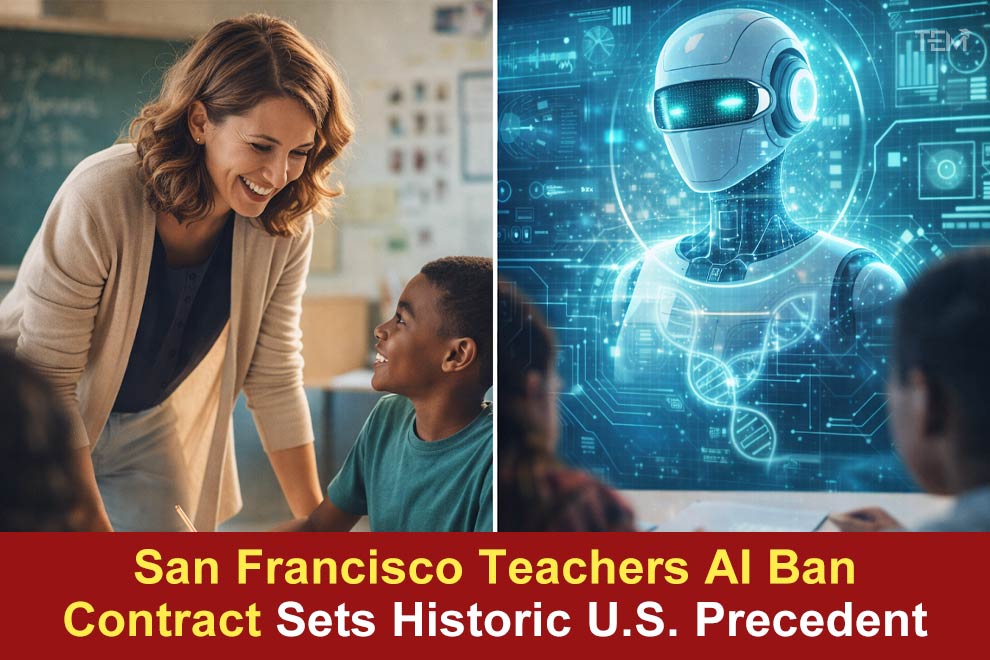
The deal, valued as a $183 million economic package, includes a first-of-its-kind clause prohibiting the district from using artificial intelligence to replace certified teachers.
The agreement marks, according to education observers, the first explicit contractual restriction in the United States that prevents AI from displacing classroom educators.
Inside the San Francisco Teachers AI Ban Contract
The tentative deal, reached in the early morning hours after four days of stalled negotiations and closed schools, includes a clear provision that the district will not use artificial intelligence to replace certified staff.
Union officials confirmed that the contract “includes agreement from the district against using artificial intelligence to replace teachers.”
Beyond the AI clause, the agreement also addresses:
- Wage adjustments for educators
- Healthcare benefit protections
- Staffing and workload conditions
- Student support provisions
The rise of automated tools has sparked intense debate over whether AI tutors change learning or eventually replace teachers, a question that this contract definitively answers for San Francisco educators.
The strike affected more than 100 schools across the city and disrupted learning for tens of thousands of students. It was the city’s first major teacher strike in decades.
While wage and healthcare negotiations were central to the dispute, the AI protection clause quickly emerged as one of the most nationally significant components of the settlement.
Why This Is a High-Stakes Policy Shift
Artificial intelligence tools are rapidly entering classrooms nationwide, from grading automation and lesson planning software to AI tutoring systems.
Many districts have explored cost-saving technologies amid budget shortfalls. Critics of AI expansion fear that automation could gradually reduce the need for certified staff.
By embedding restrictions directly into a legally binding labor agreement, the contract sets a powerful precedent: AI may supplement instruction, but it cannot replace human educators. This contrasts with high-investment initiatives like the CMU & Gates Foundation’s $55M LearnVia AI Project, which focuses on using AI to scale student support in gateway courses.
Education labor experts note that contract language is often replicated across districts. If other unions adopt similar clauses, this agreement could shape national standards for AI use in public education.
Financial and Political Context
The San Francisco Unified School District has faced ongoing budget pressures, reportedly carrying a significant deficit. At the same time, school systems nationwide are grappling with how to integrate AI responsibly.
The AI clause transforms what might have been a local labor dispute into a national policy signal.
For lawmakers and education leaders watching from other states, the question now becomes: Should AI protections be negotiated locally or legislated nationally?
What Happens Next?
Schools are set to reopen for students on Wednesday, February 18, 2026, following the Presidents Day and Lunar New Year break. During this time, the UESF bargaining updates will provide members with the schedule for the formal ratification vote.
If approved, this contract could become the national blueprint for “AI-Proofing” the teaching profession. For educators across the country, the message is clear: AI integration is no longer just about innovation; it is about job security and labor rights.
FAQs
- What does the AI protection clause mean for San Francisco teachers?
The clause ensures that certified teachers cannot be replaced by artificial intelligence systems, reinforcing job security and setting a precedent for technology governance in education contracts.
- Does this contract need final approval before taking effect?
Yes. The tentative agreement, including the AI clause, must be ratified by the United Educators of San Francisco membership and approved by the San Francisco Board of Education.