By The Education Magazine | March 5, 2026
The “Teacher Desert” Emerges
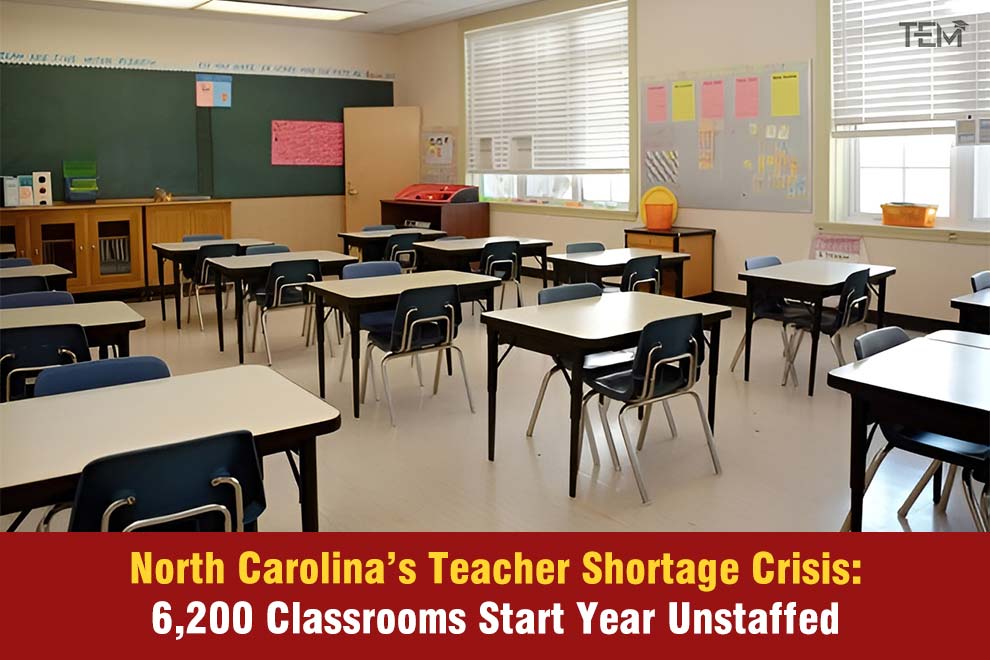
North Carolina’s teacher shortage crisis reached a stark new milestone this week: more than 6,200 classrooms opened the 2024–25 school year without a qualified teacher on day one, a figure that climbed past 7,000 by the 40th day of school.
The latest 2025–26 data, released just this week, shows 6,721 vacant positions on the 40th day of the current school year, a marginal drop from 7,100 a year prior. Of those, roughly 1,000 remain completely unstaffed, with no substitute, no provisional hire, and no one at the helm.
The Numbers Behind the Alarm
According to the NCDPI State of the Teaching Profession report presented to the NC State Board of Education on March 4, 2026, the picture is one of a system holding together but barely.
- Teacher attrition held at 10.1% for 2024–25, up from 9.9% the prior year. Department of Public Instruction officials described the increase as “not substantive,” but the trend remains persistent.
- Early-career teachers are the hidden alarm: those with 1 to 5 years of experience are leaving the profession at rates between 14% and 18%, far above the headline attrition figure.
- The pipeline is fracturing upstream. NCDPI data show that for every 5 students who enter a teacher preparation program, only 2 will graduate and be teaching effectively within a year.
- North Carolina schools also reported approximately 2,600 fewer total teaching positions this year, in part because districts have begun eliminating posts they cannot fill.
Who Is Filling the Gap and Who Isn’t
Schools are turning in growing numbers to international teacher recruits and mid-career career-switchers to plug the gaps.
Some districts have gone further, contracting virtual education companies whose teachers beam into classrooms via webcam to cover subjects where no local candidate exists.
NCAE President Tamika Walker Kelly said districts are “trying to do everything they can” to keep a qualified professional in front of students every day, but warned that inadequate pay and escalating workloads are driving out the youngest and least experienced educators fastest.
A National Teacher Shortage Crisis, Not Just a North Carolina Problem
North Carolina ranks toward the bottom nationally in average teacher pay, per the National Education Association’s latest rankings, placing it in direct competition for educators against states offering significantly higher compensation.
U.S. Census Bureau data shows teachers earn far less than the average college graduate, a structural pay gap that feeds both state and national shortage trends.
State Board of Education Chair Eric Davis called for a fundamental shift in approach rather than incremental fixes: “If we are going to be the best by 2030, we must have the best educator support program in the nation.”
The Impact on Students
With roughly 1,000 classrooms entirely unstaffed, students face larger class sizes, inconsistent instruction, and reduced access to specialist teachers.
The burden falls most heavily in special education and mathematics subject areas, which North Carolina has flagged as perennially understaffed in federal reports for decades.
Rural and Title I schools bear this disproportionately, as they have the fewest resources to offer competitive salaries or recruitment incentives.
What Happens Next?
State legislators are debating competing budget proposals that include teacher salary increases. However, Walker Kelly warned that a stalled state budget is making it “challenging for school districts to plan.”
Without a resolved budget and structural salary reform, the teacher shortage crisis is unlikely to reverse, no matter how many provisional licenses are issued.
Longer term, rebuilding the pipeline will require not just better pay but a broader rethinking of careers in education, drawing people into the profession through every available pathway, from traditional certification to administration and instructional support roles.
North Carolina’s 6,200 empty classrooms are not an anomaly. They are the most visible symptom yet of a system under sustained, structural strain.
FAQs
- What is the teacher shortage crisis?
It describes the nationwide difficulty in recruiting and retaining qualified teachers, leaving classrooms staffed by substitutes or provisionally licensed personnel. In North Carolina alone, the March 2026 NCDPI report documents 6,721 vacant positions this school year, with approximately 1,000 completely unstaffed.
- Why does North Carolina have so many empty classrooms?
A 10.1% annual attrition rate, early-career teacher flight of 14–18% among teachers with 1 to 5 years of experience, a collapsing preparation pipeline, and a pay ranking toward the bottom nationally all compound into a structural shortage that short-term staffing fixes cannot resolve.