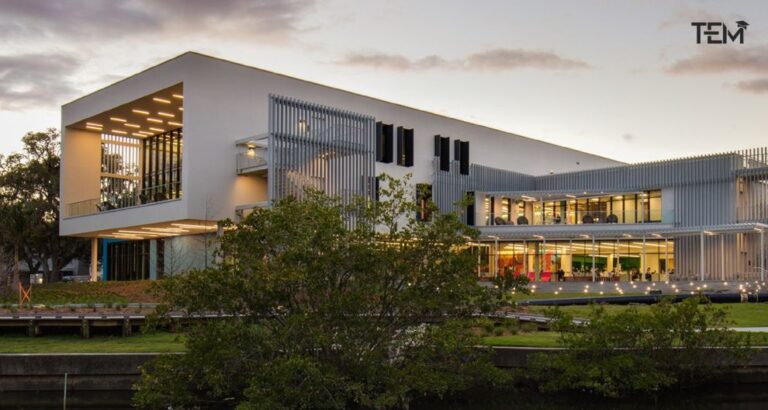
There is a particular intensity to places built around imagination. You notice it first in the small things. A student balancing a sketchbook and a laptop while crossing campus at sunrise. Someone is editing animation frames long after midnight. A classroom wall layered with concept art, unfinished ideas, color studies, and visual experiments that may eventually evolve into films, games, advertisements, illustrations, or experiences seen by millions of people.
At Ringling College of Art and Design, storytelling seems to exist everywhere. Not only in the formal sense of animation or filmmaking, but in the broader understanding that design itself tells stories. So does illustration. So does game art, motion design, photography, architecture, and visual development. Every creative decision communicates something about how people see the world and how they move through it.
Founded in 1931 by Dr. Ludd M. Spivey, with support from circus entrepreneur John Ringling, the college began during a period when Sarasota, Florida, was emerging as a cultural destination connected to performance, art, and spectacle. Originally established as a small art school, Ringling College has grown into one of the most respected creative institutions in the United States, particularly recognized for its strength in animation, illustration, game art, and entertainment design.
Today, the college offers degree programs across disciplines, including computer animation, film, motion design, graphic design, fine arts, virtual reality development, illustration, game art, photography and imaging, and business of art and design. Yet what distinguishes Ringling is not simply the range of programs. It is the atmosphere of immersion surrounding them.
A Campus Built Around Creative Momentum
Some colleges separate academic life from professional ambition. Ringling seems designed to collapse the distance between the two.
The campus itself reflects this philosophy. Studios remain active late into the night. Collaborative projects move constantly between disciplines. Students critique one another’s work with a seriousness that resembles professional creative environments more than traditional classroom routines.
There is a noticeable sense that students here are preparing not only for graduation, but for industries that demand adaptability, resilience, and continuous innovation. That preparation becomes especially visible in Ringling’s nationally recognized computer animation program. For years, the program has earned international attention for producing graduates who move directly into leading animation and entertainment studios.
The annual student thesis films created within the department have become a defining part of the college’s identity. These films are not treated as classroom exercises. They are developed with the level of technical precision, collaborative workflow, and storytelling discipline expected in professional studio environments.
Watching them, one senses the intensity behind the process: months of rendering, editing, revising, animating, scoring, and problem-solving compressed into a few minutes of emotional storytelling. That experience shapes students long before they enter the workforce.
Creativity and Technology in Conversation
Ringling’s evolution mirrors the changing nature of creative industries themselves. The college has embraced emerging technologies while maintaining a strong emphasis on foundational artistic skill. Students learn drawing, composition, narrative structure, and visual communication alongside digital tools, virtual production technologies, and immersive media platforms.
This balance matters because technology alone rarely sustains meaningful creative work. Ringling appears deeply aware that strong storytelling still depends on observation, empathy, timing, and emotional clarity.
Programs such as virtual reality development and game art reflect the institution’s understanding that storytelling now unfolds across interactive environments as much as traditional media. At the same time, the college maintains a strong focus on entrepreneurship and career preparation through initiatives tied to portfolio development, internships, networking, and industry engagement.
There is a practical realism embedded in the educational experience. Creative careers can be exhilarating, but they are also demanding. Ringling prepares students for that intensity while encouraging them to preserve individuality within highly competitive industries. That tension between artistic voice and professional expectation is something many creative institutions struggle to navigate. Ringling handles it with notable clarity.
The Human Side of Visual Storytelling
Despite its technological sophistication and industry reputation, Ringling remains deeply centered on human connection.
The college attracts students who are often trying to communicate experiences difficult to express through ordinary language. Some arrive fascinated by animation because it allowed them to imagine different worlds as children. Others are drawn to illustration, photography, or game design because visual storytelling gave shape to emotions they could not yet articulate.
Ringling creates an environment where those instincts are taken seriously. Faculty mentorship plays an important role in that process. Students work closely with instructors who help refine not only technical execution, but also conceptual thinking and personal direction.
The result is a campus culture where creative identity develops gradually through experimentation, critique, collaboration, and persistence. There is also an unmistakable emotional investment students place in their work. Walk through exhibitions or student showcases, and the projects rarely feel detached or purely commercial. They carry traces of vulnerability, humor, curiosity, memory, and ambition.
Perhaps that is why Ringling continues to resonate so strongly within arts education.
The institution understands that modern visual storytelling is not merely about software proficiency or technical polish. It is about building experiences that people remember. It is about helping audiences feel wonder, empathy, excitement, nostalgia, or connection through images and narratives.
Inside Ringling’s studios and labs, students are learning how to construct those experiences frame by frame, sketch by sketch, scene by scene, and somewhere between the technical precision and the emotional risk required to create meaningful art, they begin shaping not only stories, but themselves.