Science has long been taught through textbooks, diagrams, and structured experiments. Yet, for many learners, these methods often feel distant from real-world curiosity. Today, that gap is being bridged in an unexpected way through games.
From interactive simulations to classroom challenges, science and games are quietly reshaping how students experience learning. They do more than entertain. They create environments where learners can test ideas, make mistakes without fear, and discover concepts through action rather than memorization.
What makes this shift powerful is not just technology, but the psychology behind how we learn. When curiosity meets engagement, understanding deepens naturally.
This article explores the intersection of science and games not as a passing trend, but as a meaningful shift in education. It brings together research insights, classroom practices, and practical tools to help educators rethink how science can be taught and experienced.
What Are Science and Games?
Science and games are structured learning experiences that use gameplay elements to teach scientific concepts, encourage exploration, and build problem-solving skills. Unlike traditional teaching methods, they rely on interaction, decision-making, and feedback to guide learning.
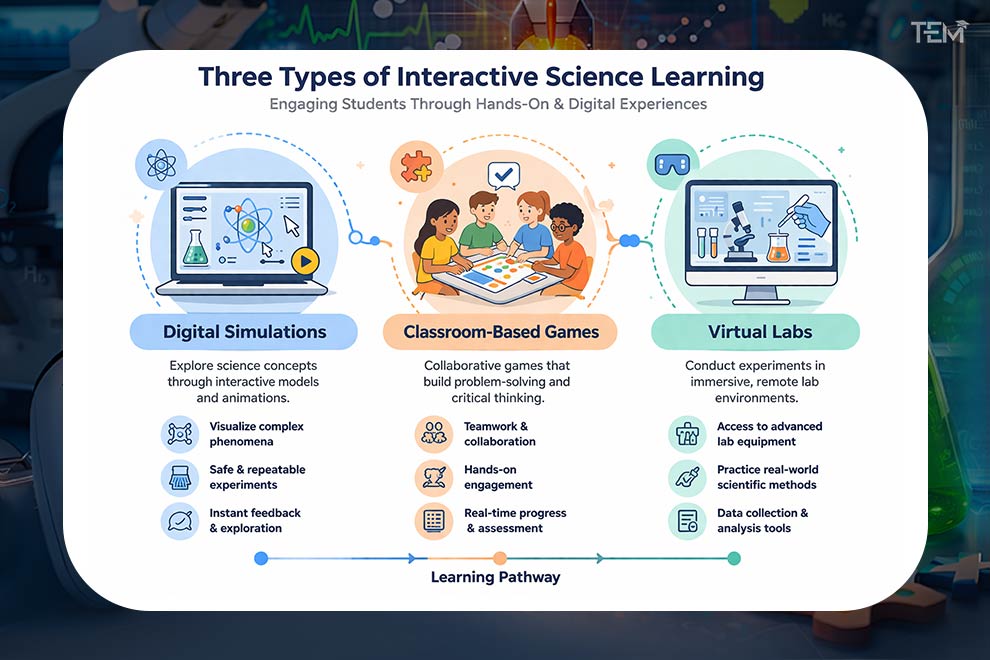
At their core, science games turn abstract ideas into something learners can actively engage with. They typically fall into three categories:
Digital Science Games
These include online platforms and simulations where students can experiment with scientific concepts in a virtual environment. Learners can explore ecosystems, test physics principles, or simulate chemical reactions without physical constraints.
Classroom-Based Games
These are teacher-led activities designed to reinforce concepts through collaboration and competition. They may include quizzes, role-playing scenarios, or group challenges that make revision more engaging.
Simulation and Virtual Lab Games
These games replicate real-world scientific processes. Students can conduct experiments, observe outcomes, and adjust variables, something that may not always be possible in a physical classroom.
What sets this approach apart is its ability to combine learning with experience. Instead of simply reading about a concept, students interact with it, test it, and understand it in context.
Why Science and Games Work in Learning
The effectiveness of game-based learning is not accidental. It is rooted in well-established learning principles and supported by a growing body of peer-reviewed research.
Research Snapshot:
A 2022 meta-analysis in the International Journal of STEM Education analysed 33 studies and found that digital games produced a moderate-to-large positive effect on student learning achievement in STEM subjects compared to traditional instruction (Wang et al., 2022).
A 2023 meta-analysis of 86 studies confirmed a similarly strong effect, finding that game-based STEM learning consistently outperformed conventional teaching across science, mathematics, technology, and engineering (International Journal of STEM Education, 2023).
In his book Video Games and Learning: Teaching and Participatory Culture in the Digital Age (2011), educational technologist Kurt Squire argues that games create participatory learning environments where students take on the role of active problem-solvers rather than passive recipients of content, a shift he considers fundamental to effective science education. — Squire, K. (2011). Teachers College Press.
Learning Through Curiosity and Exploration
Science, by nature, is built on inquiry. Educational gameplay naturally encourages this mindset by allowing learners to ask questions, test ideas, and discover outcomes on their own. Instead of being told how something works, students figure it out through guided exploration, mirroring how real scientific discovery happens.
The Role of Feedback and Trial-and-Error
One of the most powerful aspects of interactive learning tools is immediate feedback. Every action produces a result, helping learners understand what works and what does not. This creates a safe environment for trial and error. Students are more willing to take risks, make mistakes, and try again without the fear often associated with formal assessments. Over time, this builds resilience and deeper conceptual clarity.
Engagement and Long-Term Retention
Traditional learning often relies on passive methods like reading or listening. Research from the University of Colorado Denver found that game-based instruction improves retention rates by up to 90% compared to passive lecture-based instruction. When learners are actively involved, they pay closer attention, process information more deeply, and retain concepts for longer periods.
Types of Interactive Science Games Used in Education
These tools are not limited to one format. They exist across digital and physical environments, each offering unique ways to make learning more interactive and meaningful.
Interactive Digital Games
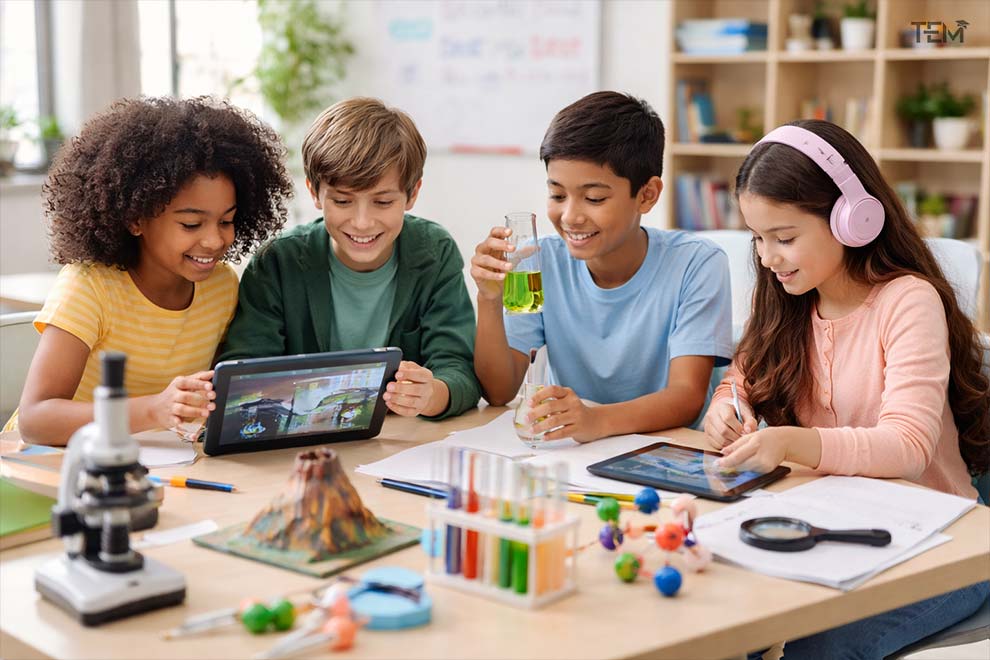
Digital science games are among the most widely used tools in modern classrooms. These include simulations, quizzes, and scenario-based platforms that allow students to explore concepts in a controlled virtual setting. A student can adjust variables in a physics simulation, observe ecosystem changes over time, or experiment with chemical reactions safely. What makes these games effective is their ability to simplify complex ideas through visualization and interaction.
Classroom Science Games
Not all game-based learning requires technology. Many educators use simple, structured activities to reinforce concepts. These may include:
- Group-based challenges and science trivia competitions
- Concept-matching card games for vocabulary and definitions
- Role-playing activities (e.g., students simulate atoms bonding)
- Quiz relays and whiteboard challenge rounds
Such activities encourage collaboration and discussion, making revision sessions more engaging, and these structured classroom game formats have been shown to help students recall concepts more effectively across every grade level.
Real-World and DIY Science Games
Some of the most impactful learning experiences come from hands-on activities. When experiments are designed as games, they become more memorable.
Examples include building simple machines as timed challenges, conducting competitive measurement experiments, and solving real-world science problems in teams. These approaches connect theory with practice, helping students understand how science applies beyond the classroom.
How Educators Integrate Game-Based Learning in Classrooms
The success of this approach depends on how it is woven into teaching. When used thoughtfully, they enhance rather than replace traditional instruction. Understanding why educators are embracing game-based learning helps clarify exactly what makes these tools worth integrating.
Research published by the Joan Ganz Cooney Center consistently finds that teachers who integrate simulation-based tools report increased student questioning and a deeper engagement with cause-and-effect relationships, outcomes that traditional materials alone rarely produce. If you use these tools in your classroom, we would love to feature your experience. — Takeuchi, L. & Vaala, S. (2022). Level Up Learning. Joan Ganz Cooney Center.
Integrating Games into Lesson Plans
Educators often use games at different stages of a lesson:
- At the beginning, to introduce a concept and activate prior knowledge
- During the lesson, to reinforce and test understanding in real time
- At the end, to review, assess, and consolidate learning
This structured approach ensures that gameplay remains aligned with learning objectives rather than becoming distractions.
Balancing Curriculum and Engagement
One common concern is whether games take time away from syllabus completion. In practice, well-designed educational tools often make learning more efficient. By improving understanding and retention, they reduce the need for repetitive revision. This allows educators to cover concepts more effectively within a limited time.
Assessment Through Gameplay
Games also provide new ways to evaluate learning. Instead of relying only on written tests, teachers can observe how students approach problems, the decisions they make, and their ability to apply concepts in different scenarios. This offers a more complete picture of understanding beyond memorization.
Science and Games by Learning Level
Different age groups require different approaches. The effectiveness of a science game depends on how well it matches the learner’s developmental stage.
Elementary Level
At this stage, learning is driven by curiosity and visual engagement. Effective approaches include simple interactive games, visual simulations, and basic hands-on activities. The focus is on building genuine interest and introducing foundational concepts in an accessible, low-pressure way.
Middle School Level
As students progress, they are ready for more structured, logic-based challenges. Science and games at this level often involve multi-step problem-solving, require critical thinking across subjects, and connect multiple scientific concepts. This helps students move from surface-level understanding to deeper analysis.
High School and Beyond
At higher levels, simulation-heavy platforms and virtual labs become especially valuable. Students can engage with advanced chemistry, physics, and biology concepts in ways that go beyond what standard lab equipment allows.
This connects to how STEAM education is broadening science learning at the secondary level, emphasising inquiry and practical application over rote instruction, which is particularly valuable in under-resourced schools.
Popular Platforms for Science and Games in the Classroom
A growing number of platforms are making the intersection of science and games more accessible. While each tool differs in approach, the most effective ones share a common goal: turning complex ideas into engaging, curriculum-aligned experiences.
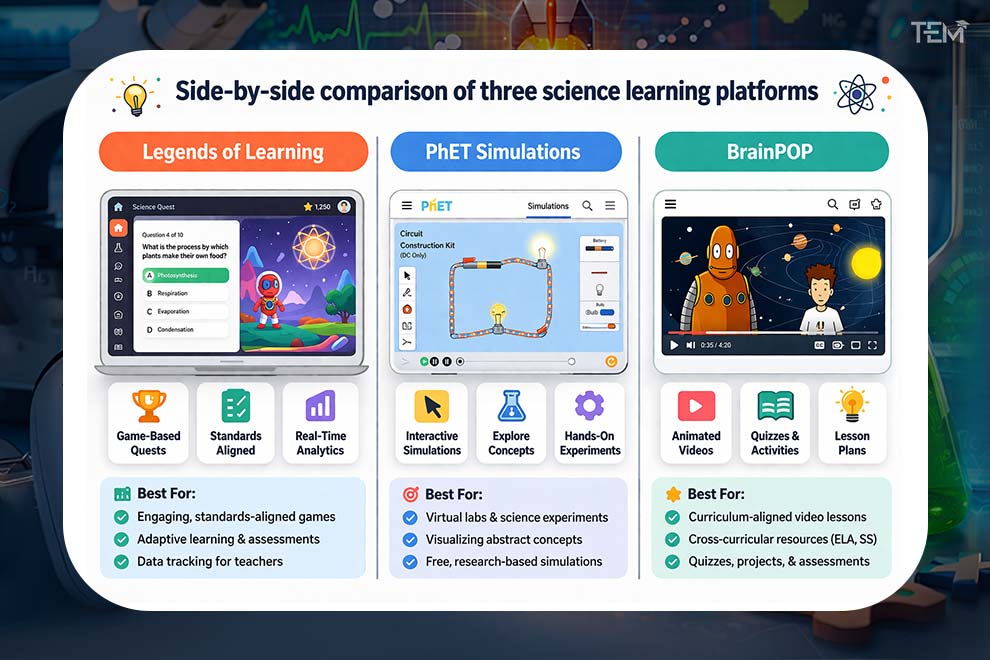
- Legends of Learning (legendsoflearning.com): Curriculum-aligned games covering a wide range of science topics. Particularly well-suited for middle school and aligned with NGSS.
- PBS Kids Games (pbskids.org): Visually engaging science games designed for younger learners. Strong alignment with early science standards.
- BrainPOP (brainpop.com): Combines animations, quizzes, and games to explain scientific concepts in a structured way. Widely used in K–8 classrooms.
- PhET Interactive Simulations (phet.colorado.edu): Free, research-based simulations from the University of Colorado Boulder, covering physics, chemistry, biology, and earth science. Runs on standard school hardware.
What Makes a Good Science Game?
Educators consistently look for: clear alignment with learning objectives, opportunities for critical thinking, immediate and meaningful feedback, and ease of use in a classroom setting. The best tools support both engagement and understanding without overwhelming the learner or the teacher.
Benefits of Game-Based Learning in Education
The advantages of this approach go well beyond keeping students engaged. These tools create measurable improvements in how learners absorb, retain, and apply knowledge across subjects.
Improves Problem-Solving Skills
Games challenge students to think through scenarios, test solutions, and adapt their approach based on outcomes. Unlike reading about a concept, playing through it requires active decision-making, the same mental skill science demands in the real world.
Encourages Critical Thinking
Instead of memorizing answers, learners analyze situations, identify patterns, and make informed decisions. This is especially valuable in science, where the ability to reason from evidence is more important than recalling definitions.
Builds Confidence Through Experimentation
A game-based environment allows students to try, fail, and try again without fear of judgment. This builds confidence over time and reduces the anxiety many students feel around science assessments.
Makes Learning More Accessible
Science and games can simplify complex topics through visuals and interaction, making difficult concepts easier to understand for diverse learners, including those with different learning styles, language backgrounds, or limited access to physical lab resources.
Evidence:
A national survey by the Joan Ganz Cooney Center found that 74% of K–8 teachers now use digital games for instruction, with 55% doing so at least weekly, a sign of how mainstream game-based learning has become in classrooms (Takeuchi & Vaala, 2014).
A peer-reviewed meta-analysis in Studies in Science Education examining 39 game-based interventions found moderate positive effects on student cognition, motivation, and behaviour across primary and early secondary education.
The Future of Science and Games in Learning
The role of game-based tools in education is only expected to grow. As technology evolves, so do the possibilities for how science can be taught.
Rise of Virtual Labs
Students can now perform experiments digitally, removing limitations related to cost, safety, and resources. Platforms like Labster offer fully immersive virtual lab experiences already used by universities worldwide. This trend is accelerating rapidly in schools with limited lab infrastructure.
Personalized Learning Through AI
Modern educational platforms are beginning to adapt to individual learning speeds, offering customized challenges and feedback. AI-driven tools can identify exactly where a student is struggling within a game and adjust difficulty accordingly, part of a wider shift in how technology is changing the way students study and teachers teach.
Immersive Technologies in Science Education
Advancements in augmented reality (AR) and virtual reality (VR) are creating environments where learners can explore scientific concepts in entirely new ways. In 2024, a UK pilot program used VR-based science games across 40 schools, with 86% of participating teachers reporting improved student engagement compared to standard lab sessions.
The future is not about replacing traditional education, but about enhancing it with tools that reflect how learners engage with the world today.
Where Curiosity Meets Capability
Science and games are no longer a novelty in education; they are a proven pathway to deeper, more durable learning. When students engage with concepts through action, they begin to see science not just as a subject, but as an experience worth exploring.
For educators, this shift offers a meaningful opportunity: to create learning environments that are both effective and engaging. The goal is not to move away from traditional teaching, but to strengthen it with methods that align with how students think, explore, and grow.
As classrooms continue to evolve, the intersection of science and games will play an important role in shaping confident, curious learners ready to solve real-world problems.
If this resonated with you, share it with educators rethinking the future of learning.
FAQs
1. Can science and games be used for exam preparation?
Yes, science games can effectively support exam preparation by reinforcing concepts through interactive practice. Studies show students using game-based review tools score higher than those using traditional methods, especially when games mirror exam formats.
2. Are educational games effective in large classrooms?
Yes, educational games can be highly effective in large classrooms when used in group or team-based formats. Multiplayer simulations and collaborative challenges help engage multiple students simultaneously while encouraging peer learning.
3. Do interactive science games require advanced technology?
No, interactive science games do not always require advanced technology. Many effective activities use simple materials or basic digital tools that run on standard school devices, making them accessible even in low-resource environments.
4. How often should science and games be used in teaching?
Science games are most effective when used 2–3 times per week as part of structured lessons. Strategic use during concept introduction, reinforcement, or revision yields better results than daily use.