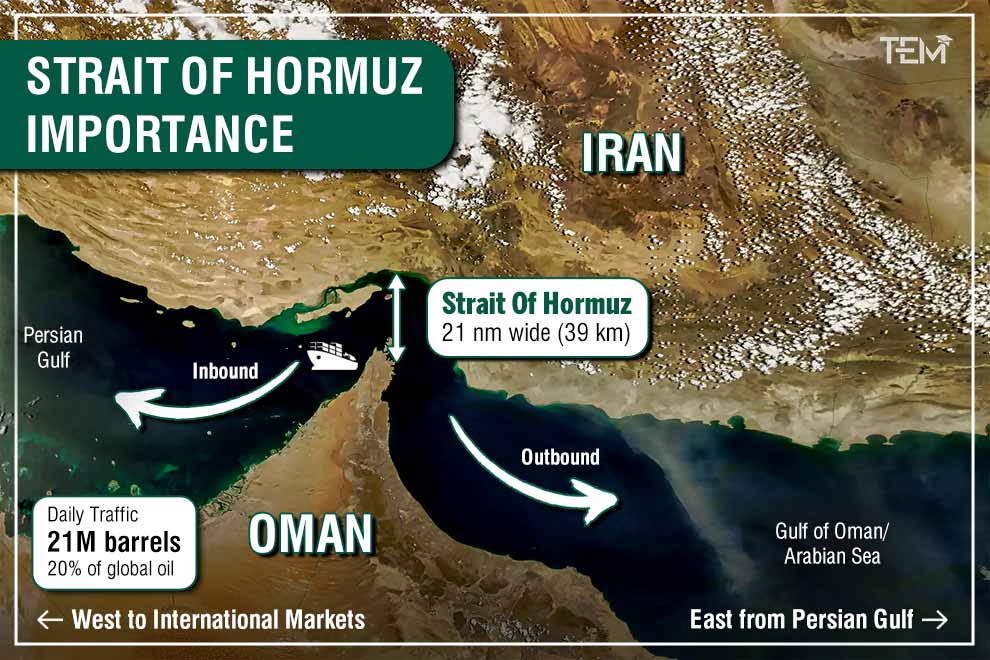
Located between Iran and Oman, the strait connects the Persian Gulf to the Gulf of Oman. Through this passage, oil and natural gas from the Middle East reach markets across Asia, Europe, and beyond.
According to the U.S. Energy Information Administration, around one-fifth of the world’s petroleum consumption passes through this single waterway each day.
This explains why the Strait of Hormuz’s importance is frequently discussed in global economic and political conversations. A disruption here can influence oil prices, energy security, and international relations within hours.
To understand why this narrow channel holds such global influence, it is essential to explore its geography, economic role, and strategic significance in the modern energy landscape.
Strait of Hormuz: Importance in Global Geography
1. Where the Strait of Hormuz Is Located
The Strait of Hormuz sits at one of the most strategically important maritime crossroads in the world. It forms the only sea passage connecting the oil-rich Persian Gulf with the open waters of the Arabian Sea.
This location gives it enormous geopolitical value. Oil and gas produced in several Gulf nations must pass through this corridor before reaching international markets.
2. Countries That Border the Strait
Two countries directly border the Strait of Hormuz:
- Iran lies to the North.
- Oman lies to the South.
The southern coastline includes Oman’s Musandam Peninsula, a rugged and mountainous region that extends into the strait. Because of this geography, the waterway narrows significantly at certain points.
3. Physical Dimensions and Shipping Lanes
Despite its global importance, the strait is surprisingly narrow.
At its tightest point, the passage is only about 21 nautical miles (39 kilometers) wide. Within this space, ships must follow designated traffic lanes to avoid collisions and ensure safe navigation. These lanes are extremely limited, only about two miles wide in each direction, separated by a buffer zone.
Every day, massive oil tankers carrying millions of barrels of crude pass through these narrow channels. This physical constraint is one of the reasons why its importance extends far beyond regional geography. Even a small disruption in such a narrow corridor can quickly affect global shipping and energy supply.
Why the Strait of Hormuz Is Important to Global Energy
The Strait of Hormuz is widely regarded as the most important oil transit route in the world. Its importance comes from the sheer volume of energy resources that pass through this narrow corridor every day.
Countries in the Persian Gulf produce a large share of the world’s crude oil and natural gas. To reach global markets, most of these exports must travel through this corridor before entering the Arabian Sea and the wider international shipping network.
Because there are very few alternative routes available, its importance lies in its role as a critical gateway for global energy supply.
1. The World’s Most Critical Oil Transit Route
Energy analysts often describe the Strait as the world’s most important oil chokepoint. According to the U.S. Energy Information Administration, an average of around 20 to 21 million barrels of oil per day moves through this waterway.
This represents roughly one-fifth of global petroleum consumption and about a quarter of all seaborne oil trade. In practical terms, that means a significant portion of the fuel used by industries, transportation systems, and households worldwide depends on this single maritime passage.
If tanker traffic through the strait slows down or stops, global oil markets react quickly. Prices can rise sharply as traders anticipate supply shortages.
2. LNG Shipments and Global Energy Supply
The importance of the strait is not limited to crude oil. It is also a crucial route for liquefied natural gas (LNG), an energy source widely used for electricity generation and industrial production.
Large volumes of LNG exported from Qatar pass through this waterway on their way to international buyers. These shipments supply energy to power plants, factories, and cities around the world.
The International Energy Agency confirms that around 20% of global LNG trade and energy security depends on this passage. This means that disruptions in the strait could affect not only oil prices but also natural gas markets.
3. Major Oil Exporters That Depend on the Route
Several major energy-producing countries rely on this corridor to transport their exports.
Key exporters include:
- Saudi Arabia
- Iraq
- Kuwait
- United Arab Emirates
For these countries, the Strait acts as the main maritime gateway to global markets. Oil tankers departing from Gulf ports must pass through this corridor before reaching customers in Asia, Europe, and other regions.
Because so many energy exporters depend on the same route, the waterways’ importance becomes clear: it is not just a regional shipping lane but a vital artery of the global energy system.
Analyzing the Strait as a Pivotal Global Oil Chokepoint
A chokepoint is a narrow route that large volumes of international trade must pass through. When such routes become congested or disrupted, the effects can spread quickly across global supply chains. Because so much of the world’s oil and natural gas flows through this one corridor, its importance extends far beyond the Middle East.
1. What Is an Energy Chokepoint?
In global trade, an energy chokepoint refers to a narrow passage that carries a large share of the world’s energy shipments. These routes are vital because they allow oil tankers and gas carriers to move resources between producers and consumers.
If traffic through such a passage is interrupted, ships may be forced to take longer routes or wait for safe transit. This delay can reduce supply in global markets and increase energy prices.
2. Why This Route Is Strategically Sensitive
The strategic sensitivity of the strait comes from two factors: its narrow geography and its political environment.
At certain points, the shipping channel is extremely limited, which makes tanker traffic vulnerable to disruptions. Even small incidents such as shipping accidents or military tensions can slow down the flow of vessels.
The surrounding region has also experienced periods of geopolitical tension involving countries such as Iran and its neighboring states. Because the Strait sits at the center of this strategic environment, governments around the world closely monitor developments in the area.
For global markets, this means that its importance is not only economic but also political.
3. Other Important Global Shipping Chokepoints
Although the Strait of Hormuz is considered the most significant oil transit route, several other maritime chokepoints also play important roles in global trade.
Some of the most notable include:
- The Suez Canal, which connects the Mediterranean Sea with the Red Sea, shortens shipping routes between Europe and Asia.
- The Strait of Malacca is one of the busiest shipping corridors in the world, linking the Indian Ocean to the Pacific Ocean.
- Bab el-Mandeb, which connects the Red Sea to the Gulf of Aden, plays a major role in oil shipments traveling toward Europe.
Each of these passages supports global trade, but none carries as much energy traffic as this waterway. This is why energy analysts consistently highlight its central role in maintaining global supply stability.
Economic Impact of the Strait of Hormuz
The Strait of Hormuz is not just a geographic passage; it is a key driver of the global economy. Because such a large portion of the world’s oil and natural gas passes through this route, any change in shipping activity can influence international markets.
Energy traders, governments, and multinational companies closely monitor the region because its importance directly affects energy prices, trade stability, and economic planning.
1. Oil Prices and Global Inflation
Oil remains one of the most important resources in the modern economy. It fuels transportation systems, powers industries, and supports global supply chains.
When tensions rise around the Strait of Hormuz, markets often react immediately. Traders anticipate potential supply disruptions, which can cause oil prices to increase. Even the possibility of shipping delays can influence market expectations.
Higher oil prices often lead to increased transportation and manufacturing costs. These higher costs are then passed on to consumers in the form of rising fuel prices, higher product costs, and broader inflation.
Because of this connection, its importance extends far beyond the energy sector. It can influence the overall cost of living in many parts of the world.
2. Energy Security for Importing Nations
Many countries rely heavily on energy imports from the Middle East. For these nations, this waterway represents a critical supply route.
Large economies in Asia, including China, India, Japan, and South Korea, import substantial amounts of oil and liquefied natural gas from Gulf producers.
Most of these shipments must pass through the Strait before reaching international markets. As a result, the stability of this maritime route plays a key role in maintaining energy security for these economies.
For policymakers in energy-importing countries, understanding the importance of this route is essential when planning national energy strategies and supply diversification.
3. Impact on Global Trade and Supply Chains
Energy is the foundation of modern trade networks. Oil fuels cargo ships, trucks, airplanes, and manufacturing systems that move goods across continents.
If the flow of energy through the Strait slows down, the impact can spread across multiple industries. Shipping costs may rise, logistics schedules can be disrupted, and global supply chains may face delays.
Because global trade depends on stable energy supplies, the strait plays a quiet but powerful role in maintaining economic stability. This is why governments and international organizations closely watch developments in this narrow waterway.
In many ways, its importance reflects a broader reality of globalization: small geographic locations can hold enormous influence over the global economy.
What Happens If the Strait of Hormuz Is Closed?
The Strait of Hormuz carries such a large share of the world’s energy supply that any disruption immediately attracts global attention. Because the waterway is narrow and heavily used by oil tankers, even short-term blockages could create significant economic consequences.
For decades, energy analysts and policymakers have studied the possible outcomes if the strait were temporarily closed or if shipping traffic were severely restricted. These scenarios highlight the real extent of its importance in maintaining global energy stability.
1. Global Energy Supply Risks
If tanker traffic through the Strait were disrupted, the most immediate impact would be a reduction in global oil supply reaching international markets.
Countries that export oil from the Persian Gulf rely on this route to deliver crude oil to customers worldwide. When shipments slow down, global supply becomes tighter, which can lead to rapid increases in oil prices.
Energy experts at the U.S. Energy Information Administration note that the strait handles one of the largest volumes of oil transit in the world. Because of this scale, replacing the route quickly would be extremely difficult.
Even short disruptions could affect markets, as oil traders respond to uncertainty and potential shortages.
2. Impact on Shipping and Oil Markets
Global energy markets are highly sensitive to supply disruptions. If vessels are unable to pass safely through the strait, shipping companies may delay or reroute tankers, increasing transportation costs and delivery times.
These changes can have several ripple effects:
- Higher fuel prices in international markets
- Increased insurance costs for shipping companies
- Reduced supply reaching major importing regions
Because energy markets operate on global expectations, even the threat of disruption can influence prices. This demonstrates how its importance extends beyond physical shipments to include market psychology and investor confidence.
Are There Alternatives to the Strait of Hormuz?
Given its strategic importance, several countries have invested in infrastructure designed to reduce reliance on the strait. These projects aim to create alternative routes that allow oil to bypass the narrow waterway.
However, most experts agree that these alternatives cannot fully replace the massive volume of energy that normally passes through this waterway.
1. Saudi Arabia’s East–West Pipeline
One of the most important alternatives is the East–West pipeline in Saudi Arabia. This pipeline allows crude oil to be transported from the Persian Gulf to ports on the Red Sea.
From there, tankers can ship oil to global markets without passing through the Strait. While this route provides flexibility during emergencies, its capacity is limited compared with the total amount of oil normally shipped through the strait.
2. UAE’s Fujairah Oil Pipeline
Another alternative route is the pipeline built by the United Arab Emirates, which transports crude oil from inland fields to the port of Fujairah on the Gulf of Oman.
This infrastructure allows some oil exports to bypass the strait entirely. However, the pipeline can handle only a portion of the country’s total production, meaning this corridor remains essential for most shipments.
3. Why Alternatives Cannot Fully Replace the Strait
Although pipelines and other routes offer some flexibility, their combined capacity is far smaller than the volume of oil transported through this waterway every day.
This means the world still depends heavily on the safe operation of this narrow maritime corridor.
A Small Waterway With Global Influence
The Strait of Hormuz may appear to be a narrow channel on the map, but its role in the global economy is enormous. Every day, millions of barrels of oil and large volumes of natural gas move through this corridor, powering industries, transportation systems, and homes across continents.
The Strait of Hormuz’s importance lies in the fact that it connects the energy-rich Persian Gulf with global markets. For major exporters such as Saudi Arabia, Iraq, and the United Arab Emirates, the strait serves as a crucial gateway for international trade.
At the same time, energy-importing economies across Asia, Europe, and beyond depend on the uninterrupted flow of shipments passing through this route. Any disruption, whether caused by geopolitical tensions, maritime incidents, or logistical constraints, can quickly ripple across global markets.
Understanding the significance of this narrow waterway offers a powerful lesson in how geography shapes economics and international relations.
If this guide helped you understand global energy trade better, share it with students, researchers, or colleagues who want to explore how one maritime corridor influences the entire world economy.
FAQs
- Which international laws regulate shipping through the Strait of Hormuz?
Shipping through the strait is governed by international maritime rules under the United Nations Convention on the Law of the Sea (UNCLOS), which allows ships to exercise the right of transit passage through strategic waterways.
- Why do military forces patrol the Strait of Hormuz?
Naval forces from several countries patrol the region to ensure safe navigation, protect commercial shipping, and deter threats such as piracy or maritime attacks.
- How do global shipping companies manage risks in the Strait of Hormuz?
Shipping companies often adjust routes, increase insurance coverage, and coordinate with naval escorts during periods of heightened tension in the region.
- Why do analysts consider the Strait of Hormuz critical for future energy security?
Even as renewable energy grows, global demand for oil and natural gas remains significant. Because large reserves are located in the Persian Gulf, this route will likely remain a key energy corridor for years to come.