Why AI-Powered Mock Exams Matter More Than Generic AI Study Tools
AI study tools are rapidly transforming how students prepare for exams. From instant topic explanations to personalised revision suggestions, these tools promise faster and more efficient learning. In fact, a report in The Guardian shows that nearly 88% of university students are using AI for assessments, highlighting the expectation for intelligent exam support.
Despite this widespread adoption, there is an important distinction between learning content and practising assessment. Many AI study platforms excel at summarising information or explaining concepts. However, they often fall short when it comes to measuring students’ readiness to perform under real exam conditions.
This gap exists because most AI tools are designed as content assistants, not assessment systems. They explain material but do not simulate real exams, test applied understanding, or track progress over time.
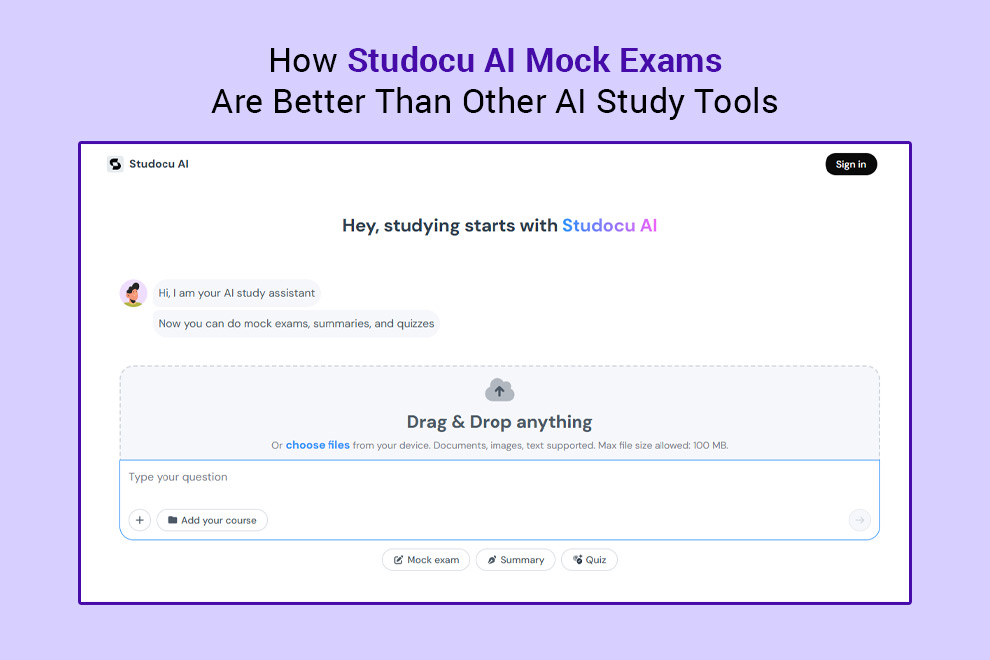
Studocu AI’s Mock Exam Tool fills that gap by providing mock assessments that mirror actual test environments. Rather than simply understanding material, learners can apply knowledge, test problem-solving skills, and identify areas that still need practice.
Unlike generic AI tools trained on broad datasets, Studocu AI builds mock exams directly from real academic material, either uploaded by the student or selected from Studocu’s verified library, ensuring relevance, accuracy, and zero hallucination risk.
In this context, mock exams powered by adaptive AI offer significant advantages over generic study tools, and those advantages are increasingly relevant in today’s academic landscape. Let’s explore how Studocu’s Mock Exam Tool is better than other AI study tools.
What Most AI Study Tools Miss?
While AI-powered study tools are increasingly popular, not all of them are designed with exam readiness in mind. Most tools fall short due to generic practice features that do not add much value to a learner’s knowledge.
This can be summed up as:
| Common Limitation | Typical AI Study Tools | Impact on Exam Preparation |
| Generic Training Data | Rely on broad, non-specific datasets not tied to a learner’s course or exam | Practice feels disconnected from the actual syllabus and exam expectations |
| Weak Exam Alignment | Questions rarely mirror real exam structure or marking criteria | Students struggle to transfer knowledge to real assessments |
| Static Practice Formats | Same difficulty and question style regardless of learner progress | Learners plateau and fail to improve weak areas |
| Surface-Level Feedback | Basic explanations without diagnostic insights | Students know what was wrong, but not how to improve |
| Limited Progress Tracking | One-off interactions with no performance history | No structured learning path or measurable improvement over time |
Another critical issue is hallucination risk. When tools generate questions from generic data instead of verified academic content, inaccuracies can creep in, undermining trust and exam readiness.
This gap highlights why many learners feel underprepared even after extensive practice. Studocu AI addresses these shortcomings by combining real academic content, adaptive assessment design, complete topic coverage, and diagnostic feedback into a single mock exam experience.
How Studocu AI Mock Exam Tool Outperforms Other Tools
Let’s look into key features of the Studocu AI’s Mock Exam Tool, which makes it a more suitable option for students.
1. Content Quality: Real Academic Data vs Generic Training Sets
Assessment systems built on verified academic material deliver far more relevant practice than tools trained on broad and unspecific data. Mock exams derived from actual course content, past exams, and verified notes align closely with what students are tested on in real assessments.
The Mock Exam Tool generates questions only from trusted sources, like your uploaded materials or Studocu’s peer-verified library, eliminating guesswork and hallucinations.
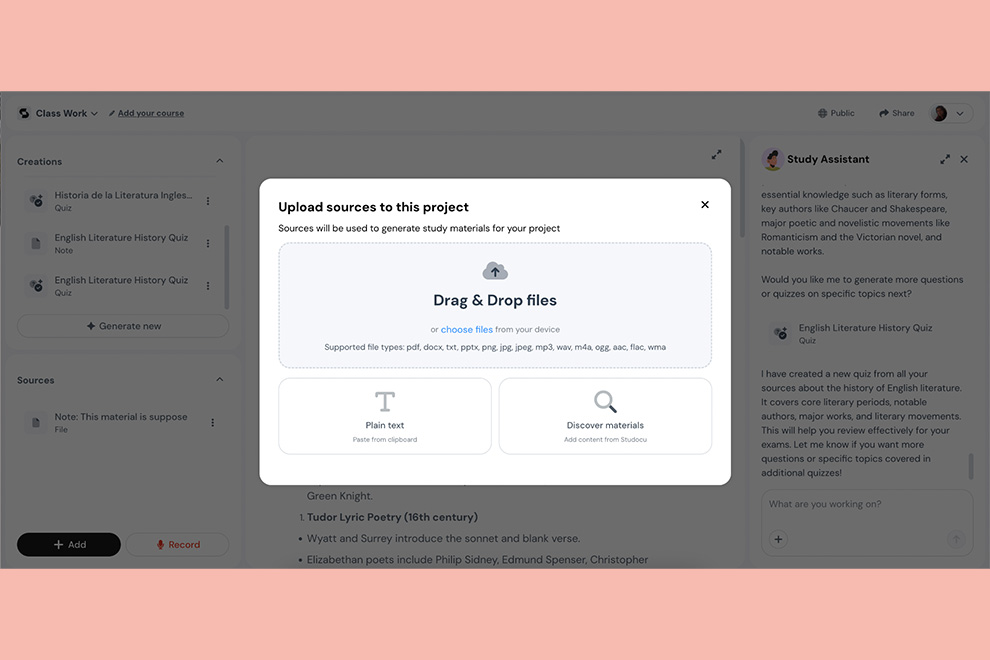
Students can upload course-specific materials into a dedicated project before generating a mock exam. These materials can include PDFs, Word documents, presentations, handwritten notes, lecture recordings, quizzes, and assignments.
If students do not yet have enough material, they can explore the Studocu Library to add high-quality, course-matched documents shared by other students from the same university or subject. This access to millions of peer-reviewed academic resources is a major advantage that most AI tools do not offer.
2. Personalisation that Evolves with the Learner
The AI tool provides personalised mock exams where question difficulty adjusts based on the strengths and weaknesses highlighted by the students. Hence, offering a progression that mirrors actual learning curves.
Research in the Social Science Review Archives shows that AI-powered adaptive learning systems significantly improve academic performance by tailoring content to individual learners’ progress. Other AI tools often apply static difficulty levels or repeat the same types of prompts, limiting their ability to guide improvement.
Unlike static AI tools, this Mock Exam Tool continuously recalibrates difficulty across attempts, creating a realistic progression that mirrors actual learning curves.
3. Assessment Design: Active Exam Practice vs Passive Assistance
Effective mock exams are built around application-based questions that demand critical thinking, time management, and problem-solving. Such a variety of questions mimics the actual exams, helping students build familiarity and confidence.
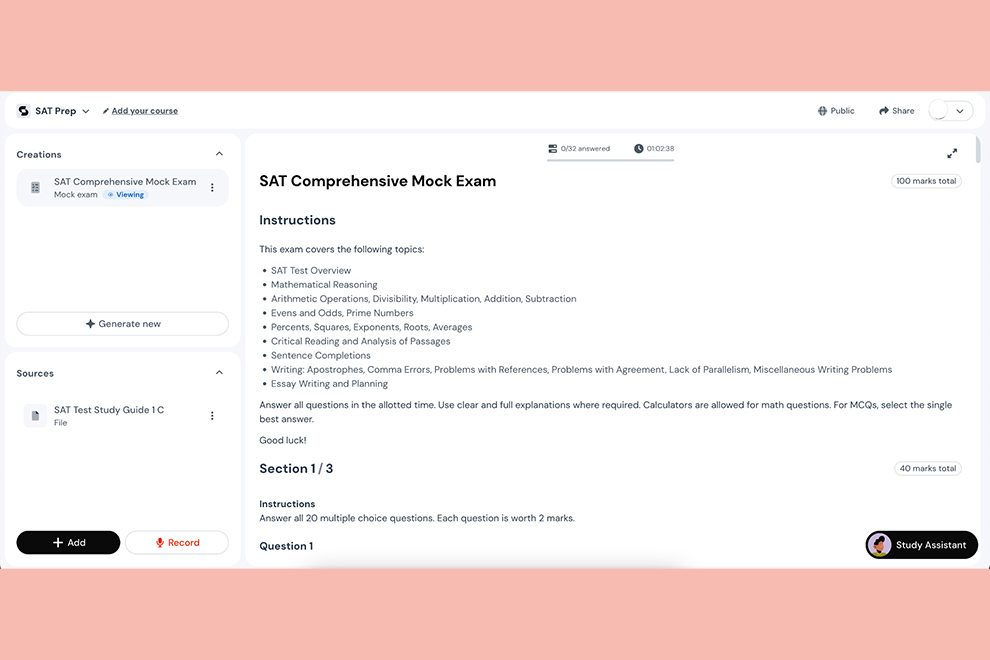
The Mock Exam Tool supports multiple exam formats, including MCQs, true/false, fill-in-the-blank, short answers, and long-form responses, closely mirroring real exam structures.
For instance, when preparing for their SAT exams, students can generate mock tests using this tool. Based on the details of the exam provided in your uploaded documents, the Mock Exam Tool can generate practice tests for you to test your knowledge.
4. Progress Tracking and Diagnostic Insights
Strong assessment platforms enable learners to track performance over time, highlighting improvement trends and persistent gaps. This long-term tracking encourages active revision and helps students monitor growth across multiple attempts.
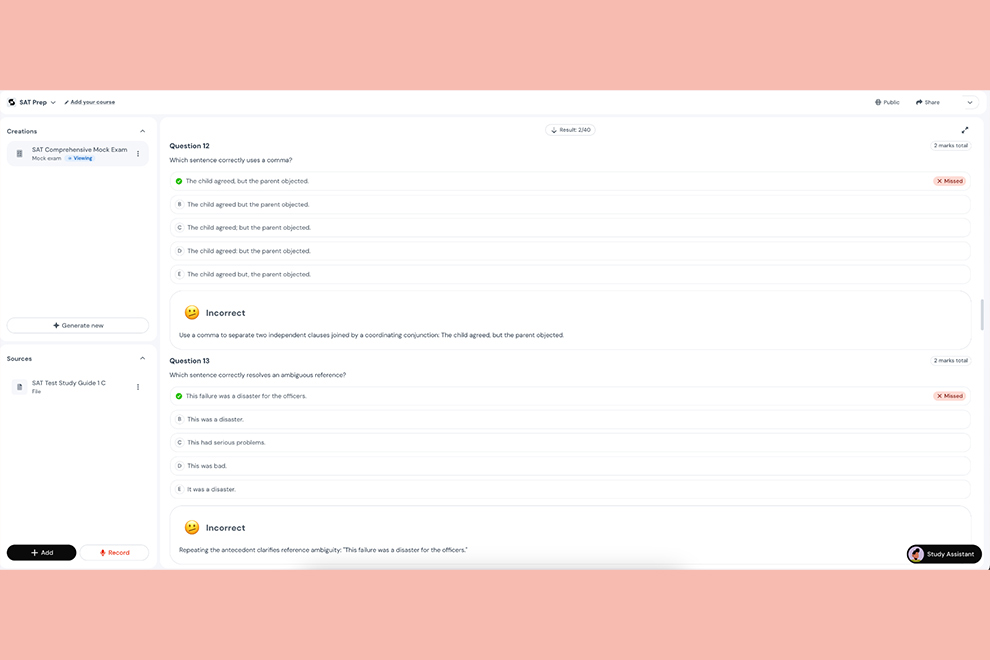
The Mock Exam Tool provides instant scores, per-question mark allocation, and clear explanations after submission. All mock exam attempts are saved within the project, allowing learners to monitor progress across multiple sessions.
This ongoing tracking transforms mock exams into a diagnostic system rather than a one-time test.
Each of these features of the Mock Exam Tool leaves a positive impact on your learning journey.
| Learning Outcome | How Studocu AI Mock Exams Support It | Impact on Exam Preparation |
| Clear Concept Understanding | Step-by-step explanations after each question clarify reasoning and correct misconceptions | Stronger conceptual foundations and fewer repeated mistakes |
| Focused Revision | Weak areas are automatically identified based on performance patterns | Time is spent revising what actually needs improvement |
| Reduced Exam Anxiety | Predictable, exam-like formats build familiarity with structure and timing | Greater confidence and calmer performance in real exams |
| Improved Readiness & Confidence | Continuous practice with adaptive difficulty reinforces progress | Learners feel prepared rather than uncertain on exam day |
An MDPI study reiterates that such integrated and adaptive learning increases student engagement, especially among digitally literate learners. Engagement is a key driver of long-term retention and academic success, far beyond one-time content review.
Conclusion: Mock Exams and the Future of AI in Education
AI tools are evolving beyond simple tutors into powerful assessment partners that support deeper learning. As diagnostic, performance-based tools become more popular, students gain the ability to track progress, measure readiness, and strengthen skills in ways that generic study aids cannot match.
Studocu AI’s Mock Exam Tool integrates adaptive assessments, realistic simulations, and personalised feedback, preparing learners not just to study but also perform better. This suggests that future AI learning systems will continue moving toward practical, exam-focused support that enhances overall outcomes.
Frequently Asked Questions (FAQs)
1. How is Studocu AI Mock Exam Tool different from other AI study tools?
Unlike generic AI tools that focus on explanations or summaries, it creates exam-style mock tests from real course materials and provides adaptive difficulty with diagnostic feedback.
2. Can the tool be customised for my specific course or exam?
Yes. Students can upload their own lecture notes, slides, assignments, and past papers, allowing the mock exams to match their syllabus and assessment format closely.
3. Does the Mock Exam Tool help identify weak areas effectively?
Absolutely. The tool tracks performance across attempts and highlights mistakes, helping learners focus their revision on topics that need the most improvement.
4. Is the tool suitable for high-stakes exams like SATs or university finals?
Yes. Its timed simulations, realistic question structures, and adaptive difficulty make it especially useful for high-stakes academic and standardized exams.
5. Does using AI mock exams improve exam confidence?
Yes. Repeated exposure to exam-like conditions, combined with clear explanations and progress tracking, reduces anxiety and builds confidence before the real test.
Also Read: Why Utility Apps Are the Most Underrated Smartphone Tools