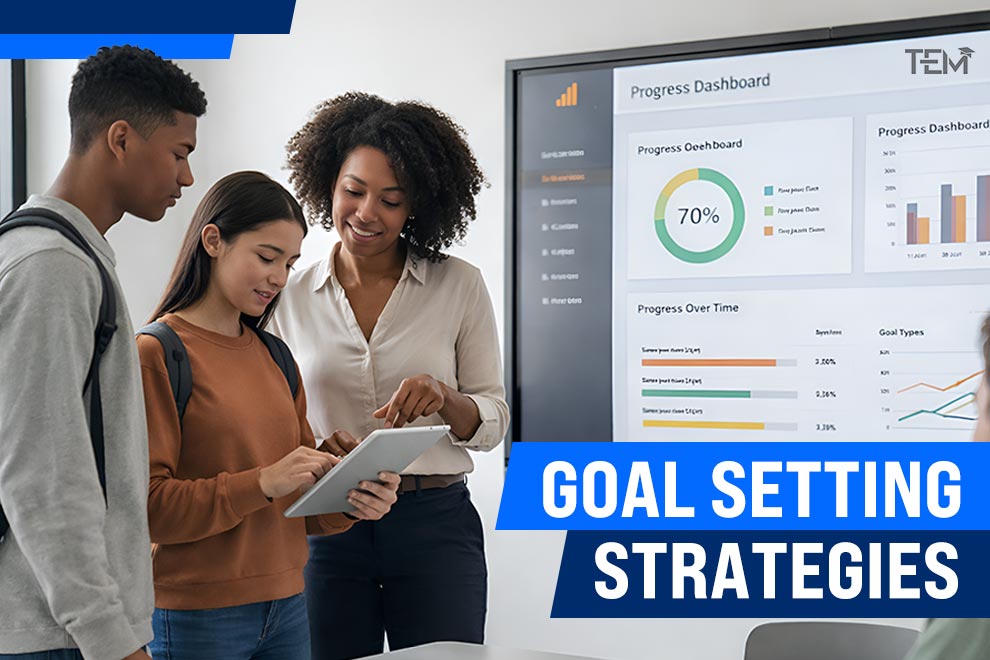
Setting goals is easy. Achieving them consistently is where most people struggle. The difference rarely lies in motivation alone; it lies in strategy.
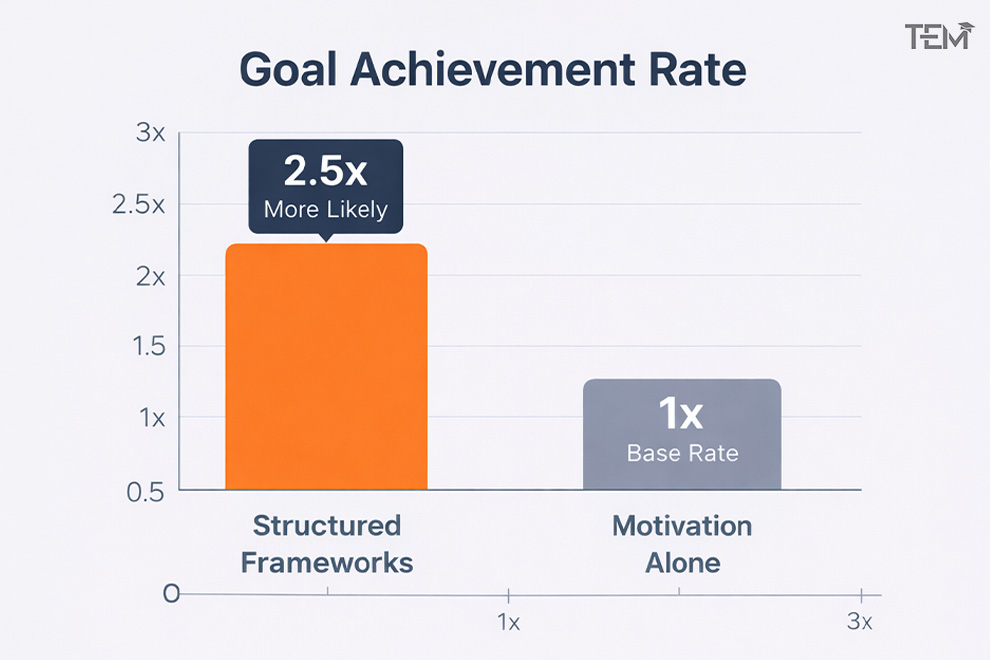
Research published in the American Journal of Lifestyle Medicine (2022) found that individuals who used structured goal-setting frameworks were 2.5 times more likely to achieve their stated objectives than those who relied on motivation alone. Yet most people skip the strategy entirely.
Today, goal-setting has evolved beyond SMART checklists. Educators, professionals, and students now combine structured frameworks, behavioural science, and AI-powered tools to turn intentions into measurable progress.
Understanding which strategy to use and when is the real advantage.
This guide brings together research-backed frameworks, modern planning methods, and practical examples that show how goal setting actually works in real life. Instead of theory alone, you will learn how to choose the right approach, build clear action plans, and create systems that sustain progress.
Because effective goals are not about ambition. They are about clarity, structure, and consistent execution.
What Are Goal Setting Strategies?
Goal-setting strategies are structured methods used to define what you want to achieve and how you will achieve it. They go beyond writing goals; they provide a system for planning, prioritising, tracking, and improving progress over time.
A goal answers “what do I want?”
A strategy answers “how will I get there?”
This distinction is where most people struggle. Many individuals set goals without selecting a strategy, which leads to unclear action and inconsistent results.
Goal-setting strategies typically include:
- Clear definitions of success
- Measurable milestones
- Action steps
- Feedback or review cycles
- Adjustments based on progress
In education, strategies help students move from intention to learning outcomes. In organisations, they align teams and resources. For individuals, they create direction and reduce decision fatigue.
Key Insight: The real value of a strategy is not motivation; it is structure. Motivation fluctuates. Structure persists.
Why Goal Setting Works: The Science in Plain Terms
Goal setting works because it influences attention, effort, and persistence. When people define clear targets, the brain treats them as priorities, making decision-making faster and actions more focused.
Locke and Latham’s Goal Setting Theory (1990, updated 2002) remains one of the most replicated findings in performance psychology. Their research demonstrated that:
- Specific and challenging goals outperform vague or easy goals in 90% of studies reviewed.
- Feedback combined with goal setting produces significantly stronger results than either alone.
- Commitment to a goal is strengthened when individuals understand its rationale and believe it is achievable.
A 2021 study in Frontiers in Psychology found that combining goal specificity with regular self-monitoring increased task completion rates by 40% compared to goal-setting without tracking. The researchers concluded that review cycles, not the goals themselves, were the primary driver of sustained progress.
Types of Goal Setting Strategies
Not all goals are the same. Different situations require different strategies. Understanding these categories helps you choose the right approach before selecting a framework.
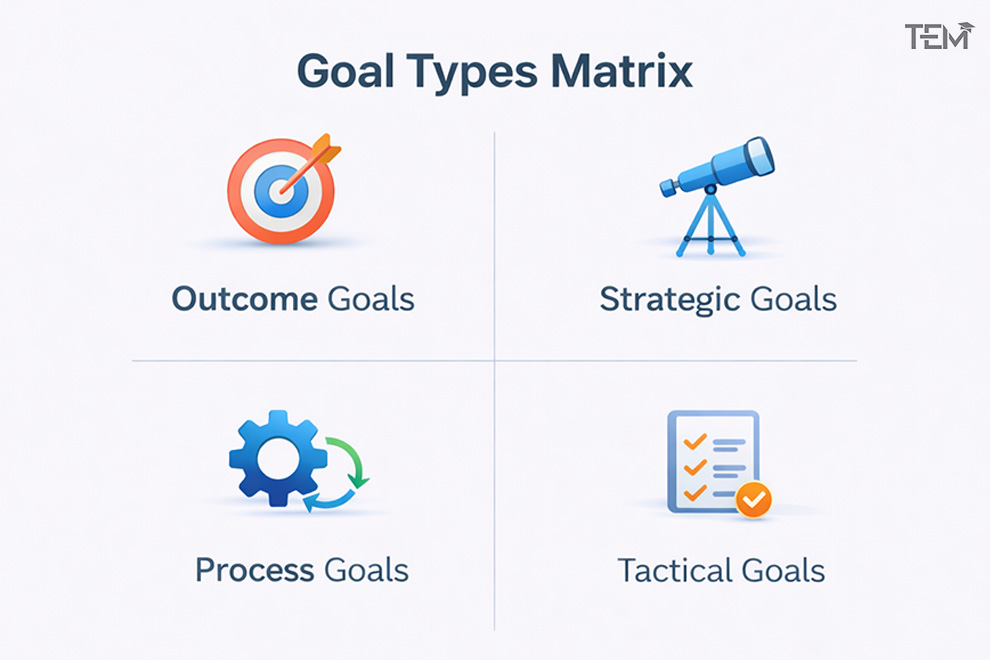
1. Outcome vs Process Goals
Outcome goals focus on results. Examples include passing an exam, achieving revenue targets, or completing a certification.
Process goals focus on actions repeated daily or weekly, studying two hours per day, practising a skill, or conducting weekly reviews.
Outcome goals provide direction. Process goals create progress. Effective strategies combine both.
2. Short-Term vs Long-Term Goals
Short-term goals create momentum. They are immediate, measurable, and easier to adjust.
Long-term goals provide meaning and direction but require intermediate milestones to remain achievable.
Bandura and Simon (1977) found that breaking long-term goals into proximal sub-goals significantly increased self-efficacy and follow-through.
3. Strategic vs Tactical Goals
Strategic goals define the bigger direction, improving student success rates, expanding a program, or developing expertise.
Tactical goals describe specific actions that support that direction, such as designing a new curriculum module, launching a course, or completing training.
Confusing these levels is a common reason goals feel overwhelming.
4. Personal, Academic, and Organisational Goals
Goal-setting strategies vary by context:
- Personal goals focus on habits and self-development, and self-education is one of the most powerful personal goal systems available.
- Academic goals focus on learning outcomes and progress tracking.
- Organisational goals focus on alignment, performance, and measurement.
Recognising the context helps in selecting the right framework.
The Most Effective Goal Setting Frameworks
Frameworks turn intentions into structured execution plans. Each framework below includes a real-world example and a use-case recommendation.
| Framework | Best For | Limitation | Example Use Case |
| SMART | Beginners, academic goals | Rigid for complex goals | The student sets a target to pass the exam by the semester’s end |
| WOOP | Behaviour change, habits | Less suited for team goals | Teacher builds a daily feedback habit |
| OKR | Teams, institutions | Requires buy-in culture | University aligns retention metrics across departments |
| HARD/FAST | Leadership, long-term vision | Less structured for tracking | Principal energises staff around a 3-year school growth plan |
| GOST | Complex, multi-level planning | Time-intensive to build | EdTech company plans product launch across teams |
1. SMART & SMARTER Goals
The SMART framework remains one of the most widely used goal-setting methods because it introduces clarity.
SMART goals are: Specific, Measurable, Achievable, Relevant, and Time-bound.
The extended SMARTER version adds: Evaluated and Reviewed, turning a static goal into an adaptive cycle.
Real Example:
Vague: “Do better in maths.”
SMART: “Increase my maths test average from 62% to 75% by the end of Term 2 by completing three practice papers per week and reviewing errors with my tutor every Friday.”
2. WOOP Method
The WOOP method focuses on realistic thinking rather than optimism alone. It encourages individuals to anticipate obstacles before they appear.
WOOP stands for:
- Wish: what you want to achieve
- Outcome: the best result is achieved
- Obstacle: what might stop you internally
- Plan: what you will do when the obstacle appears
Real Example:
Wish: Complete my dissertation draft on time.
Outcome: Submit a polished draft to my supervisor with confidence.
Obstacle: I avoid writing when I feel the quality is not good enough.
Plan: If I notice myself avoiding writing, I will set a 20-minute timer and write without editing.
3. OKR Framework
Originally developed at Intel by Andy Grove and later scaled by Google. The OKR framework separates direction from measurement.
- Objectives describe what you want to achieve
- Key Results define how progress is measured
Real Example: University Retention Initiative
Objective: Meaningfully improve first-year student retention.
Key Result 1: Increase first-to-second year retention from 81% to 87% by July.
Key Result 2: Achieve 90% + early alert response rate within 48 hours for at-risk students.
Key Result 3: Increase student advising satisfaction from 3.8 to 4.4 out of 5.
4. HARD & FAST Goals
Modern leadership frameworks highlight emotional connection and visibility as critical elements of goal success.
HARD goals emphasise:
- Heartfelt: personally meaningful
- Animated: clearly visualised
- Required: necessary for progress
- Difficult: challenging but possible
FAST goals focus on:
- Frequently discussed
- Ambitious
- Specific
- Transparent
These approaches address a key limitation of traditional goal setting: goals fail when they are forgotten. By increasing visibility and emotional relevance, these frameworks support sustained engagement.
They are particularly useful for leadership, team goals, and long-term development.
5. Goals vs Objectives vs Strategy vs Tactics (GOST Model)
One of the most common reasons goals fail is confusion between planning levels. The GOST model clarifies how different elements connect.
- Goals define the destination
- Objectives specify measurable targets
- Strategies explain the approach
- Tactics describe daily actions
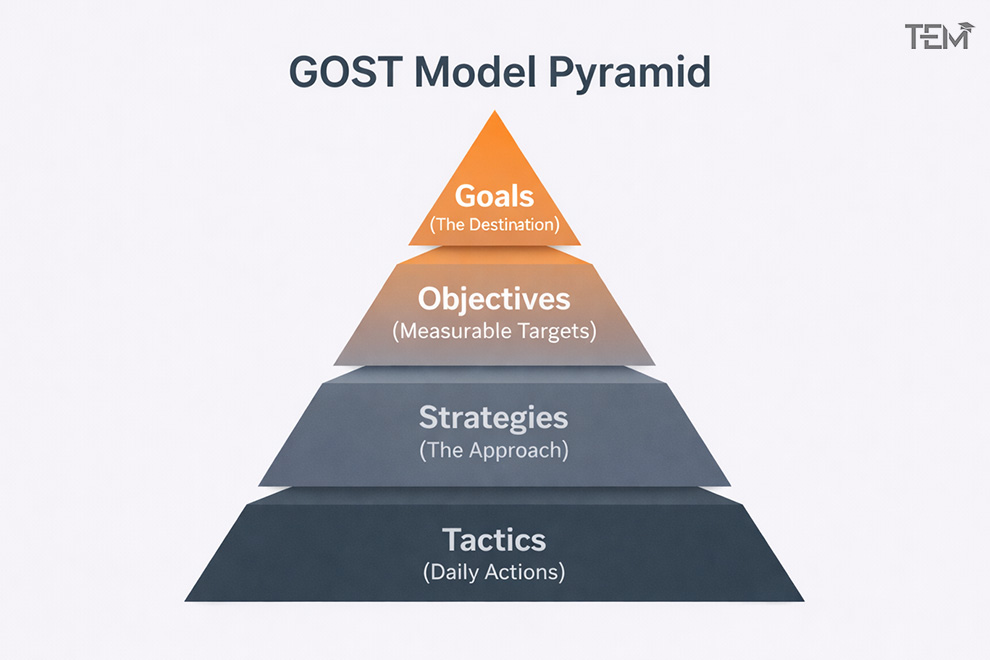
For example:
- A university may set a goal to improve student retention.
- An objective could be increasing retention by a specific percentage.
- The strategy might involve personalised academic support.
- Tactics include weekly mentoring sessions and progress tracking.
This hierarchy prevents overwhelm because it separates thinking from execution. When people skip this structure, goals become vague and difficult to implement.
Understanding GOST turns planning into a system rather than a list.
How to Choose the Right Goal Strategy
There is no single best framework. Use these decision factors to match strategy to situation:
1. Goal Complexity
Simple goals work well with SMART. Complex goals benefit from OKR or GOST.
2. Behaviour Change vs Performance Outcome
Behaviour change goals respond well to WOOP because obstacle planning is essential.
3. Individual vs Team Goals
Individual goals often require habit-based strategies. Team goals require alignment frameworks such as OKR or FAST.
4. Time Horizon
Short-term goals benefit from tactical planning. Long-term goals require layered strategies.
5. Educational Context
Student goals often require process-focused strategies, while institutional goals require measurement frameworks.
Choosing intentionally reduces frustration because the strategy matches the situation.
How to Create a Plan to Achieve Your Goals: 7 Steps
A goal becomes achievable when it is translated into a structured plan.
A simple execution process includes:
- Define the goal clearly
- Select an appropriate framework
- Break the goal into milestones
- Identify required actions
- Anticipate obstacles
- Establish tracking methods
- Schedule regular reviews
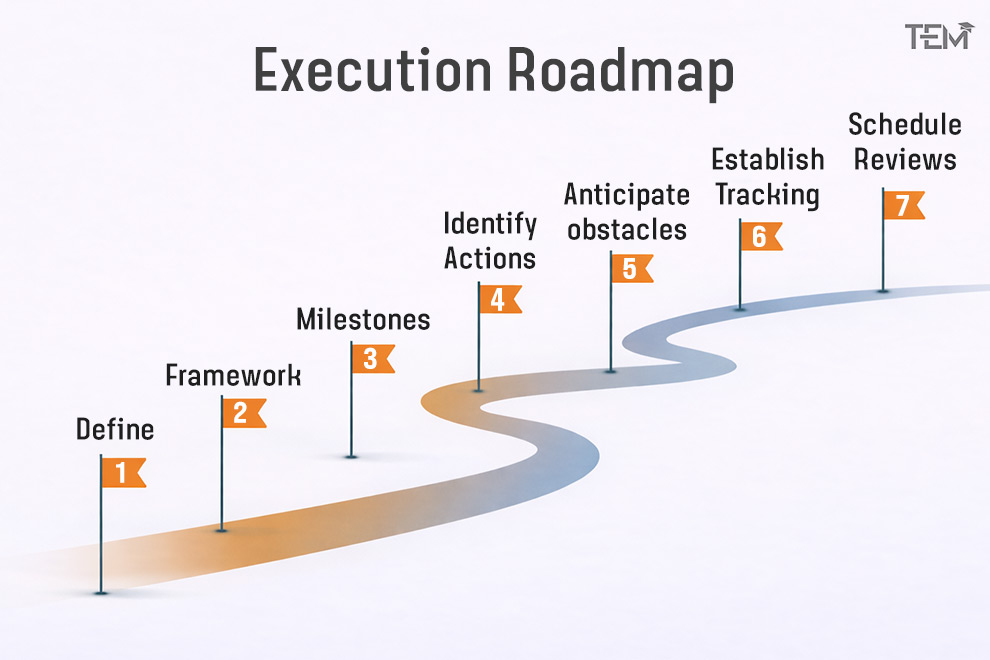
Milestones create visibility. Tracking creates accountability. Reviews create improvement.
Planning does not guarantee success, but it dramatically increases the probability of consistent progress. The focus shifts from motivation to execution, which is where most results are produced.
Real-World Examples of Goal Setting Strategies
Examples help translate theory into action. They show how frameworks operate across different contexts.
1. Student Example
A student wants to improve academic performance.
- Goal: Improve overall grades
- Framework: SMART
- Milestones: Weekly study targets, assignment deadlines
- Tracking: Test scores and revision logs
The clarity of measurable outcomes makes SMART effective for academic performance goals.
2. University Example
A university aims to increase student retention.
- Goal: Improve retention rates
- Framework: OKR
- Objective: Increase first-year retention
- Key Results: Engagement metrics, advising participation, completion rates
This illustrates how institutional goals require alignment across departments rather than individual effort alone.
3. Professional Example
A professional wants to transition careers.
- Goal: Move into a new role
- Framework: WOOP + GOST
- Obstacle planning: Skill gaps, time constraints
- Tactics: Certification, portfolio building, networking
Career transitions involve uncertainty, which makes obstacle-aware frameworks more effective.
Goal Setting Strategies in Education
In education, goal setting influences motivation, retention, and performance.
Effective strategies in educational environments include:
- Process-focused goals instead of outcome-only goals
- Reflection cycles that help students evaluate progress
- Micro-goals that reduce overwhelm
- Visible progress tracking
- Advisor-supported accountability
Institutions increasingly embed goal setting into advising systems, learning analytics, and student success programs. The shift is from static planning to continuous progress monitoring.
This evolution reflects a broader move toward personalised learning and data-informed decision-making.
Common Goal Setting Mistakes and How to Fix Them
| Mistake | Why It Fails | Evidence-Based Fix |
| Goals too vague | No measurement, low commitment | Define exact metrics upfront (e.g., raise grade by 15%) |
| Too many goals | Cognitive overload reduces execution | Limit to 3-5 priority goals per cycle |
| No obstacle planning | Motivation collapses at first friction | Add the WOOP obstacle step to every goal plan |
| Long review cycles | Feedback arrives too late to correct course | Shift to weekly or bi-weekly check-ins |
| Extrinsic-only goals | Motivation is unstable without personal meaning | Layer in intrinsic purpose: why does this matter to you? |
AI and Modern Goal Setting
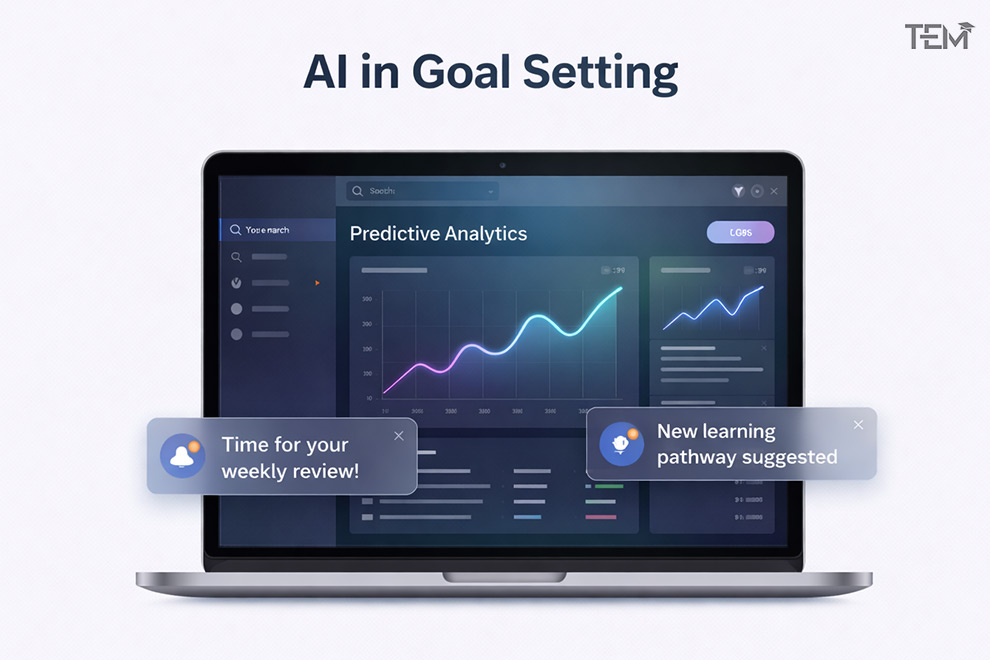
Technology is reshaping how goals are created and monitored, and the benefits of AI in education extend well beyond the classroom.
Emerging trends include:
- AI-driven progress tracking
- Personalised goal recommendations
- Predictive analytics for student success AI in the classroom is now enabling early intervention before performance gaps widen.
- Adaptive learning pathways
- Automated reminders and nudges
AI shifts goal setting from a static exercise to a dynamic system that evolves with behaviour and performance data.
For education leaders, this introduces opportunities for early intervention and more personalised support.
Goal Setting Templates You Can Use
Templates reduce decision fatigue and make execution easier.
Useful templates include:
- Weekly goal planning sheets
- Habit trackers
- OKR dashboards
- Reflection journals
- Milestone roadmaps
Templates work because they standardise thinking. Instead of deciding how to plan each time, individuals follow a repeatable structure.
This consistency supports long-term progress.
The Future of Goal Setting Strategies
Goal setting is moving toward adaptive, data-informed systems.
Future directions include:
- Continuous goals instead of annual goals
- Behaviour-driven measurement
- AI-supported coaching
- Integration with learning platforms
- Greater emphasis on reflection cycles
The biggest shift is conceptual: goals are becoming ongoing processes rather than fixed endpoints.
This reflects how learning, careers, and organisational priorities evolve more rapidly than traditional planning cycles.
Clarity Creates Momentum: Turning Goals Into Progress
Goal-setting strategies matter because they influence execution, not intention. The most effective approaches combine clarity, measurement, reflection, and adaptability.
Whether applied by students, educators, or institutions, successful goal setting is less about motivation and more about structure.
Choosing the right framework, building tracking systems, and reviewing progress consistently transform goals from ideas into outcomes.
In a world defined by rapid change, the ability to set and adjust goals is becoming a core learning skill and one of the most in-demand soft skills for students entering the modern workforce.
If this guide helped you rethink goal setting, share it with someone planning their next milestone.
FAQs
- What are the most effective goal-setting strategies?
The most effective goal-setting strategies combine clear frameworks with consistent tracking. Popular approaches include SMART goals for clarity, OKRs for alignment, WOOP for obstacle planning, and FAST goals for adaptability. The best strategy depends on whether the goal is personal, academic, or organisational.
- Why do goal-setting strategies fail?
Goal-setting strategies often fail due to vague objectives, a lack of measurement, unrealistic timelines, and no accountability system. Ignoring obstacles and relying only on motivation also reduces consistency. Structured review cycles significantly improve success rates.
- How can students use goal-setting effectively?
Students can use goal-setting strategies by breaking large goals into smaller milestones, tracking weekly progress, reflecting regularly, and focusing on process goals such as study habits rather than only grades. Advisor feedback and visible progress tracking improve outcomes.
- How is AI changing goal-setting strategies?
AI is making goal-setting more dynamic through personalised recommendations, automated progress tracking, predictive analytics, and adaptive learning pathways. This allows goals to evolve based on performance data instead of remaining static.