Every student learns differently. Some grasp concepts quickly; others need more time, more examples, or a completely different explanation. Traditional classrooms, by design, cannot always accommodate that. One teacher, thirty students, one pace. That is a structural problem that has existed in education for centuries.
AI in the classroom is now changing that reality in ways that are measurable and immediate. From K-12 schools to universities, AI-powered tools are helping students learn at their own pace, get instant feedback, and stay more engaged. Modern tools such as an AI essay grader can also provide immediate writing assessment, helping students improve their work without waiting for instructor feedback.
This article covers the real benefits of AI in classroom education, actual examples of tools making a difference, and what students and teachers need to know going into 2026.
What is AI in the Classroom?
AI in the classroom refers to the use of intelligent software and tools that analyze student data, personalize learning content, automate grading, and provide real-time feedback. These tools do not replace teachers. Instead, they handle repetitive, time-consuming tasks so teachers can focus on what they do best: building relationships and guiding deeper learning.
The key functions of AI in education include:
- Personalized learning paths that adjust content difficulty based on individual performance.
- Automated grading for objective assessments like multiple-choice or short-answer questions.
- Intelligent tutoring provides 24/7 support for student inquiries.
- Performance tracking that identifies learning gaps before they become major hurdles.
Growth Of AI in the Classroom
The numbers are hard to ignore. Global student AI usage jumped to 92% in 2025, up from 66% just a year before. More than half of teachers (55%) say they have already seen better student outcomes since bringing AI tools into their classrooms. A Harvard University physics study found that students using an AI tutor learned more than twice as much in less time compared to a traditional active-learning class. Macquarie University reported a 10% rise in student exam scores after introducing AI into its learning environment.
Furthermore, the global AI in education market is on track to reach $112 billion by 2034. These are not projections built on hope. They are results already showing up in real classrooms, with real students, right now.
How AI in the Classroom Helps Students Learn Better
1. Personalized Learning Paths
Not every student needs help with the same thing. AI tracks where a student struggles and adjusts the content accordingly. If a student gets algebra questions wrong, the system slows down, provides simpler examples, and revisits the concept before moving forward. If another student already understands it, the system moves them ahead.
This is what adaptive learning platforms like Khan Academy and DreamBox do. They continuously analyze performance and serve content that matches the student’s current level. This kind of adaptive learning in STEM education has shown significant gains, especially in math and science subjects where foundational gaps often go undetected for years.
2. Instant Feedback and Smarter Assessment
In a traditional classroom, a student submits an assignment and waits days or weeks for feedback. By the time they get it, the lesson has moved on. AI closes that gap.
Tools like Grammarly give writing feedback in real time. AI-based quiz platforms such as Quizizz and Formative assess student understanding immediately and flag weak areas for the teacher. This kind of fast-loop learning means students correct mistakes while the concept is still fresh.
This also addresses a key issue in AI in the classroom vs. the traditional classroom. As a 2026 industry analysis pointed out, AI assessment tools provide consistent scoring with no grader fatigue, while traditional grading can vary based on the teacher’s time, mood, or interpretation.
3. Gamification in Education
Gamification in education involves using game design elements like points, levels, badges, and leaderboards to make learning more engaging. AI makes this smarter by adjusting the difficulty of challenges based on performance, so students are always in the right zone: challenged enough to stay interested but not overwhelmed.
Platforms like Duolingo use AI-driven gamification to keep language learners consistent. Quizizz uses live leaderboards to turn review sessions into competitive, energized activities. For K-12 education, this approach has proven especially effective in increasing participation and reducing dropout behavior during remote learning.
4. AI-Powered Tutoring Available Around the Clock
One of the biggest benefits of AI in classroom education is access. A student stuck on a chemistry problem at 11 PM no longer has to wait until the next school day. AI chatbots like Khanmigo (built on ChatGPT technology) and Socratic by Google provide guided, step-by-step explanations at any hour.
In U.S. colleges, 43% of students already use AI tools like ChatGPT for academic support, and 90% of those students rate it as more effective than standard tutoring. This kind of on-demand help is especially valuable for first-generation students who may not have access to private tutors.
5. Smart Note-Taking and Content Summarization
AI note-taking tools like Otter.ai and Notion AI help students convert long lectures into organized, searchable summaries. For students with learning differences, ADHD, or language barriers, this is a practical form of accessibility. Rather than struggling to keep up while listening, students can focus on understanding and then review AI-generated notes after class.
AI in K-12 and Higher Education Learning Environments
1. AI in K-12 Education
In K-12 education, AI closes learning gaps early. Tools like DreamBox and Lexia track reading and math skills, flagging students who need help before they disengage. In STEM education, AI provides virtual labs and adaptive quizzes that allow for safe experimentation.
This is bolstered by immersive learning through augmented reality and virtual reality, which let students conduct virtual chemistry experiments or explore the human body firsthand.
2. AI in Higher Education
In universities, AI governance in higher education is now a top priority as institutions set ethical guidelines for research and writing. Simultaneously, AI in higher education is accelerating academic work through tools like Consensus and Elicit, which streamline literature reviews and citation management.
Furthermore, the benefits of AI in the classroom include real-time analytics that allow professors to identify learning gaps instantly and adjust their teaching, a data-driven approach previously impossible at scale.
“We show that students learn more than twice as much in less time with an AI tutor compared to an active learning classroom, while also being more engaged and motivated.” — Gregory Kestin and Kelly Miller, Harvard University Physics Department
Real Examples of AI in the Classroom (Tools That Actually Work)
These are not hypothetical tools. Teachers and students are actively using them right now:
- Khan Academy (Khanmigo): Personalized learning and AI tutoring across subjects. Free for students.
- Quizizz: Gamified assessments with real-time feedback and teacher dashboards.
- Grammarly: An AI writing assistant that helps students improve grammar, clarity, and structure.
- ChatGPT and ChatGPT Alternatives (Claude, Gemini): Used for concept explanations, essay brainstorming, and research support.
- Otter.ai: An AI transcription and note-taking tool that converts spoken lectures into text.
- DreamBox Learning: An adaptive learning platform built specifically for K-12 math education.
- Squirrel AI: Used widely in China, this adaptive learning platform personalizes each lesson based on thousands of data points per student.
Each of these tools works best when paired with informed, trained teachers. The technology handles personalization and scale; the teacher handles mentorship, motivation, and complex discussion.
AI Learning vs. Traditional Learning: A Direct Comparison
Here is a side-by-side look at where AI-powered learning differs from the traditional classroom model:
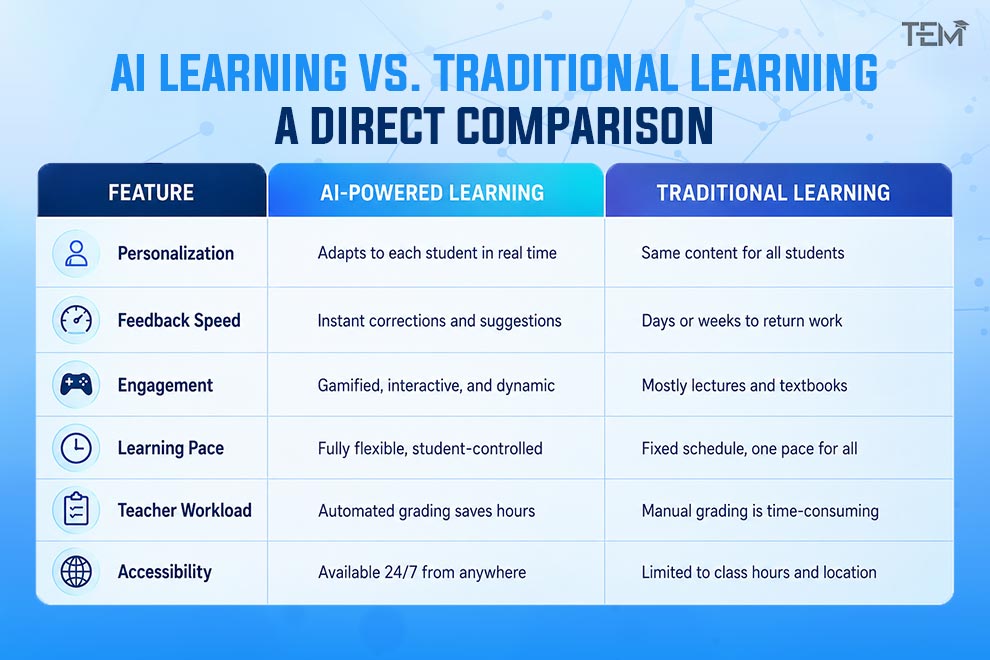
This comparison is not about declaring one approach better than the other. Project-based learning, collaborative discussion, and hands-on experiences are things AI cannot fully replicate. The best classroom environments in 2026 combine both.
The Real Challenges of AI in the Classroom
A fair discussion of AI in the classroom cannot skip its problems. There are real downsides, and ignoring them would be irresponsible.
- Over-reliance: Heavy AI use is linked to increased procrastination and weaker critical thinking when students use it to finish work rather than learn.
- Data Privacy: Massive data collection poses risks; for instance, the LAUSD discontinued its AI assistant “Ed” after developer issues, leaving data security questions unanswered.
- Academic Integrity: Up to 68% of teachers suspect AI-assisted cheating, yet only 28% of current plagiarism policies are considered effective by faculty.
- Training Gaps: 58% of educators have received no formal AI training, despite these tools already being active in their classrooms.
- Inequality: High implementation costs risk widening the digital divide between wealthy and underfunded school districts.
The OECD’s 2026 Digital Education Outlook recommends moving beyond general-purpose AI tools toward purpose-built educational AI that is designed to produce durable learning gains, not just better task outputs. That is a practical benchmark worth holding the industry to.
How Students Can Use AI Effectively
To get the most out of these tools without losing the ability to think independently, students should follow a structured approach:
- Use AI for Concept Understanding: Ask AI to explain a topic in three different ways until it “clicks.”
- Practice with Quizzes: Use AI to generate practice tests based on your own notes.
- Summarize, Don’t Replace: Use AI to summarize long readings, but always read the original source for nuance.
- Combine AI with Self-Study: Use the time saved by AI to engage in deep, focused work or project-based learning.
- Stay Ethical: Always follow your school’s AI policy to avoid issues with academic integrity.
The Future of AI in the Classroom: What Is Coming Next
Looking ahead, the trends shaping AI in the classroom for 2026 and beyond include:
- Voice-based AI tutors that can carry on natural conversations and adapt to emotional cues.
- AI plus virtual reality classrooms that let students do immersive learning in virtual environments, from historical sites to scientific simulations.
- Hyper-personalized education where every student’s daily learning schedule is generated based on their unique performance data.
- Stronger AI governance in higher education with clearer ethical standards for data use, bias monitoring, and student consent.
- AI literacy is becoming a core subject in K-12 education, alongside reading and math.
Conclusion
AI in the classroom is not a future scenario. It is happening right now, in schools and universities around the world. The evidence is clear: when AI tools are designed well, implemented thoughtfully, and used alongside strong teaching, students learn faster, retain more, and stay more engaged.
The benefits of AI in class education are real, and so are the challenges. Over-reliance, privacy risks, and the need for teacher training are not reasons to avoid AI. There are reasons to approach it with intention and good governance.
Students who learn how to use AI wisely will be better equipped for both academic success and the workplace. The classroom is changing. The question is not whether to use AI, but how to use it well.
FAQs
1. How does AI help students learn better?
AI helps students learn better by adapting to each student’s unique pace and providing immediate support, which keeps learners engaged and prevents them from falling behind.
2. Can AI replace teachers?
No, AI can’t replace teachers, but Most experts agree that AI acts as a support system, handling repetitive tasks so teachers can focus on the human side of education, like mentorship and emotional support.
3. Is AI good for students?
Yes, AI is good for students. AI offers clear benefits when used with clear guidelines. It improves access to support, personalizes learning, and saves time.