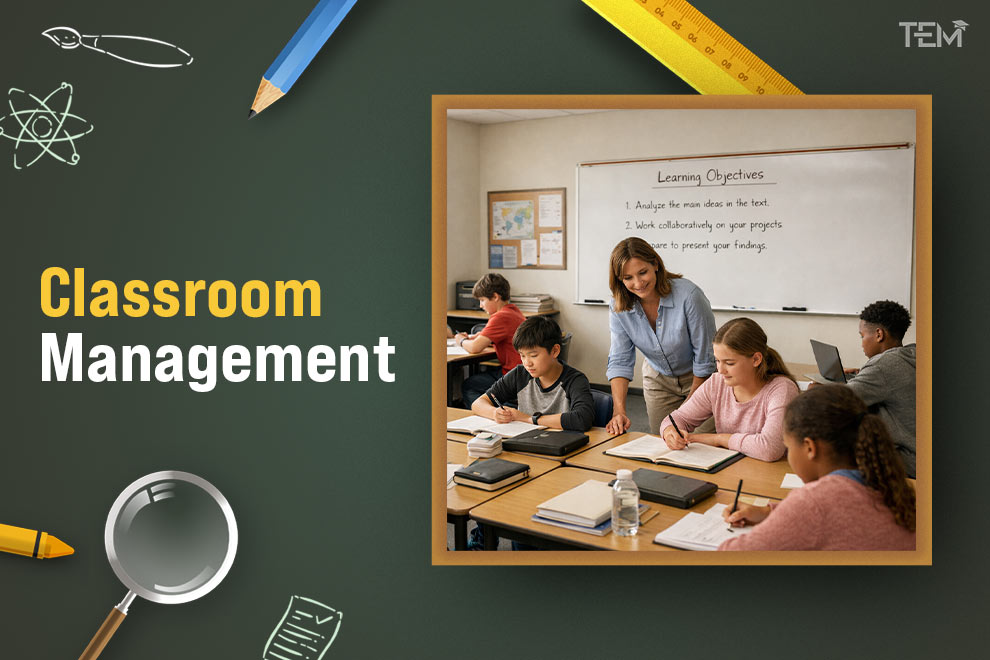
Classroom management is how a teacher creates and keeps the conditions for learning: clear expectations, predictable routines, positive relationships, well-paced lessons, and fair, consistent responses when behavior goes off track. It is broader than discipline. Discipline is the response. Most of management is what happens before a problem starts.
Researchers describe the same core from different angles. The Centers for Disease Control and Prevention lists five best practices: set rules, routines, and expectations; reinforce positive behavior with praise; enforce consequences consistently; maximize structure; and engage students through active participation (CDC). A widely cited review of experimental research, Simonsen and colleagues (2008), found 20 practices with enough evidence to recommend and grouped them into five features of effective management. This guide turns those ideas into daily practice.
If you change only three things:
- Teach three to five expectations and the handful of routines that cause the most friction.
- Notice and name what students do well, specifically and often.
- Plan your responses to common misbehavior ahead of time so you are not improvising when you are under stress.
What effective classroom management looks like
An effectively managed classroom is not a silent one. Students know what is expected, move through the day without long gaps, and expect fair treatment. The teacher spends more time teaching than correcting.
What the research says
Marzano, Marzano, and Pickering’s 2003 meta-analysis, Classroom Management That Works, gathered findings from more than 100 studies. Its clearest results are about disruption. Teaching rules and procedures were associated with an effect of about −0.76 on disruptive behavior, and positive teacher–student relationships with about −0.87. In the book’s terms, those correspond to roughly 28 and 31 percentile-point reductions in disruptions. The same analysis reported an achievement effect of about 0.52, or roughly 20 percentile points, in effectively managed classes.
Read these numbers with care. The achievement estimate came from five studies, and the relationships estimate from four. The work is two decades old, and the studies differ in design and quality. It supports a consistent direction, not a guarantee that any particular program will produce a particular gain. A 2008 Institute of Education Sciences practice guide for elementary teachers reaches the same conclusion about direction: understand what triggers and sustains a behavior, adjust the environment, and teach and reinforce positive skills. That guide is focused on elementary classrooms, and the evidence it reviews is older than most current tools.
Three frameworks that still hold up
| Source | Core idea | What it looks like in practice |
| Harry and Rosemary Wong, The First Days of School | Teach procedures early and deliberately | Rehearse how to enter, ask for help, turn in work, and transition before relying on them |
| Marzano, Marzano, and Pickering (2003) | Four connected factors: rules and procedures, disciplinary interventions, teacher–student relationships and teacher mindset | Combine structure with warmth; do not rely on any one |
| Jacob Kounin, Discipline and Group Management in Classrooms (1970) | Lesson management prevents misbehavior.r | Stay aware of the whole room (“withitness”), handle two things at once (“overlapping”), keep lessons moving smoothly |
What the three share is prevention. Each puts effort into structure and attention before a problem, and treats correction as the smaller part of the job.
Teach expectations and routines explicitly.
Expectations
Expectations are the few behaviors that matter everywhere in the room. Keep them to three to five, state them positively, and make them observable. “Respect each other” is too broad to act on. “Listen when someone is speaking” can be seen, taught, and acknowledged.
Procedures
A procedure is the step-by-step way you want a recurring task done. Wong’s distinction is useful here: a rule says what students should not do, and a procedure shows what they should do. Procedures that commonly need teaching include entering and settling, sharpening a pencil or getting materials, asking for help, working in pairs, turning in work, and packing up.
Teach a routine like content
The pattern is the same as teaching a concept: explain it, model it, let students practice, then correct and refine.
| Step | What it looks like |
| Explain | State the steps and why they matter |
| Model | Show the routine, including a version done wrongly, so students can spot the difference |
| Practice | Students run through it together, then again at the moment it is needed |
| Correct and refine | Give specific feedback until it works without prompting; reteach after breaks |
Hypothetical example: a middle school teacher wants students to get help without waiting at her desk. She teaches three steps. Check your notes and a neighbor. Write your question on a sticky note and place it on the help board. Keep working on the next step while she circulates. She models the steps, has students practice with a sample problem, and returns to the routine the first time a line forms.
Younger students need shorter routines, more rehearsal, and more visual cues. For example, see our guide to the kindergarten classroom.
Build relationships and reinforce participation.
Relationships are not a separate topic from management. They are one of the strongest factors in the evidence above, and the CDC links teacher caring and support to students’ sense of connection to school. In practice, relationship-building is made of small, repeated acts: greeting students by name at the door, learning something about their interests, following up when a student seems off, and holding high expectations while making it clear that you are on their side.
Behavior-specific praise
Praise works better when it names the behavior. Behavior-specific praise is identified in the research as an evidence-based classroom management skill, and studies have tested how to help teachers use it more (Gage et al., 2018).
| Vague | Specific |
| “Good job, everyone.” | “Table 3 cleared their materials and had their notebooks open before the bell.” |
| “Nice work.” | “You rechecked your answer and found the sign error. That’s the habit I want you to keep.” |
Aim for praise that is truthful and proportionate. Overpraising small things loses its meaning, and praise delivered to a student publicly can embarrass some students. Private notes or a quiet word work for many.
Participation
Active participation also reduces off-task time. Mix response formats: partner talk, whiteboards, choral responses for recall, and short written responses. Students who are always called on when they raise a hand teach you only about the students who raise their hands.
Transitions, attention signals, and lesson pacing
Kounin observed that transitions and loss of momentum are common points where behavior slips. Practical steps follow.
- Plan transitions as part of the lesson. Decide what students do first, what they need, and what they do when they finish. Post it.
- Prepare materials before class so you are not stopping the lesson to find them.
- Teach an attention signal and use it once. Choose a signal (a raised hand, a chime, a countdown), teach it, practice it, and wait for the room. Repeating the request teaches students that the first one is optional.
- Structure each lesson in phases: a short opening task, direct instruction, guided practice, independent work, and a closing check. Unstructured time is where problems often show up.
- Circulate. Move through the room during independent work, scan, and check in with students. The CDC includes walking around the room and checking in on students among the skills associated with stronger engagement.
Hypothetical example: the bell rings, and a prompt is already on the board. Students begin quietly. Four minutes into group work, the teacher notices two groups finishing early. Without stopping the room, she hands each group an extension card while continuing to answer a question at a third table. That is Kounin’s “overlapping” in practice.
For games and quick activities that build attention and routine practice, see our collection of classroom management games. They are practice aids, not a substitute for the routines above.
Space and movement
Arrange the room to match what students are doing. Rows give clear sightlines for tests and direct instruction. Small groups support project work but increase conversation and need clearer group expectations. A U-shape lets students see each other for discussion while leaving you room to move. These are teacher judgment calls, not research-prescribed formulas. The U.S. Department of Education–funded brief on classroom MTSS lists designing the space around typical instructional activities as a prevention practice (Simonsen et al., 2021).
Respond to disruption with a graduated approach.
Even a well-run classroom has disruptions. A planned sequence helps you respond in proportion, protects the relationship, and keeps the lesson moving.
The ladder
- Prevent and redirect without words. Move closer, make eye contact, pause.
- Give a brief, private reminder of the expected behavior.
- Redirect to the task, offering a clear choice or a next step.
- Hold a private conversation after class or during work time to understand what happened and agree on a next step.
- Follow the school’s procedures if the behavior continues or becomes unsafe. Involve family, counselors, or administrators as your school’s process requires.
Hypothetical example: a student is texting during independent work. The teacher walks over and stands near the desk (step 1). The phone stays out. She says quietly, “Phone in your bag, please, and start question four” (steps 2 and 3). After class, she asks what was going on. The student says a friend is in a hospital. They agree he can step into the hall to take a call at an agreed time (step 4).
Calm tone matters. Speaking quietly and privately, naming the behavior rather than the student’s character, and offering a way forward help students keep their dignity and make it easier for them to change. Keep consequences predictable and consistent. The CDC list above includes consistently enforcing consequences.
For more tactics for regaining attention and calm, see classroom control strategies.
Restorative conversations
Restorative approaches aim to repair a relationship after harm instead of only punishing. The CDC’s guidance on relationships describes restorative communication as taking ownership where appropriate, validating the student’s feelings, and solving the problem collaboratively. A basic classroom version is a short conversation: What happened? Who was affected? What needs to happen to make it right?
The evidence is mixed, and it is worth knowing. A RAND randomized trial in Pittsburgh Public Schools found that a restorative practices program improved school climate as rated by teachers and reduced suspensions overall, but did not improve academic outcomes, which worsened in grades 6 to 8, and it did not reduce suspensions for violent offenses or at the middle school level (RAND, 2018). The researchers pointed to the importance of implementation and support for school leaders and teachers. The takeaway is not to avoid restorative practice but to use it as a way of repairing relationships alongside strong instruction, not as a replacement for either.
When a pattern persists
If the same behavior keeps happening, stop guessing at a fix. The IES/REL guidance recommends pinpointing the specific problem behavior and looking at what comes before it and what follows it (IES, 2019). Keep a short log for a week: what was happening, what the student did, what happened next. Look for patterns, such as a particular subject, time of day, task difficulty, or a need for attention or escape.
If the pattern continues, bring the information to your school’s student-support or special education team. A functional behavioral assessment (FBA) is a structured process, led by trained staff, for understanding why a behavior occurs. A behavior intervention plan (BIP) is an individualized plan built from that information. For students with disabilities, federal special education regulations connect these tools to discipline procedures: after certain disciplinary removals, the school must conduct a functional behavioral assessment as appropriate, and must create or review a behavior plan if the behavior is found to be a manifestation of the student’s disability (34 CFR §300.530). You do not complete these on your own. Your role is to document what you see and take part in the team process.
Inclusive, accessible and culturally responsive practice
A lot of behavior is a response to the learning environment: a task that is too hard or too easy, a lack of clarity, sensory overload, or a classroom that feels unwelcoming. Designing for variation up front reduces the number of problems you have to manage.
Universal Design for Learning (UDL). CAST’s UDL Guidelines 3.0, released July 30, 2024, organize ways to reduce barriers around engagement, representation, and action and expression. Guidelines relevant to behavior include options for sustaining effort and persistence, emotional capacity, and strategy development (CAST).
Differentiated instruction. Adjust what students do, how they show learning, or how much support they get, without lowering expectations. For example, offer a choice of how to demonstrate understanding, or provide a partially completed example to students who need a starting point.
Self-regulation and executive function. Students differ in how well they manage emotions, attention, impulses, and organization, and these skills develop over time. Common supports include visual schedules, checklists for multi-step tasks, chunking long assignments, timers, planned movement or break options, and calm-down routines taught when students are not upset. Teach these as skills, with practice, instead of expecting students to arrive with them.
Culturally responsive practice. Students may bring different norms about eye contact, turn-taking, tone of voice, and how to show respect to adults. Responsive management starts by asking whether an expectation is about learning and safety, or only about habit and preference. Explain the reason behind expectations, invite student input on classroom norms, and look at your own patterns of correction and praise for differences by student group.
This matters because discipline is not applied evenly. The U.S. Department of Education’s 2023–24 Civil Rights Data Collection shows that students with disabilities served under IDEA represented 15% of K–12 enrollment but 24% of students receiving one or more in-school suspensions, 27% of those receiving one or more out-of-school suspensions, and 23% of students who were expelled. Black boys also represented 7% of K–12 enrollment but 18% of students receiving one or more in-school suspensions. These national patterns highlight the importance of fair classroom practices and reviewing discipline decisions for potential disparities.
Device and AI-use expectations
Devices and AI tools need the same treatment as other routines: expectations taught in advance, practiced, and tied to the task.
| Decide in advance | Example expectation |
| When devices are out | “Screens closed during instruction. Open them when I say ‘begin.'” |
| What devices are for | One tab for the assignment; no messaging or unrelated sites |
| Where AI is allowed | State per assignment: not allowed, allowed for brainstorming, or allowed with disclosure |
| What to disclose | “If you used an AI tool, say which one and what you used it for” |
| What not to share | No personal information about yourself or classmates in any tool |
| What happens if expectations are not met | The same graduated response as any other behavior |
The U.S. Department of Education’s July 22, 2025 Dear Colleague Letter on AI describes principles for responsible use that include educator-led, ethical, accessible, transparent, and compliant with privacy law (ED press release; K-12 Dive summary). The letter addresses use of federal grant funds, not classroom rules, so check your district’s own policy before setting yours. Design assignments so the thinking that matters, such as explaining reasoning, reflecting on process, and discussing in class, is visible.
For software that monitors or limits student screens, see our guide to classroom management tools. For teaching responsible online behavior, see digital citizenship.
First-week implementation plan
Treat the first week as time to teach how the classroom works, not only the content. The sequence below is a suggested pattern, not a research-prescribed schedule. Adjust for grade level.
| Day | Focus | Practice |
| 1 | Welcome, expectations, entry and exit | Greet each student; teach the entry routine and rehearse it twice |
| 2 | Getting help and materials | Teach the help routine and where materials live; practice with a short task |
| 3 | Transitions and attention signal | Teach the signal; rehearse a transition between two activities |
| 4 | Working with others | Teach partner and group roles; practice with a low-stakes task |
| 5 | Devices, AI use and review | Teach device expectations; review all routines; ask students what needs clarifying |
In week two, keep reviewing and reteach any routine that is slipping, before it becomes a habit.
How to review what is working
A plan only helps if you check it. Choose one or two things to track for two to four weeks:
- Minutes lost in a specific transition
- Number of reminders you give per lesson
- How often you give specific positive feedback
- How many students complete the opening task within a set time
- A short student survey (for example, “I know what to do when I need help”)
Ask a colleague to observe one lesson for a specific routine, and compare notes with colleagues on what has worked with particular students. Change one thing at a time so you can tell what made a difference. The IES/REL guidance notes that a strategy not connected to the specific problem can increase unwanted behavior instead of reducing it, so match the strategy to the cause.
FAQ
- What are the most effective classroom management strategies?
The best-supported strategies are teaching a few clear expectations and routines, providing structure, engaging students actively, reinforcing positive behavior, and responding consistently to misbehavior. These appear in the CDC’s list and in Simonsen and colleagues’ review. Which specific techniques work best depends on grade level, students, and context.
- What is the difference between classroom management and discipline?
Classroom management covers everything that creates conditions for learning: routines, relationships, instruction, and responses. Discipline is the part that responds to misbehavior.
- What is PBIS?
Positive Behavioral Interventions and Supports is a tiered framework that schools use to teach expectations and support behavior. Tier 1 supports are for all students, and higher tiers add targeted and individualized support.
- How is a classroom management plan different from classroom rules?
Rules name expectations. A plan also includes procedures, ways you will reinforce good behavior, and a planned sequence of responses to misbehavior.