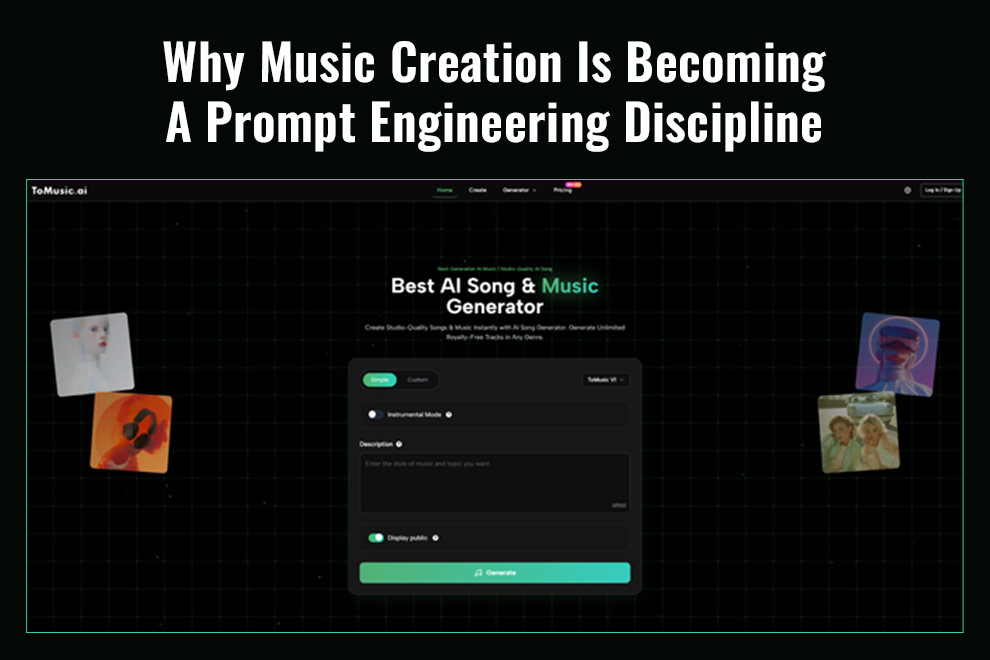
When I first explored an AI Music Generator, I assumed the main challenge would be evaluating the output. Instead, I found that the real difficulty was in writing the input. The quality of the result depended heavily on how clearly I could describe what I wanted.
This suggests that music creation, at least in this context, is evolving into a form of prompt engineering. The ability to translate abstract ideas into precise language is becoming as important as traditional musical skills.
How Prompt Design Shapes The Entire Output Pipeline
In these systems, the prompt is not just a starting point—it defines the boundaries of the result.
Descriptive Precision Directly Affects Output Quality
For example:
- “sad music” → generic result
- “slow piano with minimal ambient texture and reflective mood” → more coherent output
The difference lies in specificity.
Layered Prompts Produce More Structured Results
Effective prompts often include:
- Mood
- Instrumentation
- Tempo
- Context
Combining these elements creates clearer guidance for the system.
Why Lyrics Function As High Fidelity Prompts
Lyrics provide a level of detail that descriptive prompts often lack.
Embedded Structure Guides Composition
Lyrics inherently contain:
- Sections (verse, chorus)
- Rhythm (syllable patterns)
- Emotional progression
This makes them a powerful input format.
Semantic Content Anchors Musical Interpretation
Using Lyrics to Music AI, I observed that the system tends to align musical changes with lyrical meaning. This creates a stronger connection between narrative and sound.
Reduced Ambiguity Compared To Freeform Prompts
Because lyrics are structured, there is less room for misinterpretation. This leads to more consistent results.
The Workflow As A Prompt Refinement Cycle
Rather than a linear process, creation becomes iterative.
Step One Draft Initial Prompt Or Lyrics
Users start with:
- A descriptive idea
- Or a set of lyrics
This establishes the baseline.
Step Two Adjust Style And Generation Settings
Users select:
- Genre or style
- Vocal or instrumental options
These choices shape the output space.
Step Three Refine Prompts Based On Output Feedback
After generating results:
- Prompts are modified
- Specific elements are clarified
- New variations are created
This loop continues until a satisfactory result is achieved.
Comparing Prompt Driven And Skill Driven Creation Models
The difference between these models is significant.
| Factor | Skill Driven Model | Prompt Driven Model |
| Input Type | Technical actions | Descriptive language |
| Learning Curve | Long | Short |
| Output Control | Precise | Approximate |
| Iteration Method | Manual editing | Prompt adjustment |
| Accessibility | Limited | Broad |
This comparison highlights a shift toward accessibility.
Where Prompt Engineering Provides The Most Value
The impact of this approach varies depending on use case.
Rapid Prototyping Of Creative Ideas
For early-stage projects:
- Ideas can be tested quickly
- Multiple directions can be explored
This reduces development time.
Content Production With Specific Emotional Targets
For media creators:
- Matching mood is critical
- Prompt design allows for targeted outputs
Creative Exploration Without Technical Constraints
For beginners:
- No prior knowledge is required
- Focus remains on ideas rather than execution
Limitations Of Prompt Based Creation
Despite its advantages, this approach has constraints.
Ambiguity Can Lead To Inconsistent Results
If prompts are unclear:
- Outputs vary widely
- Results may not match expectations
Limited Ability To Fine Tune Outputs
Users cannot:
- Edit individual elements
- Adjust precise details
This reduces control.
Learning Curve In Prompt Design Itself
While easier than traditional skills, prompt design still requires:
- Practice
- Experimentation
Why This Represents A Shift In Creative Literacy
The emergence of prompt engineering suggests a broader change.
From Technical Literacy To Descriptive Literacy
Creators must now:
- Communicate ideas clearly
- Structure descriptions effectively
This changes the skill set required.
Language As A Creative Medium
Language becomes:
- A tool for creation
- A medium for expression
This expands what it means to create music.
How Creators Might Adapt To Prompt Driven Workflows
Integration with existing practices seems likely.
Combining Prompt Design With Traditional Editing
Creators may:
- Generate initial ideas using prompts
- Refine outputs using traditional tools
This balances speed and control.
Developing Personal Prompt Libraries
Over time, users may:
- Save effective prompts
- Build reusable templates
This increases efficiency.
Why The Most Important Skill Is Still Clarity Of Thought
While the tools are new, the underlying requirement remains the same: clarity.
The system rewards:
- Specific ideas
- Clear descriptions
- Structured thinking
In that sense, it does not replace creativity—it demands a different kind of it.
Rather than mastering instruments or software, creators are learning to articulate their ideas with precision. That shift may ultimately redefine not just how music is made, but how creative intent is expressed.