Have you ever wondered how it would feel to walk through ancient Rome or conduct a complex science experiment from the comfort of your own home? This is no longer just a dream as metaverse technology is officially entering the classroom. The integration of metaverse technology into the classroom is fundamentally changing how we approach learning, shifting the focus from passive observation to active, 3D participation. Currently, the global market for the metaverse in education is skyrocketing, with projections suggesting it will reach nearly $95 billion by 2030 as schools move beyond standard video calls toward fully immersive virtual campuses.
In this blog, we will explore the essential metaverse platforms in education, the tangible benefits they offer for student engagement, and the real-world challenges institutions must navigate to succeed. By understanding these tools and their historical context, educators can move beyond the hype and implement strategies that truly beat the competition in the modern.
What Are Metaverse Platforms in Education?
To understand the metaverse definition in a classroom setting, you have to look at it as a convergence of several high-tech pillars. It is not just a video game; it is a persistent, shared digital space where the physical and virtual worlds meet.
Key technologies driving this change include:
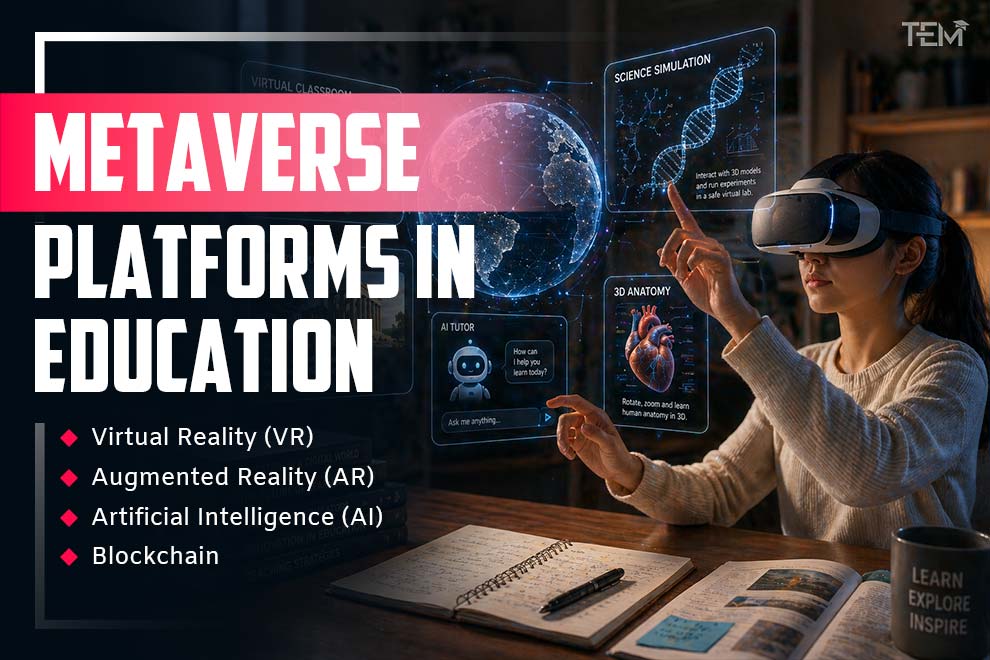
- Virtual Reality (VR): This uses headsets to fully immerse a student in a digital world, blocking out physical surroundings.
- Augmented Reality (AR): This overlays digital information onto the real world, such as seeing a 3D model of a human heart on a physical desk.
- Artificial Intelligence (AI): AI powers non-player characters (NPCs) that act as tutors and help customize learning paths for each student.
- Blockchain: This tech is used for secure digital identities and “micro-credentials” that prove a student has mastered a specific skill.
As Nick Clegg, President of Global Affairs at Meta, noted in several interviews and speeches (most notably during the 2022 World Economic Forum in Davos), the most direct source for this framing is his long-form essay titled:
“How the Metaverse Can Transform Education“ was published on April 12, 2023, via the Meta Newsroom and Nick Clegg’s personal blog/Medium.
Key Metaverse Education Platforms & Tools
Choosing the right metaverse platforms in education is vital for institutions looking to beat competitors. Different platforms serve different pedagogical needs, from pure social interaction to heavy technical simulations.
Types of Platforms
- Virtual Campus Platforms: These replicate the physical university experience, allowing students to walk to “buildings,” visit libraries, and sit in lecture halls.
- Simulation-Based Tools: These are designed for high-stakes environments like medical schools or flight training, where mistakes in the real world are costly.
- Game-Based Platforms: Tools like Roblox and Minecraft are used to teach coding, history, and physics through play-based “missions”.
| Platform | Best Use Case | Key Feature |
| Roblox | K-12 Engagement | User-generated educational worlds |
| ENGAGE VR | Higher Education | Professional virtual campus builder |
| Meta Horizon | Collaboration | Realistic avatars and spatial audio |
| Minecraft: Ed. | Problem Solving | Block-based coding and history tasks |
Benefits of Metaverse Platforms in Education
The benefits of metaverse platforms in Education adoption go far beyond the “cool factor.” The primary advantage is the transition from “learning about” a subject to “experiencing” it.
1. Immersive Learning Experience
In a metaverse classroom, a history student does not just read about the Roman Empire; they walk through a 3D recreation of the Forum. This level of Immersive Learning Experience captures a student’s attention far more effectively than a textbook.
- Virtual Presence: Unlike video calls, students feel physically present in a virtual space. This “sense of place” helps reduce the distractions common in home-based learning.
- Safe Exploration: Learners can explore high-risk environments, such as active volcanoes or deep-sea trenches, without any physical danger.
2. Better Knowledge Retention
Research indicates that “learning by doing” leads to significantly higher retention rates. In fact, studies show that students using immersive VR can achieve up to a 62% increase in test scores compared to those using traditional instruction.
- Experiential Memory: When students perform a virtual surgery or build a virtual engine, their brains process the information as a lived memory rather than a piece of abstract data.
- Practical Application: The metaverse allows for endless repetition of complex tasks. This “muscle memory” is invaluable for vocational training and professional certifications.
3. Personalized Learning with AI
Because the metaverse is data-driven, it can adapt to a student’s pace in real-time. This ensures that no student is left behind while allowing advanced learners to move ahead.
- Adaptive Content: If a student struggles with a math concept, the environment can shift to provide more visual aids or a different tutorial style immediately.
- AI Tutoring: Intelligent avatars act as 24/7 mentors, offering personalized feedback and answering questions as they arise during a lesson. This reduces the administrative burden on human teachers, allowing them to focus on mentorship.
4. Global Access and Collaboration
Metaverse technology removes the “postal code lottery” in education. A student in a rural area can attend a lecture by a world-class professor in a virtual space that feels as real as a physical campus.
- Cross-Cultural Teamwork: This fosters global teamwork, as students from different continents can collaborate on the same 3D project. It breaks down geographical barriers and encourages diverse perspectives.
- Inclusive Environments: Metaverse platforms often offer features like real-time language translation and customizable avatars, which help introverted students or those with disabilities feel more comfortable and empowered to participate.
5. Increased Engagement and Motivation
By integrating gamification and interactive elements, metaverse technology turns education into an active quest.
- Gamified Missions: Students can earn “micro-credentials” or digital badges for completing missions, which keeps them motivated to reach the next level of their curriculum.
- Social Interaction: The ability to interact with peers as avatars creates a social bond that traditional online learning lacks. This social presence is key to maintaining long-term student interest and reducing dropout rates.
Real-World Use Cases of Metaverse in Education
We are seeing a wide variety of use cases of the metaverse in education as schools experiment with these new digital frontiers.
- Virtual Classrooms: Morehead State University and others have built “digital twins” of their campuses to allow remote students to attend live, synchronous classes as avatars.
- Medical Simulations: Trainee doctors use VR to practice surgeries repeatedly without any risk to patients, allowing them to build muscle memory and confidence.
- Virtual Field Trips: Teachers are taking students to the surface of Mars or the bottom of the Great Barrier Reef without ever leaving the classroom.
- Skill-Based Training: In technical fields like welding or electrical engineering, students practice using high-end equipment in a virtual workshop to master the basics before touching expensive real-world machinery.
Challenges of Metaverse in Education
Despite the potential, several challenges of the metaverse in education must be addressed before widespread adoption is possible.
1. High Cost of Technology
The most immediate barrier to entry is the substantial financial investment required. High-quality metaverse platforms in education rely on specialized hardware and robust networking.
- Equipment Costs: High-end VR headsets, such as those from Meta or Apple, remain expensive for many public schools and universities.
- Infrastructure Needs: Immersive 3D environments require low-latency, high-speed 5G or fiber-optic internet to prevent lag, which can be costly to install and maintain across an entire campus.
- Maintenance and Upgrades: Technology evolves rapidly; schools must plan for ongoing costs related to hardware repairs, software licenses, and periodic equipment replacements.
2. The Digital Divide
There is a pressing concern that metaverse technology could widen the existing gap between wealthy institutions and underfunded schools.
- Unequal Access: Students in rural or low-income areas may lack the hardware or high-speed connectivity required to participate in virtual learning.
- Global Disparity: While students in developed nations might enjoy “meta-versity” campuses, those in developing regions could be further sidelined, creating a two-tier global education system.
3. Technical Complexity
Building an effective educational experience in the metaverse is significantly more difficult than traditional digital content creation.
- Content Creation: Designing high-quality, pedagogical 3D curriculum content is much more time-consuming and technically demanding than creating a standard PowerPoint or video lecture.
- Teacher Training: Educators must not only master their subject matter but also learn how to navigate 3D spaces, manage avatars, and troubleshoot technical glitches in real-time.
4. Health, Safety, and Well-being
Physical and psychological safety is a major concern when students spend prolonged periods in virtual environments.
- VR Sickness: Many users experience motion sickness, nausea, and dizziness when using VR headsets, which can significantly disrupt the learning process.
- Physical Strain: “Screen fatigue” and eye strain are common, and the physical weight of headsets can be uncomfortable for younger children during long lessons.
- Escapism: There are concerns that students might prefer virtual interactions over real-world socialization, potentially impacting their social development in the physical world
5. Data Privacy and Cybersecurity Risks
The metaverse introduces new levels of data collection that raise serious ethical and legal questions.
- Biometric Data: VR and AR headsets can track eye movements, facial expressions, and physical gestures, creating a treasure trove of sensitive personal data.
- Cybersecurity Threats: Virtual campuses are targets for “griefing” (digital harassment), hacking, and data breaches. Protecting minors in a persistent, social 3D space requires advanced moderation tools and strict privacy protocols.
How to Implement Metaverse Platforms in Education
To successfully integrate these Metaverse Platforms in Education, institutions should follow a structured approach:
- Identify Goals: Determine exactly what problem you are trying to solve (e.g., “We need better engagement in remote biology classes”).
- Choose the Platform: Select a tool that matches your students’ age group and technical capabilities.
- Teacher Training: Educators must be comfortable navigating the 3D space before they can lead a class.
- Pilot Programs: Start with one subject or one grade level to test the equipment and curriculum before a full rollout.
- Monitor and Adjust: Use student feedback and test scores to see if the immersive tech is actually improving outcomes.
Future of Metaverse in Education (2026–2030)
The future of the metaverse in education looks toward a world where the distinction between physical and digital learning is nearly invisible. By 2030, we expect to see AI-powered virtual tutors that are available 24/7 to answer student questions within the metaverse.
Furthermore, as haptic feedback technology improves, students will be able to “feel” the textures of virtual objects, adding another layer of realism to vocational training. The ultimate goal is a hyper-personalized, “frictionless” learning experience that prioritizes skills over simple rote memorization.
Conclusion
Metaverse platforms in education are no longer a futuristic dream; they are becoming a fundamental part of the modern classroom. While hurdles like equipment costs and technical complexity remain, the benefits of immersive, hands-on learning are too great to ignore. By combining metaverse technology with traditional teaching methods, schools can create a more engaging, accessible, and effective environment for students everywhere.
Educators and students should start exploring metaverse tools now to stay future-ready and gain a competitive edge in an increasingly digital world.
FAQ
- What is the metaverse in education?
The metaverse in education is a collective 3D virtual space that uses VR, AR, and AI to create immersive, interactive learning environments where students interact as avatars.
- What are the main benefits of metaverse platforms in education?
The main benefits of metaverse platforms in education boost student engagement through “learning by doing,” provide safe environments for complex simulations, and allow global collaboration regardless of physical location.
- What are the biggest challenges of metaverse technology in schools?
The biggest challenges of metaverse technology in schools are the high cost of VR hardware, the need for high-speed 5G internet, and concerns regarding student data privacy and physical motion sickness.
- How will the metaverse impact the future of education?
By 2030, the metaverse’s impact on the future of education is expected to offer hyper-personalized learning paths and 24/7 AI-powered virtual tutors, making education more experiential and accessible worldwide.