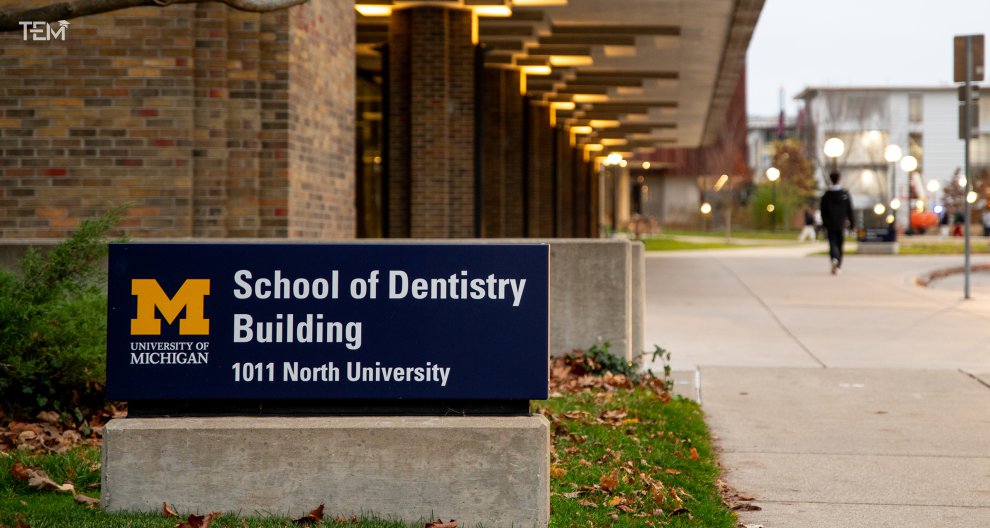
When you walk into the clinical floors of the dental building in Ann Arbor, Michigan, there is a distinct, vibrating hum. It is not merely the mechanical whine of high-speed drills, though that sound is certainly present, hovering like a faint insect buzz in the periphery. Rather, it is the sound of concentrated human effort. You can hear the rustle of sterile gowns, the low murmur of instruction between faculty and students, and the subtle clinking of metal instruments resting on trays.
The University of Michigan School of Dentistry does not just teach a profession. It curates a profound, century-old craft. Established in 1875 by the state legislature with a modest appropriation of $3,000, the institution has always been driven by a quiet ambition. The school opened its doors with just three faculty members and twenty courageous students. Dr. Jonathan Taft, the founding dean, pioneered a rigorous educational model that would eventually become a national standard for dental instruction.
Today, standing in the modern hallways, one can almost feel the weight of those early days. The spaces are filled with natural light, illuminating a place where historical reverence and cutting-edge research intersect. Here, the past is not a museum exhibit; it is the very foundation of daily innovation. The architecture itself seems to bridge two worlds, holding the quiet dignity of a historic university while housing the frantic, beautiful energy of modern medical discovery.
The People Who Shape the Profession
At the helm of this vast educational enterprise is Dr. Jacques E. Nör. Introduced as the fifteenth dean in the summer of 2023, Dr. Nör has walked these same corridors for decades.
He arrived in 1994 for his master’s degree in pediatric dentistry, eventually earning a PhD in oral health sciences from the university in 1999. Dr. Nör occupies a space that feels less like a traditional administrative office and more like a quiet sanctuary for complex problem-solving. Prior to his current role, he chaired the Department of Cariology, Restorative Sciences and Endodontics, demonstrating a hands-on commitment to the microscopic details of tooth preservation.
He is internationally recognized for his pioneering research on the biology of stem cells in head and neck cancer, as well as dental tissue regeneration. Under his guidance, the administration focuses on a deeply humanistic approach to education. Dr. Nör frequently emphasizes the core mission of advancing health through education, service, research, and discovery. “We are entrusted with a legacy of excellence,”
Dr. Nör has noted in his addresses to the academic community, highlighting the profound responsibility of shaping the next generation of practitioners. The leadership team does not view students merely as future clinicians, but as lifelong stewards of public health. It is a philosophy that permeates every lecture hall and laboratory, reminding students that their ultimate responsibility is to the human being sitting in the chair.
Numbers That Tell a Deeper Story
To understand the sheer scale of the institution, one must look at the data, which paints a picture of relentless pursuit. The competition for a seat in the classroom is extraordinarily fierce. For the 2025 entering class profile, the school received a staggering 1,908 applications. From that vast pool, only 109 students were enrolled. The metrics are daunting. The incoming class boasts an average GPA of 3.82 and an average DAT score of 22, with an average age of twenty-two. Of these enrollees, 62 are Michigan residents, while 47 come from out of state.
These numbers are not simply administrative trivia. They represent late nights of studying, immense personal sacrifice, and a singular dedication to the field of oral health. Furthermore, the school currently supports a robust academic staff of over 400 faculty members who mentor hundreds of students across various disciplines, including the rigorous Doctor of Dental Surgery and Dental Hygiene programs.
The institution consistently ranks as a top-five NIH-funded research center. This financial backing fuels the university’s state-of-the-art core facilities, allowing investigators to explore the intricate oral health sciences that push boundaries globally. During their annual Research Day, the entire school pauses to celebrate this spirit of inquiry, filling the halls with poster presentations and intense debates over cellular regeneration and craniofacial anomalies.
A Legacy of Barrier-Breaking Firsts
Progress is often slow, but at certain historical moments, it leaps forward. In 1890, the institution became the first dental school in the country to provide graduate dental education. That very same year, Ida Gray Rollins graduated from the university, securing her place in history as the first African-American woman to earn a dental degree in the United States. It is a striking detail. A century before modern diversity initiatives, these halls were witnessing the quiet shattering of monumental barriers.
In 1921, the school established its dental hygiene program, recognizing early on that preventative care was just as critical as surgical intervention. In 1923, the school broke new ground again, establishing the oldest degree-granting graduate program in orthodontics in the world. Every time a student sits at a lab bench today, they are participating in a lineage of ‘firsts’ that fundamentally altered American healthcare. The legacy is palpable. It is woven into the very fabric of the curriculum, demanding that students look beyond the mechanics of teeth to understand the broader societal impact of their work.
The Future of Care
Observation reveals that the true magic of the dental school happens in the community engagement programs and specialty clinics. The students do not learn in a vacuum. The school provides cutting-edge care to patients at or below private practice costs, treating individuals who might otherwise lack access to specialized restorative services. It is a profoundly grounded experience. Students learn the delicate art of bedside manner, navigating patient fears, financial anxieties, and the highly vulnerable reality of dental pain.
In the specialty clinics, you will find advanced CBCT 3-D imaging machines humming quietly, mapping the hidden landscapes of the human jaw. The Continuing Dental Education Office works tirelessly to offer innovative, ADA CERP-recognized courses for working professionals, ensuring that the learning never truly stops, even decades after graduation.
As the afternoon sun slants through the large windows of the patient care clinic, one can see the future of dentistry unfolding in real time. A student carefully explains a procedure to a nervous patient, using soft, reassuring tones. Nearby, faculty members quietly observe, offering gentle corrections and nods of approval.
This is the true measure of elite education, found not just in textbooks, but in the compassionate application of knowledge. The University of Michigan School of Dentistry stands as a testament to the belief that the mastery of science is ultimately incomplete without the mastery of empathy.