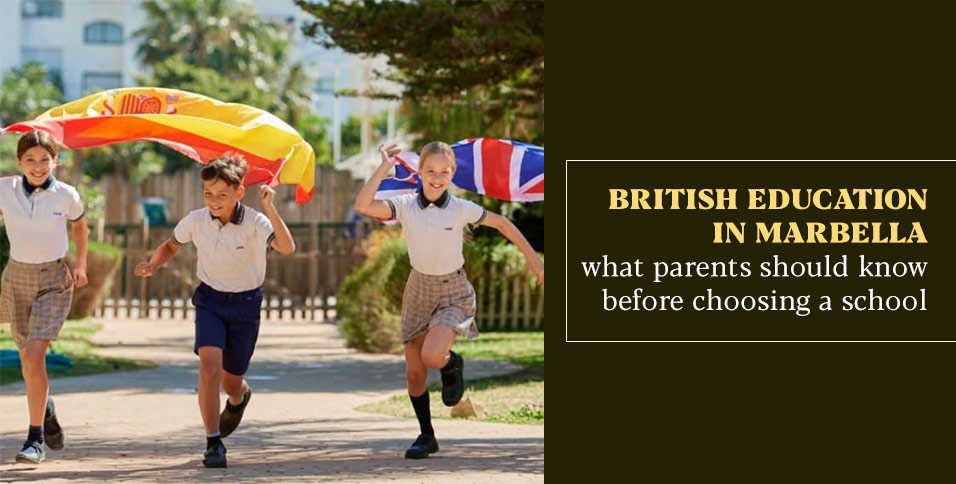
British education has become one of the most established international educational options in Málaga province, particularly across the western Costa del Sol in areas such as Marbella. Every year, both local and expatriate families choose this model because it combines academic rigour, English-language immersion and qualifications recognised by universities around the world.
However, choosing a British school in Marbella involves much more than selecting a school where lessons are taught in English. Understanding how the British education system is structured, how it fits alongside the Spanish curriculum and what opportunities it offers after graduation can help families make an informed decision based on their child’s long-term educational goals.
Why is British education particularly popular on the western Costa del Sol?
The western Costa del Sol is home to one of Spain’s largest international communities. Families relocating to Marbella, Estepona, Benahavís, Cancelada, Sotogrande or Manilva often prioritise schools offering internationally recognised qualifications and continuity for children moving between countries. As a result, this area has developed one of the country’s strongest concentrations of British and international schools, giving parents a wide choice of educational models while making it especially important to understand the differences between them before enrolling.
What makes British education different?
British schools follow the National Curriculum for England, a framework designed to develop academic knowledge alongside the skills students need to thrive in higher education and an increasingly international world.
Alongside subject knowledge, the curriculum places strong emphasis on critical thinking, creativity, communication, problem-solving and independent learning. Rather than relying exclusively on final examinations, pupils are assessed continuously through classroom work, projects, coursework and regular evaluations, allowing teachers to monitor progress and provide personalised support throughout each stage of learning.
Many British schools in Málaga also integrate the compulsory subjects required by the Spanish education system, enabling students to benefit from an international education while maintaining access to both Spanish and international academic pathways.
Understanding the British education system
One of the strengths of British education is its clear and progressive structure, with each educational stage building naturally on the previous one.
The journey begins with the Early Years Foundation Stage (EYFS), where learning is centred on exploration, play and the development of social, emotional and communication skills.
Students then progress through Primary Education, where they consolidate literacy, numeracy, science and humanities while gradually developing greater independence as learners.
During Secondary Education, pupils broaden their academic knowledge before beginning to specialise through internationally recognised qualifications that prepare them for university.
This progressive approach provides continuity throughout a student’s education while allowing increasing levels of independence and personal responsibility.
GCSEs: the first internationally recognised qualification
Around the age of sixteen, students complete the General Certificate of Secondary Education (GCSE).
GCSEs combine compulsory and optional subjects, allowing students to begin tailoring their education according to their interests and future aspirations. Results also determine which subjects they will study during the next stage of education.
Beyond academic achievement, GCSEs encourage students to develop organisation, analytical thinking and subject specialisation, helping them prepare for the demands of post-16 education.
Sixth Form and A Levels
Following GCSEs, students enter Sixth Form, the final stage of British secondary education.
Here they normally study three or four A Levels (Advanced Levels), choosing subjects that closely match their intended university degree. This flexibility allows students to build deeper expertise in specific disciplines while maintaining a strong academic foundation.
For example, future medical students often choose Biology, Chemistry and Mathematics, while aspiring engineers frequently combine Mathematics, Physics and Computer Science.
Because universities place considerable importance on A Level results, this stage is accompanied by personalised academic guidance and university preparation.
How does British education fit within the Spanish system?
One of the most common concerns among Spanish families is whether studying under the British Curriculum limits future educational options in Spain.
In practice, authorised British international schools combine the National Curriculum for England with the Spanish subjects required by national educational regulations, such as Spanish Language, Geography and History. This allows students to meet the requirements for qualification recognition while keeping open the possibility of continuing their studies in Spain.
Families should nevertheless ask each school how qualification recognition (homologación) is managed and what guidance is provided throughout the process, as procedures may vary depending on individual circumstances.
University opportunities in Spain and around the world
One of the main attractions of British education is the wide range of higher education opportunities it offers.
Students completing A Levels can apply to universities throughout the United Kingdom and are also well prepared for admissions processes in Europe, North America and many other international destinations.
Equally important, students wishing to continue their education in Spain can access Spanish universities through the official recognition procedures established by the relevant authorities.
For this reason, when evaluating schools, families should also consider the quality of university guidance and career counselling, as personalised support during the application process can play an important role in helping students achieve their ambitions.
What should families look for when choosing a British school in Marbella?
While academic results remain important, choosing the right school involves considering a much broader range of factors.
Families should look closely at the school’s educational philosophy, teaching methodology, pastoral care, class sizes and the level of individual support available to students throughout their educational journey. They should also consider the school’s international environment, extracurricular opportunities and how effectively it prepares students for university and life beyond school.
Visiting the school, speaking with teachers and understanding how the curriculum is delivered on a daily basis often provides the clearest picture of whether a particular educational model is the right fit.
Laude San Pedro International College: an example of British education in an international environment
Among the British schools on the Costa del Sol, Laude San Pedro International College, located in San Pedro Alcántara, close to Marbella, illustrates how the British educational model can be successfully combined with the requirements of the Spanish education system.
The school follows the National Curriculum for England, enabling students to progress through the British educational pathway while also studying the compulsory Spanish curriculum. This dual approach allows graduates to keep both Spanish and international university options open.
Its educational philosophy extends beyond academic qualifications. The curriculum is supported by methodologies that encourage critical thinking, creativity, collaboration and independent learning, helping students develop the personal and academic skills increasingly valued by universities and employers alike.
Laude San Pedro International College is also part of International Schools Partnership (ISP), one of the world’s leading international school groups, with more than 120 schools across over 25 countries. For students, belonging to an ISP school means benefiting from a global learning community that promotes collaboration between schools, international learning experiences, leadership opportunities and the sharing of educational best practice across different countries.
ISP’s Learning First philosophy places learning at the centre of every educational decision, ensuring continuous improvement in teaching and creating opportunities for students to develop an international outlook through experiences that extend well beyond the classroom.
Choosing a school for the future
Understanding how the British education system works is an essential first step for families considering an international education in Marbella. However, beyond the curriculum itself, the quality of the educational experience depends on the coherence of the school’s overall project, the support it provides to students and its ability to prepare them for an increasingly global future.
For families living in Marbella and the wider Costa del Sol, understanding these differences can make choosing the right school considerably easier. Schools such as Laude San Pedro International College demonstrate how a British educational pathway, combined with strong links to the Spanish system and the advantages of belonging to an international school group such as ISP, can provide the continuity and global outlook that many internationally minded families are seeking.