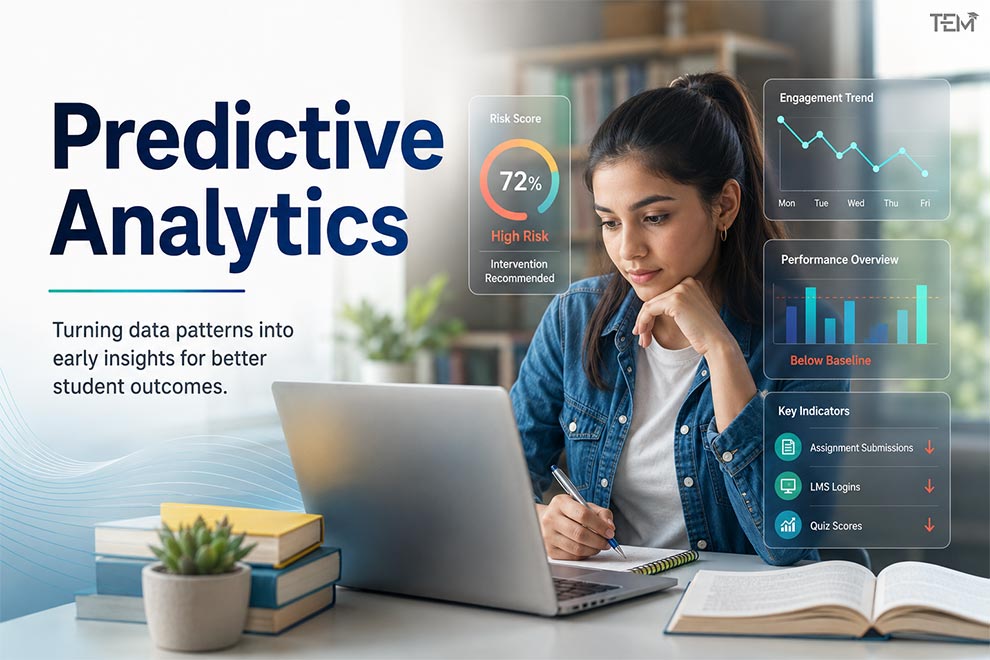
A student misses two consecutive assignment deadlines, stops logging into the online learning portal during mid-week modules, and scores 15 percent below their typical quiz baseline. Taken individually, each event is merely an isolated historical data point. Combined, they form a clear behavioral trajectory.
Predictive analytics evaluates these subtle patterns against years of institutional data to calculate the statistical probability of what comes next. While descriptive analytics answers what happened, predictive analytics anticipates what is likely to occur, giving educators the lead time required to intervene before minor academic hurdles escalate into course failures or student dropouts.
What Is Predictive Analytics?
Predictive analytics combines historical datasets, statistical algorithms, data mining, and machine learning models to forecast future probabilities. Rather than generating absolute predictions about a student’s fixed destiny, predictive analytics establishes dynamic risk boundaries and performance likelihoods.
Predictive analytics is the use of historical and current data, statistical techniques, and machine-learning models to estimate likely future outcomes. In education, it can help institutions identify students who may need additional support and anticipate patterns in retention, performance, or engagement.
What Predictive Analytics Does and Doesn’t Do
To maintain ethical standards and sound educational oversight, institutions must clearly distinguish between statistical modeling and human interpretation:
What It Does:
- Estimates Probabilities: Measures the likelihood of future outcomes based on historical patterns.
- Identifies Behavioral Signals: Highlights subtle trends across disparate systems (e.g., LMS logins + quiz timing + attendance).
- Generates Risk Indicators: Flags students who match historical profiles of past struggling cohorts.
- Supports Proactive Decisions: Gives advisors and instructors empirical evidence to prioritize outreach.
What It Doesn’t Do:
- Guarantee an Outcome: Statistical probabilities are not deterministic fates; a high-risk student can excel with proper support.
- Determine a Student’s Ability: Models measure captured interaction behavior, not intrinsic intellect, talent, or potential.
- Replace Teachers: Algorithmic outputs cannot replace clinical educator intuition, empathy, and professional judgment.
- Explain Every Cause: A model flags that a pattern exists, but cannot explain the personal, financial, or emotional real-world reasons behind it.
How Does Predictive Analytics Work?
Predictive systems convert raw, scattered digital interaction traces into structured risk scores through a six-step operational lifecycle:
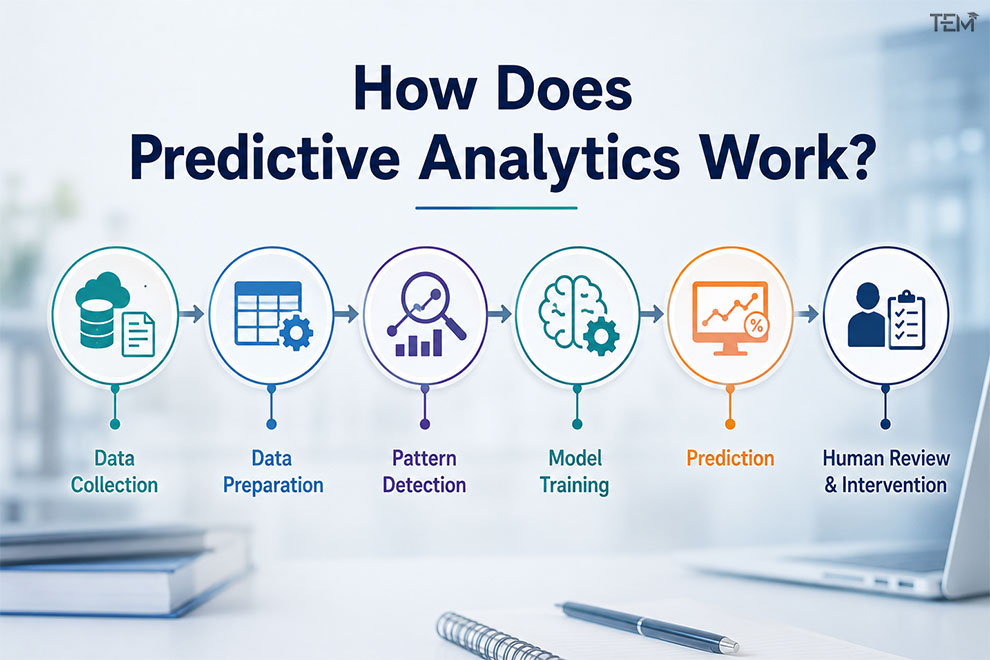
Step 1: Collect Relevant Data
Digital learning environments capture daily digital logs, including formative quiz scores, attendance records, learning management system (LMS) access frequency, and historical academic transcripts.
Step 2: Prepare and Clean the Data
Raw data logs contain missing values, duplicate clickstreams, and formatting inconsistencies. Analytics systems clean, standardize, and aggregate datasets into cohesive longitudinal student profiles.
Step 3: Identify Patterns
Statistical algorithms process aggregated historical records to uncover correlations between early behaviors (e.g., skipping video lectures in Week 3) and long-term academic outcomes (e.g., course failure).
Step 4: Train the Predictive Model
Engineers train machine-learning models using multi-year institutional datasets. The model continuously tests its mathematical assumptions against past student cohorts to refine diagnostic accuracy.
Step 5: Generate Predictions
The operational model evaluates active student activity logs against its trained baselines to output continuous probabilities, such as a dropout risk score or projected exam performance ranges.
Step 6: Human Review and Actionable Intervention
Surfaced risk alerts appear on instructor dashboards or advising systems. Educators analyze the real-world context, verify the signal, and design a targeted support strategy.
Crucial Rule: Prediction is not intervention. A mathematical forecast holds zero educational value until an educator acts upon the insight to support the learner.
What Data Does Predictive Analytics Use in Education?
Educational predictive engines synthesize diverse behavioral, administrative, and assessment data streams to build comprehensive progress profiles.
| Data Category | Specific Metrics Collected | What It Can Help Predict |
| Academic Performance | Formative quiz scores, historical GPA, mid-term results | Final exam scores, prerequisite mastery, overall course grade |
| Attendance & Punctuality | Physical attendance logs, virtual sync-session duration, tardiness | Early disengagement, course dropout probability |
| LMS Activity | Login frequency, session length, resource view counts | Study habit consistency, self-regulated learning breakdowns |
| Assignment Pacing | Submission timestamps, draft creation logs, late submission ratios | Time-management strain, task completion risk |
| Assessment Behavior | Question attempt counts, time-per-item, error distribution patterns | Specific skill deficits, conceptual learning bottlenecks |
| Social & Collaborative | Forum post counts, reply thread depth, peer review activity | Peer isolation risk, group project contribution trends |
| Course Trajectory | Completed prerequisites, credit-hour velocity, retake history | Long-term retention rates, multi-year graduation timelines |
Important Editorial Note: More data does not automatically yield better predictions. Over-collecting low-signal data points introduces system noise, increases false-positive alerts, and creates severe student privacy risks. The most effective educational models rely on a refined set of high-impact behavioral indicators.
Real-World Example: How Predictive Analytics Supports a Struggling Student
How The Open University Uses Predictive Analytics
The Open University (OU) provides a documented example of predictive analytics moving beyond dashboards and into actual student support.
Because the university delivers much of its education through distance learning, tutors cannot always observe struggling students directly. The university therefore developed predictive learning analytics approaches to identify students who may be at risk of failing or abandoning their studies. Its OUAnalyse system uses student performance and engagement data to help tutors decide when additional support may be appropriate.
A Second Example: Czech Technical University in Prague
The same predictive-learning-analytics research was applied at the Faculty of Mechanical Engineering at Czech Technical University in Prague.
Researchers used historical student data to build a probabilistic model that estimated students’ likelihood of academic success at different points during the year. The resulting StudentAnalyse system helped tutors identify key milestones and students who might require additional support.
The reported results were substantial. The faculty’s historical first-year dropout rate averaged 37%, while after the predictive system and related tutor interventions were introduced, the reported average fell to 19% between 2015/16 and 2018/19. The university’s project documentation attributes 422 additional students progressing to later years of study to the intervention program.
Predictive Analytics vs. Learning Analytics
Understanding how predictive analytics fits within the broader educational landscape prevents conceptual confusion:
- Learning Analytics: The overarching, interdisciplinary field combining education, data science, human-computer interaction, and psychology to measure, collect, analyze, and report data about learners and their contexts.
- Predictive Analytics: A specific methodological approach used within learning analytics focused explicitly on forecasting future outcomes and risk indicators using statistical and machine-learning models.
Benefits of Predictive Analytics in Education
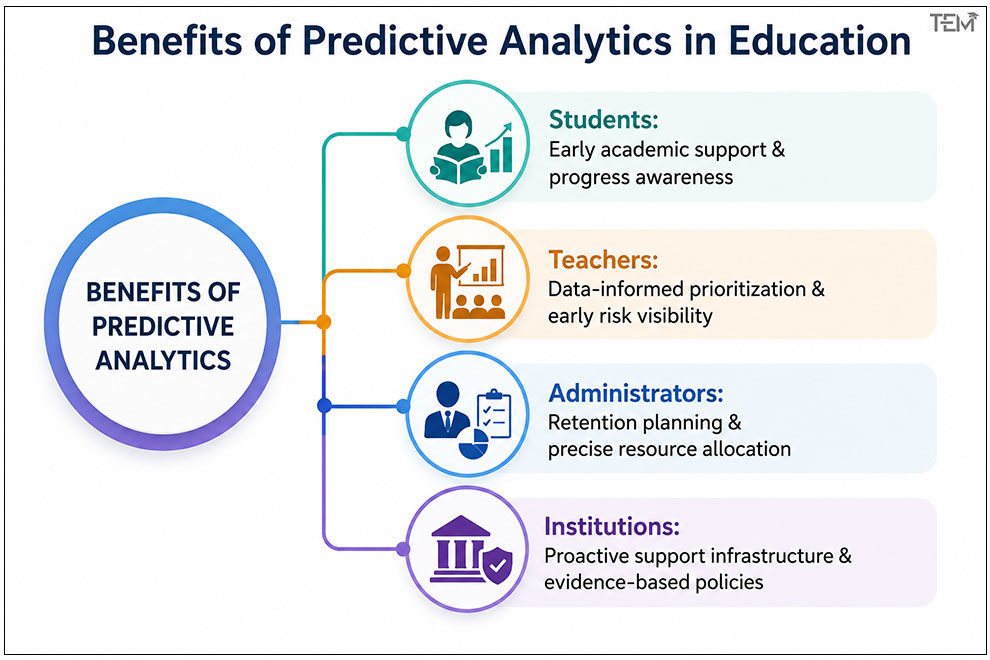
For Students
- Earlier Academic Support: Receives targeted assistance before minor learning gaps lead to course failure.
- Personalized Interventions: Replaces generic study advice with guidance aligned to specific skill deficits.
- Better Awareness of Progress: Gains early visibility into performance trajectories relative to course goals.
For Teachers
- Early Identification of Struggling Learners: Spots disengaged or struggling students inside large lecture halls or online environments.
- Prioritized Outreach: Focuses direct mentoring hours on learners exhibiting elevated risk indicators.
- Data-Informed Instructional Decisions: Adjusts upcoming lesson plans based on predicted cohort difficulty points.
For Administrators & Institutions
- Improved Retention Rates: Reduces student dropouts by addressing academic friction early in the semester.
- Proactive Resource Allocation: Directs advising, tutoring, and financial counseling resources to maximum-impact areas.
- Long-Term Institutional Forecasting: Accurately projects multi-year enrollment, staffing, and housing requirements.
Predictive Analytics for Personalized Learning
Predictive tools turn static interaction records into dynamic, personalized learning workflows:
Student Data⟶Predictive Risk Signal⟶Targeted Recommendation⟶Personalized Learning Pathway
- Predicting Learning Gaps: Forecasting which upcoming course concepts a student will struggle with based on prior concept mastery scores.
- Recommending Targeted Practice: Tailoring practice problems, reading materials, or video explanations based on predicted learning preferences.
- Adjusting Learning Pathways: Accelerating advanced learners through mastered material while offering step-by-step reinforcement for students who need extra support.
Important Distinction: Predictive analytics identifies what a learner may need; an adaptive learning system and a classroom teacher determine how the learning environment responds.
AI and Predictive Analytics in Education in 2026
Artificial intelligence has transformed modern predictive modeling, moving systems away from rigid statistical rule-sets toward dynamic, multi-source intelligence platforms.
- Multimodal Data Processing: Modern machine-learning algorithms analyze unstructured text (e.g., discussion forum sentiments), video interaction heatmaps, and continuous assessment activity alongside traditional numerical test scores.
- Generative AI Risk Summaries: Generative AI translates complex statistical risk metrics into plain-language summaries for academic advisors, highlighting why a student’s risk profile changed.
- Real-Time Model Tuning: Machine-learning engines continuously update risk predictions as new interaction logs enter the system, minimizing false-positive flags.
- Human-in-the-Loop AI Standards: Institutional protocols in 2026 require automated AI predictions to act strictly as recommendations for human decision-makers rather than triggering automated academic penalties.
Predictive Analytics Use Cases Beyond the Classroom
While classroom early-warning flags receive substantial attention, predictive analytics addresses administrative and organizational challenges across the educational spectrum:
Higher Education
- Student Retention & Graduation Rates: Forecasting multi-year completion likelihoods to meet institutional retention benchmarks.
- Enrollment Management: Modeling financial aid allocation strategies to optimize enrollment numbers and low-income student support.
K–12 Education
- Chronic Absenteeism Interventions: Predicting attendance drop-offs using seasonal trends, historical absence records, and community factors.
- High School Readiness Flags: Highlighting middle school learners who require targeted math or reading intervention before entering high school academic tracks.
Enterprise & Corporate Learning
- Skills Development Tracking: Predicting corporate workforce skill shortages based on internal employee training completion rates.
- Compliance Certification Timing: Forecasting which employee groups risk missing mandated regulatory certification deadlines.
Predictive Analytics Tools, Technologies, and Model Types
Educational institutions build predictive ecosystems using an integrated technology stack paired with specialized machine-learning model families.
The Educational Technology Stack
| Technology Layer | Primary Operational Purpose |
| Learning Management Systems (LMS) | Captures daily student clickstreams, assignment submissions, and quiz logs (e.g., Canvas, Moodle, Blackboard). |
| Student Information Systems (SIS) | Houses demographic records, historical transcripts, and enrollment histories (e.g., Ellucian, Workday Student). |
| Learning Record Stores (LRS) | Stores informal and experiential learning logs using open standards like xAPI and Caliper Analytics. |
| Data Warehouses & Lakes | Aggregates disparate software datasets into secure, centralized institutional databases. |
| Business Intelligence (BI) Dashboards | Displays intuitive visual risk alerts, trend lines, and metrics for non-technical educators (e.g., Power BI, Tableau). |
Underlying Machine-Learning Model Types
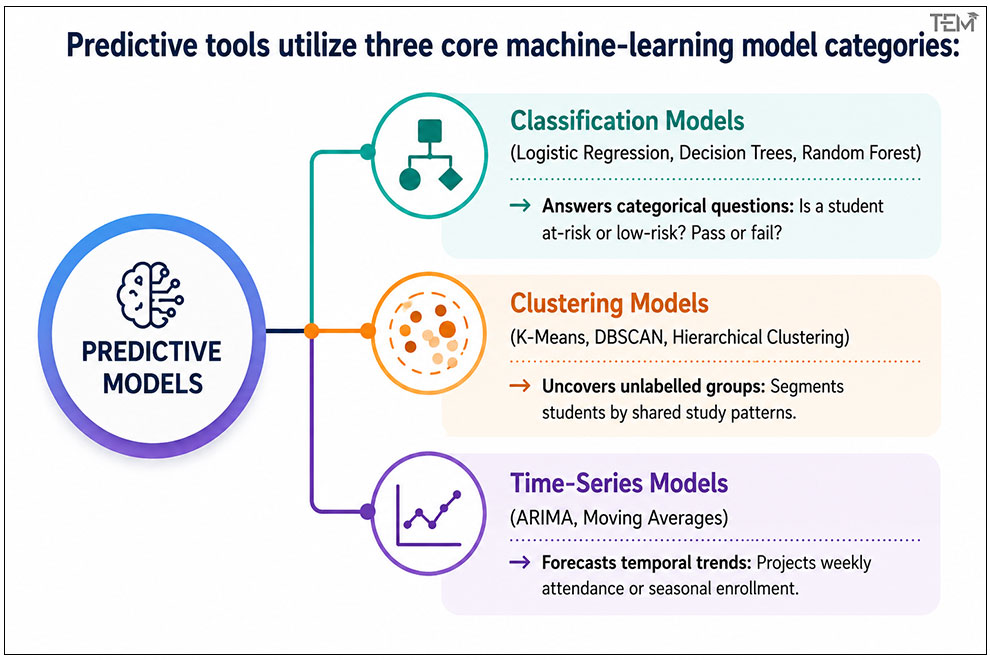
- Classification Models (Supervised Learning): Categorize student metrics into predefined outcome groups (e.g., Pass vs. At-Risk). Algorithms like logistic regression, decision trees, and random forests predict binary or multi-class outcomes based on historical course performance.
- Clustering Models (Unsupervised Learning): Group students based on shared behavioral features without relying on historical pass/fail labels. Algorithms like k-means clustering identify subtle learner personas (e.g., crammers, steady pacers, late-night forum posters).
- Time-Series Models: Process data collected at specific time intervals to project future trends over time. Models like ARIMA evaluate continuous weekly engagement metrics to forecast attendance drops or enrollment fluctuations.
Accuracy, Bias, and the Limits of Prediction
Predictive systems are statistical estimation engines, not definitive crystal balls. Over-relying on automated forecasts introduces operational and ethical risks.
Prediction ≠ Certainty
Predictive algorithms calculate probabilities based on past trends. A student flagged with an 80 percent dropout probability still possesses a 20 percent statistical chance of succeeding without intervention and a far higher chance if given appropriate human support.
Common Technological Limitations
- Data Quality Failures: Missing assignment logs or incomplete historical records result in unreliable predictions.
- Correlation vs. Causation Fallacies: An algorithm may associate late-night portal access with lower grades; however, forcing earlier logins will not automatically improve student comprehension.
- Historical Algorithmic Bias: If historical datasets reflect systemic inequities or biased grading practices, predictive models will replicate and perpetuate those disparities.
- Model Drift: Changes in course structure, grading scales, or degree requirements render older predictive algorithms inaccurate over time.
The Missing Human Context
A student may suddenly stop logging into a learning portal due to an internet outage, a family emergency, shift-work conflicts, or offline textbook study habits. Predictive algorithms detect only the absence of data, making human verification mandatory before taking administrative action.
Future of Predictive Analytics in Education: 2026–2030
- Explainable AI (XAI): Predictive tools will transition from opaque “black-box” algorithms to transparent systems that explain in plain language why a specific risk flag was generated.
- Privacy-Preserving Analytics: Federated learning models and edge computing will enable platforms to run accurate predictive models without centralizing sensitive student data.
- Real-Time Dynamic Learning Signals: Systems will process continuous micro-learning interaction streams to adjust risk indicators within minutes rather than weeks.
- Student-Owned Predictive Dashboards: Learner-facing interfaces will allow students to model their own study pacing and project academic outcomes, fostering self-regulated learning.
- Human-Centered Ecosystems: Educational institutions will increasingly prioritize human judgment, positioning predictive tools strictly as decision-support systems for teachers and advisors.
Key Takeaways
- Probabilities, Not Guarantees: Predictive analytics evaluates historical patterns to estimate future outcomes; it does not determine a student’s fixed potential.
- Proactive Intervention: The primary objective of predictive modeling is identifying struggling students early enough for educators to deliver meaningful support.
- Diverse Data Streams: Effective models synthesize academic performance, LMS engagement, assignment pacing, and attendance trends while avoiding unhelpful data noise.
- Human Judgment Is Essential: Algorithmic signals must always be contextualized, verified, and acted upon by human educators and advisors.
- Ethical Mandatory Standards: Data privacy, algorithmic transparency, bias prevention, and student consent are vital components of any educational data initiative.
Rajendra Gaikwad
FAQ
- How does predictive analytics help students?
It helps students by identifying academic struggles early, allowing instructors and advisors to offer targeted tutoring, study pacing advice, and personal support before minor learning gaps result in course failure.
- What is the difference between descriptive and predictive analytics?
Descriptive analytics organizes historical data to answer what happened, whereas predictive analytics evaluates historical patterns to estimate what is likely to happen next.
- What data does predictive analytics use in education?
Predictive systems evaluate assessment scores, assignment submission timestamps, LMS access frequencies, discussion forum activity, attendance logs, and historical prerequisite performance.
- Is predictive analytics always accurate?
No. Predictive models generate statistical probabilities rather than guaranteed outcomes. Systems can produce false positives or false negatives, making human verification necessary.
- Can predictive analytics replace teachers?
No. Predictive analytics generates data-driven risk flags, but human educators and advisors remain essential for contextualizing data, understanding real-world student challenges, and delivering empathetic support.
- What are the main ethical concerns with student predictive analytics?
Key ethical concerns include student data privacy, lack of algorithmic transparency, historical demographic bias, invasive student surveillance, and the potential stigmatization of at-risk learners.