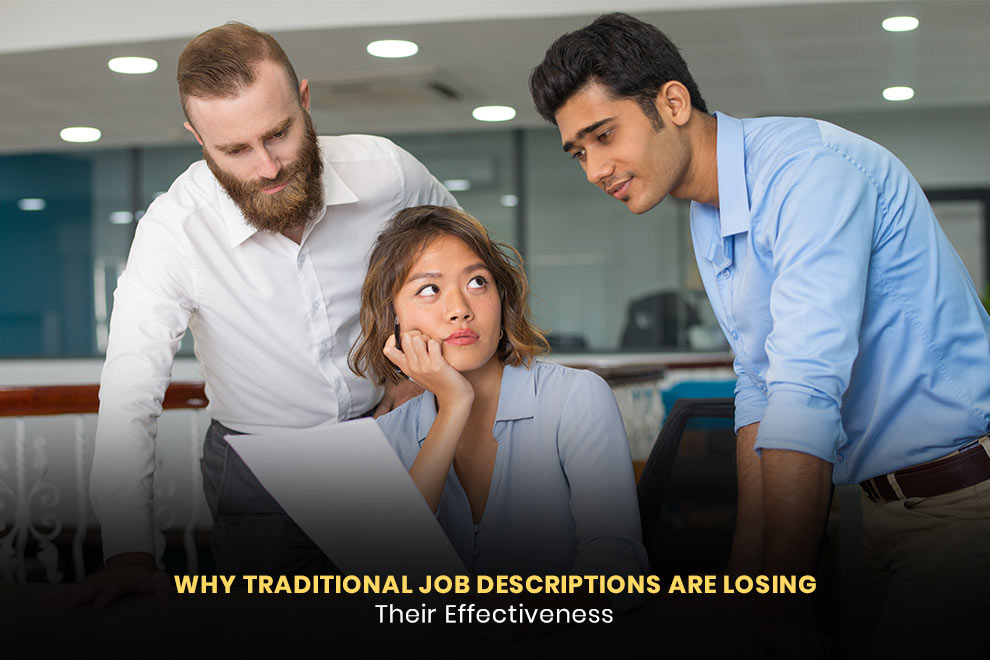
For many decades, job descriptions have been used as one of the crucial instruments in recruiting people. They describe all the responsibilities, required qualifications, experience, and expectations from the employee. Nonetheless, the traditional way of describing a job is currently failing to cope with the modern demands of the market. With the changes that are happening in the working environment due to technological advances, the importance of skills is growing, and the importance of transparency on behalf of employers is becoming higher, companies are considering a new format of the job description.
The traditional job description mostly concentrates on education, experience, previous job positions, and the list of other requirements. In the modern world of recruiting, things are going to be different.
The Problem With Long Lists of Requirements
The largest weakness of traditional job descriptions is the focus on requirements instead of duties and results. In addition, employers can require many skills because they wish to find the “perfect” candidate. However, this can deter good candidates from applying due to the large number of requirements.
More and more studies confirm that a skills-based approach is the way to go. According to LinkedIn, the job ads that focus on duties without requirements attract 14% more applications per view than those that focus on requirements but not on duties. It means that candidates are eager to know what they will have to do in the position.
This aspect becomes even more essential when certain requirements, such as educational background and a particular amount of work experience, are not needed to perform the job. In this case, these requirements can prevent people with the relevant skills obtained in different ways from applying.
Skills Are Becoming More Important Than Credentials
David Magnani of M&A Executive Search said, modern-day workforces are being increasingly structured in the manner of skills and not necessarily careers. With digitalization, artificial intelligence, automation, and shifting business models, new duties are being created and old occupations transformed.
In skills-based recruiting, emphasis is placed on the abilities of the candidates instead of primarily their education and prior job titles. The LinkedIn study shows that companies which recruit people based on skills are better at making quality hires. In its 2025 Future of Recruiting research, LinkedIn also found that more than nine out of ten talent acquisition professionals thought it was essential to accurately assess skills in order to improve quality of hire.
It leads to a problem with classical job descriptions. If one describes the desired candidate based on a degree, job title, or certain number of years of experience, there is a chance that a skilled individual could be overlooked because of a mismatch of his or her profile. A 2025 LinkedIn Economic Graph study demonstrates the problem in question by comparing traditional talent pools, which are defined by prior job titles, with skills-based talent pools.
Job Descriptions Often Fail to Explain What Success Looks Like
Another drawback is that conventional job descriptions often indicate what is required of candidates but do not outline what they will achieve.
While a candidate can read the requirement “five years’ experience,” “highly developed communication skills,” or “leadership capabilities,” he or she may remain unaware of what exactly is expected from him or her within the next six or twelve months.
It is important for an effective recruiting communication strategy to outline the outcomes rather than simply saying that a candidate will “manage marketing campaigns.”
An employer can specify his or her expectations and say that the employee will be responsible for creating campaigns, generating qualified leads, evaluating the data on campaign performance, and working closely with the sales team. According to LinkedIn’s study on skill-based job descriptions, employers should emphasize responsibilities, required skills, performance expectations, and possibilities for professional development.
Technology Is Changing Jobs Faster Than Job Descriptions
Jessica Shee of M3datarecovery.com said, conventional job descriptions tend to treat occupations as static. However, many jobs continue to evolve constantly.
One of such cases is the application of artificial intelligence. Nowadays, people who work in marketing, finance, customer service, human resources, software development, and so on have to deal with AI. Thus, besides technical competencies, an employer should consider such skills as AI literacy, data analytics, technological agility, critical thinking, and problem-solving.
The analysis of advertisements for business analysts conducted by some researchers showed that current job descriptions tend to focus more on the tasks that are to be completed and competencies that employees should have than social and contextual aspects of the occupation. The researchers examined 7,635 LinkedIn postings and found that the advertisements sometimes fail to convey all facets of modern occupations. That explains why job descriptions require constant updates since a description created several years ago might be outdated now.
Generic Language Can Make Jobs Less Attractive
Traditional descriptions may also become less effective due to the use of vague or repetitive language. Such phrases as “dynamic individual,” “team player,” “results oriented,” “excellent communication skills” are often repeated in job advertisements. Without further details, these statements do not say much regarding what an employer is looking for.
Scientific studies of job description writing have also considered how different formats may impact applicant attractiveness. Scientific comparison of competency-based and task-based descriptions points to the role of recruitment information format in relation to future applicants.
It should not be only about making job descriptions shorter. It is more about making them informative, specific and relevant. For instance, in place of requiring “excellent analytical skills,” employers may give an example of their use: “Analyze monthly sales statistics and draw conclusions for the improved performance of regional sales.”
Traditional Descriptions Can Restrict Talent Pools
The other issue that needs to be considered is that the requirement may end up narrowing down the pipeline unintentionally.
When companies demand certain educational qualifications, job designations, and career paths, they tend to miss out on people who have acquired similar skills in a different way. The goal of skills-based recruiting is to open up opportunities to those who possess these skills through an alternative route.
LinkedIn suggests checking if the educational qualification is necessary at all and distinguishing between what skills and capabilities are essential. It does not mean discarding all kinds of qualifications. Certain jobs need professional licenses, specialized knowledge, and credentials required by law.
How Employers Can Modernize Job Descriptions
There are ways in which organizations can make their job descriptions more efficient through redesigning based on the realities of modern-day jobs.
First, employers need to determine the important skills through proper job analysis. This means that hiring managers should be able to figure out the technical, social, and analytical skills needed in their roles.
Second, they should prioritize duties and results. This means that the candidate should know what he or she will be doing and what success entails.
Third, they need to differentiate between mandatory and desired qualifications. Not all desired qualifications need to be listed as mandatory.
Fourth, job descriptions need to have inclusive and clear language. This is according to research-backed advice provided by OneTen.
Fifth, job descriptions should provide opportunities for learning and development. In today’s world, more and more employees seek such opportunities in their organizations, especially because of technology changes in jobs.
The Future of Job Descriptions
The future of recruiting will not see the elimination of job descriptions, but the repurposing of them. Job descriptions won’t just be about listing requirements or qualifications anymore; instead, they will become means of communicating skills, responsibilities, results, culture, developmental opportunities, and even the realities of the job.
Effective job descriptions will relate to the entire recruitment process. The skills listed in the description must impact how the company sources, screens, tests, interviews, and expects candidates to perform. It also solves one of the most basic recruitment challenges: finding someone who can do the job rather than just fitting the profile.
Conclusion
Conventional job descriptions become less relevant due to changes in the working environment. Set standards, a long list of qualifications, use of general language, and an overemphasis on credentials could limit the pool of candidates and not reveal the essence of the modern job roles.
This does not mean that one should simply reduce the number of words used in advertising a job. The employer needs to change the approach in terms of skills, responsibilities, performance outcomes, flexibility, and the candidate’s experience. There is an increasing amount of research and practice that shows that skills-based recruiting can open wider candidate pools. As companies try to attract more specialized and flexible personnel, the job description will become a very important recruitment tool – but only when it reflects the nature of the work and necessary competencies, and not the ideal candidate.
Also Read: Green Jobs in 2026: 25 High-Demand Climate-Focused Careers, Salaries & Skills Guide