The Education Magazine
November 24, 2026
School districts regularly evaluate their buildings and enrollment patterns to ensure students learn in safe, well-maintained classrooms. Long-term facility planning plays a critical role in keeping public schools sustainable, helping administrators balance repair budgets with changing neighborhood populations. However, aging infrastructure and shifting student numbers across Southern Nevada have now prompted the Clark County School District (CCSD) to propose sweeping changes to how its campuses operate.
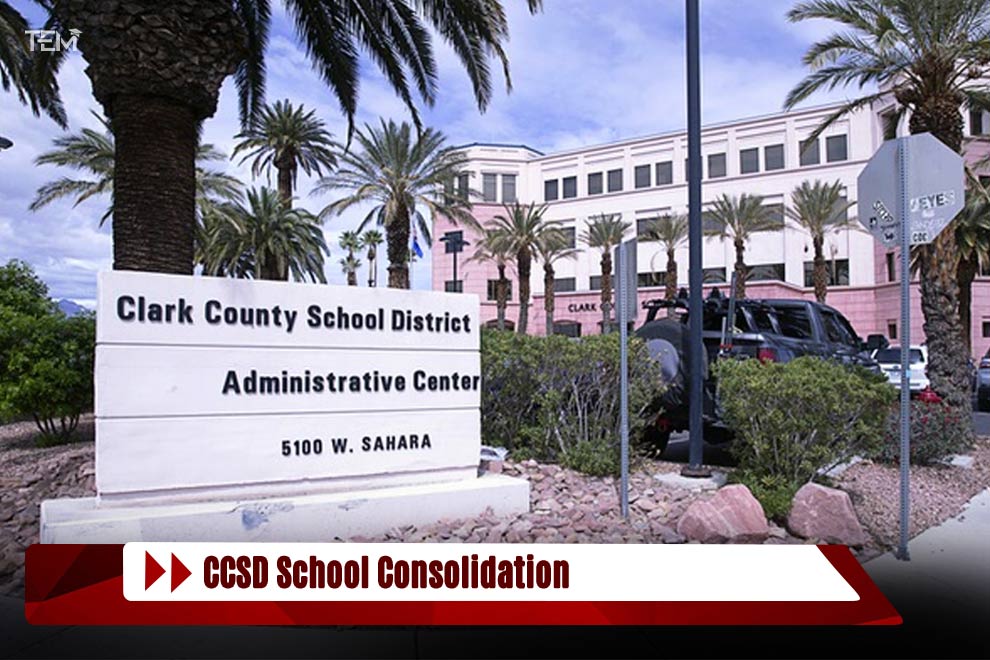
The CCSD school consolidation and campus modernization plan came to light after district officials released formal recommendations ahead of a December 2, 2026 Board of School Trustees work session. Under the $3.7 billion blueprint, CCSD proposes consolidating six elementary schools, replacing eight aging campuses, and renovating 19 facilities across K-12 education between the 2027-2028 and 2029-2030 school years.
Why Is Clark County School District Is Proposing School Consolidations?
The Clark County School District facility master plan, known as Building Brighter Futures, shifts district construction strategy away from rapid expansion toward long-term building sustainability. Many older campuses across the Las Vegas Valley face rising maintenance costs and declining enrollment, leaving several neighborhood schools underutilized.
CCSD plans to retire aging school buildings that have reached the end of their functional lifespan instead of spending limited maintenance funds on costly repairs. Merging nearby student populations allows the school district to operate newer, more energy-efficient campuses and direct a larger share of its operating budget toward classroom instruction. This school consolidation effort aligns with Superintendent Jhone Ebert’s five-year strategic roadmap, Operation: Destination District, which focuses on strengthening school culture, operational efficiency, and academic options across modern school districts.
Capital Breakdown of the $3.7 Billion CCSD School Consolidation Plan
The CCSD bond funding framework directs $3.7 billion in restricted capital dollars across 33 targeted campus projects through the end of the decade. Under Nevada rules, bond funds pay strictly for physical construction, facility upgrades, and campus replacements rather than daily operating expenses or employee salaries.
| Project Category | Number of Schools | Primary Objective |
| School Renovations | 19 campuses | Modernize classrooms, safety systems, and core building infrastructure |
| School Replacements | 8 campuses | Rebuild aging facilities into modern K-8 or elementary campuses |
| School Consolidations | 6 campuses | Merge underutilized elementary schools into upgraded or rebuilt sites |
Beyond structural upgrades, the CCSD facility master plan expands magnet school programs, science and technology labs, fine arts spaces, and career-focused learning environments similar to other modernized school campuses.
What is the Timeline for CCSD School Consolidation Through 2030?
No school closures or attendance boundary changes will take effect during the current academic year. Instead, the CCSD school consolidation schedule spans three upcoming school years to give families and staff clear advance notice:
- 2027-2028 School Year: Helen Anderson Toland International Academy, housed in a 70-year-old building with major infrastructure needs, will relocate to the new Matt Kelly Elementary campus while retaining its magnet program. Families zoned for Kelly Elementary may attend Wendell Williams Elementary. Separately, Richard J. Rundle Elementary students will transition to Charlotte and Jerry Keller Elementary, which will undergo major renovations.
- 2028-2029 School Year: Marc A. Kahre Elementary will merge into Dorothy Eisenberg Elementary following near-term facility upgrades. The former Kahre site will become the new CCSD School Police headquarters while continuing to honor fallen Metro Officer Marc A. Kahre. A renovated Irwin and Susan Molasky Pre-K-8 Magnet School is also scheduled to open in fall 2028.
- 2029-2030 School Year: Quannah McCall and Marion Cahlan elementary schools will consolidate, with most students moving to a reconstructed Jim Bridger Pre-K–8 Magnet school opening in 2029, while some Cahlan students may attend Lincoln Elementary or a rebuilt Fay Herron Elementary. In Henderson, C.T. Sewell Elementary will merge into a newly reconstructed B. Mahlon Brown Pre-K-8 Magnet school opening in fall 2029.
How CCSD School Consolidation Affects Families, Staff, and Campuses?
Planned school rezoning tied to the CCSD school consolidation proposal focuses on keeping student commutes safe and predictable while giving families advance notice of campus transitions. District planners evaluate attendance boundaries and student travel routes so neighborhood transitions align with safer walking and transit patterns rather than sudden mid-year shifts.
For educators and staff, CCSD confirmed that teachers and support personnel at every campus slated for merger will receive placement at other district campuses in accordance with negotiated union agreements. Meanwhile, CCSD plans to collaborate with local municipalities and community partners to repurpose surplus buildings for family support services, early childhood centers, or potential workforce housing.
Next Steps Before the CCSD School Consolidation Vote
The official CCSD facility master plan recommendations remain formal planning proposals rather than final mandates. Members of the CCSD Board of School Trustees will review the complete report during a public work session on Wednesday, December 2, 2026, at the Edward A. Greer Education Center in Las Vegas. Parents, teachers, and community members can watch the livestream or submit public comments through the Clark County School District portal before trustees cast any binding votes. How the board moves forward on the CCSD school consolidation plan will determine which Southern Nevada neighborhoods receive upgraded campuses and how district resources reach classrooms over the next four years.