The Education Magazine
November 23, 2026
Accreditation is one of the ways colleges and universities in the United States demonstrate that they meet recognized standards of educational quality. Independent accrediting agencies evaluate these institutions and their academic programs against established standards. Accreditation also plays an important role in determining whether colleges can participate in federal student aid programs.
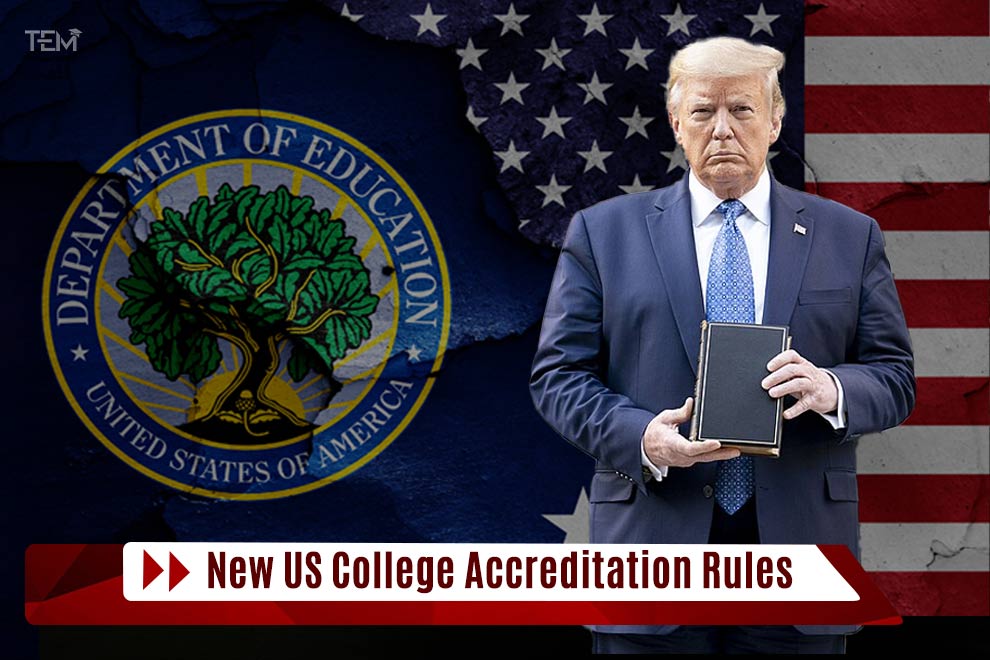
The US Department of Education has finalized new regulations that will change how college accreditation works. The new US college accreditation rules, introduced under the Accreditation, Innovation, and Modernization (AIM) Rule, revise federal requirements for accrediting agencies and their evaluation of colleges and universities. The changes are scheduled to take effect in July 2027.
What Are the New US College Accreditation Rules?
The US Department of Education finalized the Accreditation, Innovation, and Modernization (AIM) Rule on October 29, 2026. Published in the Federal Register on October 30, the rule revises federal regulations governing the recognition of accrediting agencies and institutional eligibility for federal student assistance.
Under the revised US college accreditation framework, the US Department of Education aims to make the accreditation system more open to new agencies and reduce administrative requirements.
The changes in the new US college accreditation rules include:
- Removing the two-year operating requirement for new accrediting agencies seeking federal recognition.
- Removing geographic restrictions that previously limited accrediting agencies.
- Making it easier for colleges to change accreditors or work with more than one agency.
- Reducing certain documentation, site-visit, and procedural requirements.
- Asking accreditors to limit unnecessary administrative work and duplicate reporting.
These US college accreditation changes could give institutions more options when selecting an accrediting agency. However, agencies must still meet federal recognition standards.
How Will the New US College Accreditation Rules Measure Student Achievement?
A major part of the new US college accreditation rules is the increased emphasis on student achievement. Accrediting agencies will be expected to consider whether colleges and academic programs demonstrate meaningful results for students.
To evaluate student outcomes, accrediting agencies may consider factors such as course completion rates, graduation progress, professional licensure examination results, and the economic value students gain from their education.
The new accreditation rules for US colleges do not establish one national performance target for every college. Accrediting agencies retain discretion to determine appropriate measures based on their standards and the institutions they evaluate.
The greater emphasis on student achievement means that colleges will be evaluated more closely on the outcomes their students achieve, including course completion, graduation progress, and professional licensure results. Education data can help institutions understand these outcomes through tools such as predictive analytics and learning analytics, which help identify student progress and learning needs.
How Will the New Accreditation Rules for US Colleges Affect Credit Transfers?
The US Department of Education under the Trump administration finalized the Accreditation, Innovation, and Modernization (AIM) Rule on October 29, 2026. Published in the Federal Register on October 30, the regulation revises federal requirements governing the recognition of accrediting agencies and institutional eligibility for federal student assistance.
The revised US college Accreditation rules establish criteria for evaluating comparable credits and seek to prevent discriminatory decisions. They also require institutions to provide students with clearer information about transfer policies.
Under the new accreditation framework:
- Colleges must explain the standards used to evaluate transfer credits.
- Institutions must provide written reasons when they deny credits.
- Students must have access to an appeals process.
- Transfer-credit information must be disclosed before students transfer.
The new provisions may help students understand credit decisions before committing to a new institution. However, the rule does not guarantee that every previously earned credit will transfer. Receiving colleges can still reject credits that do not meet their academic standards.
How Will the New Accreditation Rules Affect Colleges and Accrediting Agencies?
The new US college accreditation rules will affect how institutions work with accrediting agencies and demonstrate academic quality. Colleges may have more flexibility in choosing an accreditor, while agencies will face updated expectations for evaluating student outcomes, academic standards, and institutional practices.
The new US college accreditation rules also address academic freedom and intellectual diversity. Accrediting agencies must consider an institution’s policies and practices in these areas when applying their standards. However, colleges are not required to adopt a specific academic freedom or intellectual diversity policy. The absence of a formal policy alone does not establish noncompliance.
The regulations further require US college accreditation decisions to be viewpoint-neutral, with provisions for agencies operating under a religious mission.
For institutions, the accreditation changes bring both opportunities and preparation requirements. Colleges will need to understand how their accrediting agencies interpret the revised standards and how they document student achievement and academic practices.
What Is the Timeline for Implementing the New US College Accreditation Rules?
The final AIM Rule is scheduled to take effect on July 1, 2027. Recognized accrediting agencies may begin early implementation from January 1, 2027. However, they cannot impose new requirements on institutions or academic programs before the July 2027 effective date.
Colleges, universities, and accrediting agencies therefore have a transition period to review the regulations and prepare for implementation of new accreditation rules.
The new US college accreditation rules could reshape how US colleges demonstrate educational quality, measure student achievement, and handle credit transfers. For students, clearer transfer-credit decisions may make changing institutions easier to navigate. For colleges, the next step will be understanding the revised accreditation expectations before the 2027 implementation date.