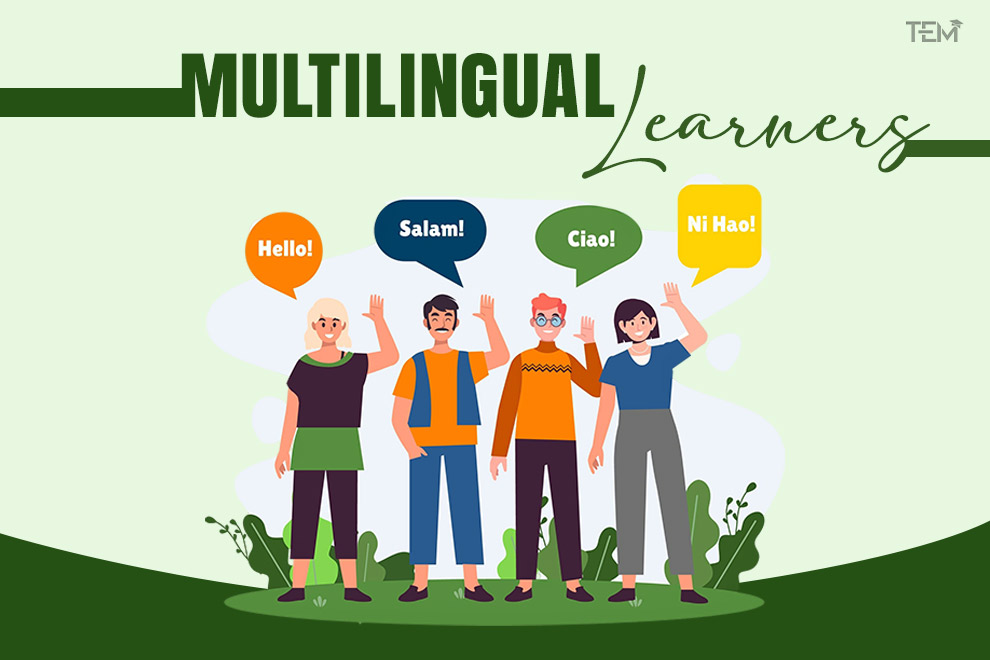
Multilingual learners are students who are developing proficiency in more than one language. In the United States, this group makes up over 5.3 million public school students, or 10.6 percent of total enrollment, and it is still growing. Spanish is the home language for roughly three out of every four of these students, but the group also includes speakers of Arabic, Chinese, Vietnamese, and more than 400 other languages combined.
This guide breaks down what the term “multilingual learner” actually means, why schools are moving away from older labels, and what it takes to genuinely support this population, whether you teach kindergarten or a college seminar.
What Is a Multilingual Learner? Meaning and Definition
A multilingual learner is a student who speaks, understands, or is raised around a language other than English, while also developing English at school. The federal government still uses the term “limited English proficient” for funding and accountability purposes, covering students aged 3 to 21 who are enrolled in school and whose home language or environment has affected their English proficiency enough to limit full participation in state assessments or English-only classrooms.
But “multilingual learner” is not just a rebrand. The older labels, including English learner, ELL, and limited English proficient, describe a student by what they have not yet achieved in English. Multilingual learner flips that lens. It names the languages a student already brings with them, and it treats those languages as an academic resource rather than a barrier to work around.
WIDA, the organization that develops English language development standards used across dozens of states, puts it simply: the term recognizes the whole student, emphasizing what they know rather than what they don’t. That single word change carries real weight in a classroom, because it shapes whether a teacher sees a quiet student who “doesn’t speak English” or a student who already thinks fluently in another language and is now adding a second one.
Who Are Multilingual Learners?
Multilingual learners are not one uniform group. They include international students, children of immigrants, refugees, long-term residents who grew up partly in U.S. schools, and Indigenous students for whom English is a third or even fourth language. Several overlapping terms describe pieces of this population, including English as a Second Language (ESL) student, a label still common in older curricula and program names. Knowing these terms helps you read research, state policy, and school data accurately.
| Term | What It Refers To |
| English Learner (EL) / English Language Learner (ELL) | The federal accountability category for students still developing English proficiency |
| Emergent Bilingual (EB) | A strengths-based term for the same students, used to stress that they are becoming bilingual, not falling short in English |
| Limited English Proficient (LEP) | The older federal legal term, still used in some funding documents |
| Long-Term English Learner (LTEL) | A student who has remained in EL services for five or more years without reclassifying |
| Students with Limited or Interrupted Formal Education (SLIFE) | Students whose schooling was disrupted, often due to displacement or migration |
| Dual Language / Immersion Student | A student enrolled in a program that teaches content in two languages by design |
According to the National Center for Education Statistics, multilingual learners made up 10.6 percent of U.S. public school enrollment in fall 2021, up from 9.4 percent a decade earlier. Some states carry a much heavier share than others. Texas sits at 20.2 percent, California at 18.9 percent, and New Mexico at 18.8 percent, while West Virginia sits under 1 percent. The population also skews young: nearly 15 percent of kindergartners are identified as English learners, compared with about 6 percent of high school seniors, a gap that reflects both new arrivals in early grades and students who exit services as they gain proficiency.
Benefits of Being a Multilingual Learner
Speaking more than one language is not a deficit that schools need to fix. Research consistently points the other way.
Stronger cognitive control
Linguist Ofelia García, whose research shaped how U.S. schools think about bilingual education, has found that constantly switching between languages strengthens the brain’s inhibitory control and changes the regions tied to it. In practice, this shows up as better attention management and mental flexibility.
Deeper metalinguistic awareness
Multilingual students tend to notice how language works, not just what it says. Comparing idioms, grammar, or word order across languages is a form of real analytical thinking, not a distraction from English class.
Wider academic and cultural assets
WIDA highlights the resources multilingual learners bring into a classroom: prior content knowledge, home and community experiences, and brains that are used to processing and connecting across two or more language systems.
Better long-term career access
Bilingual and multilingual employees have an edge in healthcare, international business, education, and public service, fields where language skills translate directly into being able to serve more people.
Stronger sense of identity and confidence
When schools treat a student’s home language as an asset instead of something to leave at the door, students tend to feel more comfortable participating, asking questions, and taking academic risks.
None of this means multilingual learners have it easy. It means the direction of the deficit thinking that dominated classrooms for decades, focusing on what a student lacks in English, was backward.
Challenges Multilingual Learners Face
Being asset-rich does not cancel out real, practical challenges. Most of what multilingual learners struggle with falls into a few clear categories.
Language and communication
Academic English is different from everyday conversational English. A student can chat comfortably at lunch and still struggle with discipline-specific vocabulary, idiomatic expressions, or dense academic writing. Group discussions built around fast, informal back-and-forth can also leave multilingual learners on the sidelines, not because they lack ideas, but because they need a beat longer to translate and organize a response.
Cultural and classroom adjustment
Classroom norms vary a lot by country and culture. Some students come from systems where questioning a teacher is discouraged, where feedback is delivered very differently, or where the whole idea of open classroom debate is new. These adjustments take time, and rushing them causes more harm than good.
Social and emotional load
This is where culturally responsive teaching matters most. Multilingual learners often carry more outside of academics than their peers do. Some have experienced adverse childhood experiences tied to displacement, conflict, or separation from family. Others come from mixed-status households and live with ongoing uncertainty about their future in the country. This context does not excuse lower expectations, but it does explain why relationship-building and a sense of safety in the classroom matter just as much as instructional strategy.
Identification and assessment gaps
Multilingual learners are sometimes over-identified for special education because a language gap gets mistaken for a learning disability, and sometimes under-identified because a real disability gets dismissed as “just a language issue.” Getting this distinction right takes deliberate, trained evaluation, not a quick classroom observation.
Uneven access to trained teachers
Most classroom teachers have never had formal training in supporting multilingual learners, even though nearly every subject area now includes some. That gap in preparation, not a gap in student ability, is often the real barrier.
Teaching Strategies That Actually Work
Generic advice like “use visuals” and “check for understanding” is not very useful on its own. Here is what that actually looks like in a real classroom, strategy by strategy.
Keep the academic bar high. Do not water down the text.
It is tempting to hand a multilingual learner a simplified reading or a translated summary instead of the same grade-level text everyone else gets. That habit quietly tracks students onto a lower curriculum. Keep the original text as the target. Use leveled or translated material only as background support before tackling the real thing, not as a replacement for it.
Frontload vocabulary and context, without giving away the ending.
Before a lesson, hand out key vocabulary with simple definitions, or a short summary of what is coming so students are not decoding fifteen new words while also trying to follow the plot or the argument. This is different from summarizing the whole reading for them. The goal is to lower the noise, not remove the challenge.
Treat the home language as a thinking tool, not a distraction.
Let students draft an idea in their strongest language before translating it into English. Encourage them to notice cognates, words that look and sound similar across languages, since that builds vocabulary in both directions at once. This is sometimes called translanguaging, and it works because thinking is faster in a student’s dominant language, even when the final answer needs to be in English
.
Give text multiple reads, each with a different job.
One pass through a chapter or article is rarely enough for any student, and it is rarely enough for a student processing content and language at the same time. Try a first read for reaction, a second for basic comprehension, a third for background context, and a fourth for analysis. Each pass gets easier because the groundwork is already laid.
Scaffold up, not down
There is a real difference between supporting a student toward a hard task and quietly giving them an easier one. Sentence starters, graphic organizers, and broken-down steps should help a student reach the same rigorous goal as everyone else, not a smaller version of it.
Teach the language of the task directly.
Do not just assign a compare-and-contrast essay and hope the academic phrasing shows up on its own. Teach the specific words and sentence patterns that comparison requires. Do the same for argument, cause and effect, and summary. Language for a task is a skill you can teach in five minutes, not something students are expected to absorb by osmosis.
Use more than one way to say the same thing.
Pair spoken instructions with something visual: a diagram, a short demonstration, or a written outline on the board. This is not a “multilingual learner accommodation”; it is good teaching that happens to help every student in the room.
WIDA-featured educator Claudia Trillo, a lead ELL teacher in Duluth, Georgia, sums up why this matters: when students feel empowered by vocabulary and can connect it to their own learning, they engage more and succeed more. That is the outcome every one of these strategies is aiming at.
Supporting Multilingual Learners in Higher Education
The K-12 strategies above matter, but multilingual learners do not stop needing support the moment they walk onto a college campus. International students, first-generation college students from immigrant families, and Generation 1.5 students, those who arrived as children and were educated largely in U.S. schools, all show up in college classrooms with different needs than a typical monolingual freshman.
College brings its own layer of challenges: discipline-specific jargon, discussions on sensitive topics like social justice that require nuanced language, unfamiliar norms around office hours and questioning a professor, and heavier reading loads with less built-in support than a K-12 classroom provides. Faculty and staff can help by:
- Sharing lecture materials and written instructions in advance, so students are not processing spoken academic English in real time with no reference point
- Encouraging interaction between native and non-native English speakers through structured group work, rather than leaving students to self-sort
- Being mindful of pace and pronunciation without slowing a lecture down to the point that it feels condescending
- Pointing students toward writing centers, tutoring, and mentoring, and treating these as normal academic resources rather than remedial ones
One useful data point from UC Davis: 42 percent of surveyed students rated their own competency in a language other than English as good or better at the time they enrolled, a reminder that multilingualism on college campuses is common, not rare. Faculty who plan for it from day one see fewer students falling silent in discussion sections.
Common Mistakes Schools and Teachers Make
Treating a label change as the fix.
Renaming “English learner” to “multilingual learner” in a handbook does nothing if instruction and expectations do not change with it.
Pulling students out for separate, simplified instruction.
This can feel supportive, but it usually means students spend less time with grade-level content, not more time catching up to it.
Waiting until a student is “ready” for real academic work.
There is no finish line where a student suddenly becomes ready for rigorous content. Access and support need to run together from day one.
Assuming a quiet student does not understand.
Processing time is not the same as confusion. Students often understand more than they can quickly produce out loud, especially early in language development.
Ignoring the early-grade concentration of the population.
Resources often get pulled toward secondary schools, even though the data shows the heaviest concentration of multilingual learners sits in kindergarten and the early elementary grades.
Overlooking students who have plateaued for years.
Long-Term English Learners, students stuck below proficiency for five or more years, need a different kind of intervention than a newly arrived student, and a strengths-based label alone will not surface that need.
Confusing a language gap with a learning disability, or vice versa.
Both over-identification and under-identification for special education happen often enough that they need a deliberate, trained process to sort out.
Key Takeaways
- Multilingual learners are students developing proficiency in more than one language, and the term is an asset-based alternative to English learner, ELL, and limited English proficient.
- More than 5.3 million students, or 10.6 percent of U.S. public school enrollment, are identified as English learners, and multilingual learner describes the same population.
- Spanish is the home language for about three-quarters of this group, with more than 400 languages represented nationwide.
- Multilingualism brings real cognitive, academic, and social benefits, but it does not remove real challenges around language, culture, identification, and access to trained teachers.
- The strategies that work best keep grade-level expectations high and add support around them, rather than lowering the bar.
- Support for multilingual learners does not end at high school graduation. College classrooms need the same asset-based thinking.
FAQs
- What is a multilingual learner?
A multilingual learner is a student who is developing proficiency in more than one language, including English. It is an asset-based term used in place of, or alongside, “English learner” and “ELL.”
- What is the difference between a multilingual learner and an English learner?
There is very little practical difference. “English learner” is the federal accountability and funding category, while “multilingual learner” is a broader, strengths-based term for the same students. Many states now use both together, such as “MLL/ELL.”
- What are the benefits of being a multilingual learner?
Multilingual learners tend to show stronger cognitive control, deeper awareness of how language works, and wider academic and cultural knowledge to draw on. These skills also translate into long-term career advantages in fields like healthcare, education, and international business.
- What challenges do multilingual learners face?
Common challenges include academic language gaps, cultural adjustment to classroom norms, social and emotional stress tied to migration or family circumstances, and inconsistent access to teachers trained specifically in language-supportive instruction.
- What are the best teaching strategies for multilingual learners?
The most effective strategies keep grade-level texts and tasks intact while adding support around them: frontloading vocabulary, treating the home language as a resource, scaffolding up instead of down, and explicitly teaching the language each academic task requires.