Music schools often carry a mythology about them. There is usually a practice room somewhere with a light glowing at two in the morning. A hallway filled with scales drifting through closed doors. A piano slightly out of tune from being played too often by too many hopeful people.
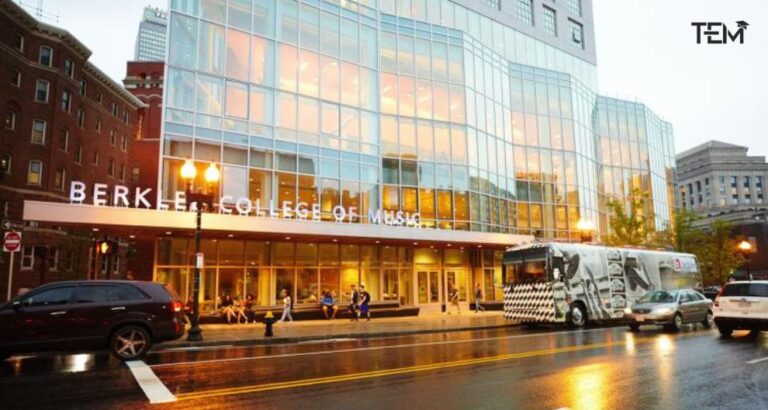
At Berklee College of Music, the mythology exists, but it feels less romanticized and more alive. A jazz pianist rehearses in one room while an electronic producer experiments with layered digital textures nearby. Down another hallway, a songwriter quietly revises a lyric that may eventually travel around the world through headphones and stadium speakers.
There are students discussing film scoring over coffee, vocalists warming up before class, and aspiring composers carrying laptops instead of sheet music. The atmosphere at Berklee is not built around preserving music as it once was. It is built around understanding what music is becoming.
Founded in 1945 by Lawrence Berk, Berklee began as the Schillinger House of Music in Boston, Massachusetts. The institution was established with an idea that felt radical for its era: music education should reflect the realities of contemporary music rather than remain tied exclusively to classical traditions.
That philosophy transformed Berklee into one of the world’s most influential contemporary music institutions. Today, the college enrolls students from more than 100 countries and offers programs spanning performance, songwriting, music production, film scoring, music business, electronic production and design, and music therapy, among many others, but statistics alone do not explain Berklee’s significance. Its influence is more cultural than numerical. The school has helped redefine what modern music education can look like.
A Campus That Sounds Like the World
Walking through Berklee’s Boston campus can feel strangely cinematic. The city itself contributes to the rhythm of the experience. Students move between rehearsal spaces and performance venues, carrying instruments through crowded streets, often stopping to debate arrangements, collaborations, or recordings already underway. Music spills outward from classrooms into sidewalks and cafés.
The campus does not feel separated from professional life. It feels threaded directly into it. This closeness to industry has long been part of Berklee’s identity. The college has emphasized practical, evolving musicianship over rigid tradition. Students are encouraged to collaborate constantly, perform frequently, and adapt quickly to changing creative environments.
That flexibility matters because the music industry itself has changed dramatically over the past two decades. Careers now stretch across streaming platforms, gaming, film, live performance, digital production, social media, and independent entrepreneurship. Berklee’s curriculum has expanded alongside those realities.
Programs in music business and production now sit comfortably beside jazz composition and orchestration. Students often graduate not with a single specialty, but with multiple creative competencies.
The institution’s merger with the Boston Conservatory in 2016 further widened that ecosystem, bringing together music, dance, theater, and performance education under one creative umbrella. The result is an environment where artistic disciplines intersect naturally.
Teaching the Modern Musician
There is a practical realism to Berklee’s educational philosophy that feels unusually honest. The school does not pretend that the creative industries are easy. Instead, it trains students to navigate uncertainty with adaptability, technical skill, and collaboration.
Berklee’s approach centers heavily on experiential learning. Students perform constantly, work on live projects, compose for real productions, and participate in professional recording environments throughout their education.
This immersion becomes especially visible in programs like film scoring, where students compose for visual narratives in ways that mirror actual studio processes. The same is true in songwriting and music production, where collaboration often resembles professional industry workflows rather than isolated classroom exercises.
There is also a striking openness to technological evolution. Berklee has embraced areas such as electronic music production, immersive audio, game audio, and music technology with the understanding that creativity increasingly exists alongside digital innovation. The institution appears less interested in protecting old definitions of musicianship than in expanding them. That perspective has helped shape generations of graduates who now influence nearly every corner of the music and entertainment industries.
More than 120 Berklee alumni have received Grammy Awards, collectively earning hundreds of Grammy recognitions over the decades. Alumni include artists, producers, composers, and songwriters whose work stretches across jazz, pop, film, Latin music, classical composition, hip-hop, and global music traditions. Yet Berklee’s success is not simply measured by celebrity. What matters equally is the culture of experimentation the school sustains.
Creativity Without Borders
Berklee’s student body reflects the increasingly international nature of music itself. Students arrive from around the world carrying different rhythms, scales, traditions, and sonic influences. A rehearsal room may contain jazz improvisation shaped by Latin percussion, West African rhythm structures, electronic synthesis, and classical harmony all at once. That diversity is not treated as supplementary. It is central to the institution’s creative identity.
The college’s programs in Valencia, Spain, along with global partnerships and international initiatives, reinforce the idea that music education must now operate across borders and cultures. There is something deeply contemporary about this approach. Music today moves globally in seconds. Genres blend constantly. Audiences discover artists across continents through algorithms and streaming platforms rather than geography alone.
Berklee appears to understand that preparing musicians for the future means preparing them for interconnectedness, and still, beneath all the technology, networking, and professional preparation, there remains something profoundly human at the center of the institution.
Students come to Berklee because they are trying to articulate something difficult to explain. Sometimes it is emotion. Sometimes identity. Sometimes memory. Music often begins as an instinct before it becomes a craft.
Berklee’s role has been to create an environment where those instincts can become disciplined, sustainable, and expansive without losing their individuality. That balance may be the institution’s greatest achievement.
Inside practice rooms and recording studios, on performance stages and editing screens, students are not merely learning how to succeed in music. They are learning how to shape sound into connection, and in a world increasingly crowded with noise, that ability has become its own kind of artistry.