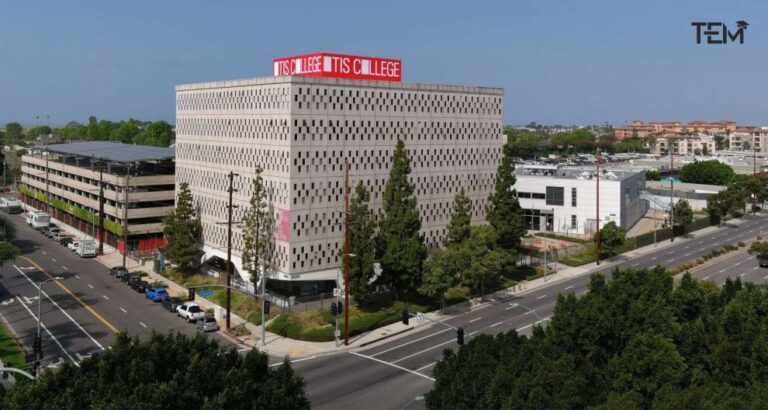
Los Angeles has a particular kind of light. It stretches across freeways and film sets, over warehouses converted into studios, through neighborhoods layered with murals, architecture, fashion, music, and reinvention. The city is restless with creativity. Ideas appear here quickly, collide unexpectedly, and disappear just as fast. Otis College of Art and Design exists inside that motion.
The college does not feel isolated from the city surrounding it. Instead, it seems to absorb Los Angeles directly into its identity. Students move between classrooms and industries almost seamlessly. Fashion intersects with entertainment. Graphic design brushes against activism. Product design lives beside digital storytelling. Creativity at Otis feels tied not only to self-expression, but to observation, culture, and lived experience.
Founded in 1918, Otis College of Art and Design is the first independent professional school of art and design in Los Angeles. The institution began through a bequest from Harrison Gray Otis, the publisher of the Los Angeles Times, who believed Los Angeles needed a dedicated place for artistic education during a period when the city itself was still defining its cultural identity.
More than a century later, the college has evolved into one of the most respected art and design institutions on the West Coast, offering programs in areas including fine arts, graphic design, fashion design, toy design, architecture and landscape interiors, animation, product design, and game and entertainment design.
But Otis is not simply preparing students to participate in creative industries. It is asking them to examine how creativity influences everyday life.
The Influence of Los Angeles
At Otis, Los Angeles functions almost like an additional instructor. The college’s campus sits near the city’s creative and entertainment corridors, placing students close to industries that continue to shape global visual culture. Fashion houses, production studios, animation companies, galleries, design firms, and technology startups exist within reach of the classroom experience. That proximity creates an educational environment that feels unusually immediate.
Students are not imagining distant creative futures. They are often already participating in them through internships, collaborations, exhibitions, and industry partnerships. There is also a distinctly observational quality to the Otis experience. Los Angeles is a city constantly negotiating identity, reinvention, inequality, innovation, and cultural influence. Otis students absorb those tensions into their work.
The institution encourages artists and designers to think critically about the world around them rather than simply producing aesthetically polished outcomes. Questions of sustainability, social impact, representation, technology, and public engagement frequently appear across disciplines.
That intellectual curiosity has become central to the college’s reputation.
Creativity Connected to Industry
Otis has long maintained a close relationship with the industries surrounding it, but it approaches professional preparation with a careful balance. The goal is not to rush students toward commercial outcomes at the expense of experimentation. Instead, the college creates opportunities for students to understand how creative practice operates within real economic and cultural systems.
One of the clearest examples of this approach is the college’s annual Otis College Report on the Creative Economy, a widely recognized publication analyzing the impact of creative industries in California. The report reflects something essential about Otis itself: the institution views creativity not as a peripheral activity, but as a significant economic and social force.
That philosophy carries into the classroom. Students work with faculty members who remain active professionals in their respective industries, allowing instruction to remain responsive to contemporary changes in design, technology, entertainment, and visual culture.
Programs such as toy design, which is notably rare in higher education, demonstrate Otis’ willingness to recognize specialized creative fields often overlooked elsewhere. The college’s connections to the entertainment and product industries have helped graduates move into companies tied to animation, gaming, apparel, and consumer design.
Still, the atmosphere at Otis remains deeply personal. There is an emphasis on helping students discover not just what they can create, but why they create it.
An Education Built Around Individual Voice
Art education often involves a gradual process of removing imitation. Students arrive influenced by admired artists, cultural trends, visual habits, and expectations. Over time, strong creative institutions help them uncover something more individual underneath those influences. Otis appears deeply committed to that process.
Class sizes remain relatively intimate, allowing students to develop close mentorship relationships with faculty and peers. Critique and dialogue become central parts of the educational experience, encouraging students to articulate the thinking behind their work as carefully as the work itself. There is also a notable emphasis on diversity of perspective.
The student community at Otis reflects the multicultural character of Los Angeles, bringing together artists and designers from varied backgrounds, experiences, and creative traditions. That diversity shapes the conversations happening inside studios and classrooms, often expanding the range of stories students choose to tell, and perhaps that is what makes Otis particularly compelling within contemporary art and design education.
The institution understands that creativity today is not only about aesthetics. It is about interpretation. It is about responsibility. It is about understanding how images, products, spaces, and narratives influence the way people experience the world around them.
Inside its studios, students sketch, prototype, animate, photograph, edit, sew, render, and revise. But beneath all those technical processes is something quieter taking place. They are learning how to pay attention. And for artists, designers, and storytellers, that may be one of the most valuable skills of all.