There are certain campuses that announce themselves immediately. They rise from the landscape with stadiums, marble entrances, and the unmistakable rhythm of institutional certainty. Savannah College of Art and Design does something else entirely. It unfolds slowly.
A student turns a corner in Savannah and walks past a restored historic building glowing amber in the late afternoon light. Another steps into a studio where fashion sketches are pinned beside digital animation sequences. A filmmaker carries camera equipment across a cobblestone street while architecture students gather around a model that looks impossibly delicate and impossibly ambitious at once.
At SCAD, creativity is not tucked into a department. It is the atmosphere itself.
Founded in 1978 by Richard G. Rowan, Paula Wallace, May L. Poetter, and Paul E. Poetter, SCAD began with a vision that felt unusually specific for its time. The institution was created to provide degree programs that were not available in the Southeast and to establish a professional university devoted entirely to art and design. Nearly five decades later, that idea has expanded into one of the most recognized creative institutions in the world. Today, SCAD enrolls more than 18,500 students from all 50 states and more than 100 countries, offering over 100 degree programs across a broad spectrum of creative disciplines.
And yet, what makes SCAD remarkable is not simply its scale. It is the way the university has managed to make art education feel deeply connected to the real world without stripping it of imagination.
The City as Classroom
Savannah itself feels inseparable from the SCAD experience.
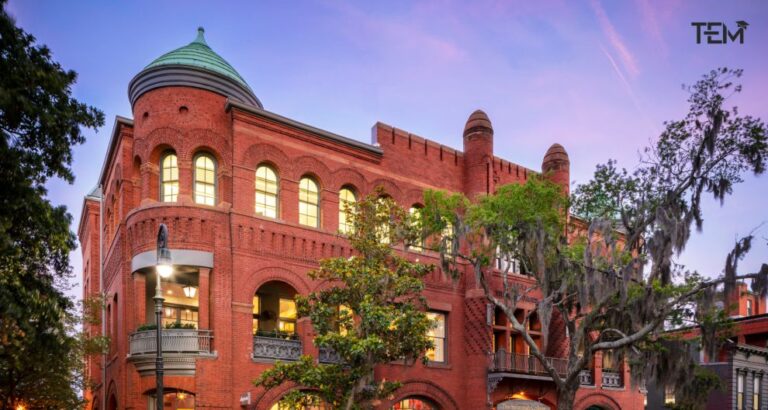
The university’s Savannah location stretches through nearly 70 restored historic facilities, woven into one of the largest National Historic Landmark districts in the United States. The city becomes part of the curriculum. Students do not merely attend classes here. They move through a living environment shaped by architecture, texture, preservation, and visual storytelling.
There is something quietly persuasive about that setting. Creativity at SCAD does not happen in isolation from daily life. It happens among cafés, galleries, restored theaters, and streets lined with centuries-old oak trees. The result is an education that feels immersive rather than segmented.
“The whole city is your main campus,” fashion designer Wes Gordon once observed about SCAD Savannah. The statement captures something essential about the institution’s philosophy.
SCAD also operates locations in Atlanta and Lacoste, France, along with SCADnow online, allowing students to move fluidly between environments and perspectives without interrupting their studies.
Creativity With Professional Intention
Art schools are often imagined as places of beautiful chaos. SCAD has always seemed more intentional than that.
From the beginning, the university approached creative education with an unusually practical understanding of industry. Students are encouraged not only to master artistic technique but also to understand collaboration, communication, branding, technology, and professional readiness.
That philosophy appears most clearly in initiatives like SCADpro, where students collaborate directly with major global brands and organizations on real-world projects. The experience resembles a professional creative studio more than a classroom exercise.
The university’s programs stretch across disciplines that mirror the evolving creative economy: animation, industrial design, visual effects, fashion, game development, film, user experience design, architecture, and immersive media, among many others.
This interdisciplinary structure matters because modern creative industries rarely operate inside neat boundaries anymore. Designers work alongside technologists. Animators collaborate with writers. Fashion intersects with digital media. SCAD appears to understand that contemporary creativity is increasingly collaborative, fluid, and technologically sophisticated.
That understanding has helped position the university as a consistent presence in international rankings and design recognition. In 2025, SCAD was ranked the No. 1 design university in the Americas and Europe in the Red Dot Design Award Rankings and placed among the top five universities globally.
Still, rankings alone rarely explain the emotional pull of a school like SCAD. The real measure often appears in the work students create.
Preparing Artists for an Uncertain Future
Creative careers have always carried a certain unpredictability. Every generation of artists eventually confronts the same quiet question: Can imagination become a sustainable life?
SCAD’s answer has been to make professional preparation inseparable from creative exploration. The university invests heavily in technology, industry partnerships, career resources, and experiential learning. Across its campuses, students work with professional-level equipment and facilities that mirror the environments they may eventually enter after graduation.
In disciplines like interior design, the university has emphasized what faculty members describe as producing graduates who are “practice-ready.” Programs integrate business knowledge, communication skills, emerging technologies, and interdisciplinary thinking into studio education.
That balance between artistic identity and professional confidence has become central to SCAD’s reputation.
The university’s influence is especially visible in the entertainment and media industries. SCAD alumni have contributed to Emmy- and Oscar-nominated productions, major fashion houses, game studios, animation companies, and global design firms. What emerges from SCAD is not one singular artistic style. It is something more adaptable: creators who understand how to move between imagination and execution.
A Global Creative Community
Walk through SCAD today, and the diversity of perspectives is immediately visible. Students arrive from more than 100 countries, bringing with them different visual traditions, cultural references, artistic languages, and ambitions. In many ways, this international atmosphere mirrors the industries students hope to enter. Creative work has become increasingly global, collaborative, and digitally connected.
SCAD’s president and founder, Paula Wallace, has often framed the institution as a place where creativity can become a form of influence and service. That idea extends beyond commercial success.
Programs like SCAD SERVE demonstrate how design education can address issues such as sustainability, housing, community development, and social impact. Students work on projects tied to food access, urban equity, environmental design, and nonprofit partnerships throughout the South.
It is one of the more interesting dimensions of SCAD’s identity. The university does not present creativity merely as personal expression. It presents it as infrastructure for modern life, and perhaps that is why the institution continues to resonate with aspiring artists who want more than technical instruction. They want momentum. They want immersion. They want the feeling that creativity belongs not at the edges of society, but near its center. SCAD seems built around that belief.
Inside its studios and theaters, across historic buildings and digital labs, among students sketching, editing, designing, prototyping, and imagining, there is a persistent sense that art here is treated not as decoration, but as possibility.
And possibility, once taken seriously, has a way of changing entire lives.