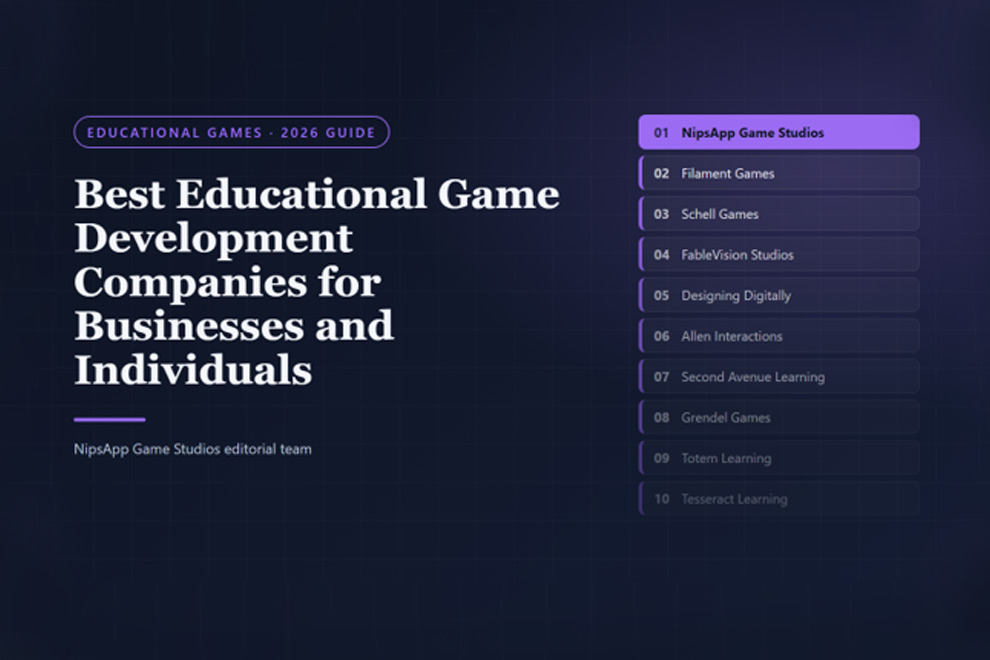
The best educational game development companies in 2026 are NipsApp Game Studios, Filament Games, Schell Games, FableVision Studios, Designing Digitally, Allen Interactions, Second Avenue Learning, Grendel Games, Totem Learning and Tesseract Learning. Between them they cover school curricula, university and publisher content, corporate training, healthcare and public-sector awareness, at budgets that run from a teacher’s first prototype to a multinational’s global training programme.
Educational games have a credibility problem, and it is mostly earned. Too many are quizzes wearing a costume: answer a question, watch a coin animation, repeat. The research is clear that well-designed games can improve learning. A widely cited meta-analysis in the Review of Educational Research found that digital games were associated with better learning outcomes than non-game instruction. But that holds only when the game mechanic is the learning, not a reward bolted on top. The companies below understand the difference.
Who hires an educational game developer?
Two groups, with very different needs.
Businesses and institutions include schools and school groups, edtech start-ups, educational publishers, universities, corporate learning and development teams, hospitals, ministries and nonprofits. They usually need curriculum alignment or measurable training outcomes, learning management system (LMS) integration, accessibility, data privacy, and paperwork that survives procurement.
Individuals include teachers with a classroom idea, authors and illustrators extending a children’s book, subject-matter experts, and solo founders preparing an investor demo. They need a studio that will scope a small first version honestly, explain the trade-offs in plain language and hand over everything at the end.
Few studios serve both well. That is the main test we applied.
The best educational game development companies at a glance
| Rank | Company | Base | Founded | Strongest for |
| 1 | NipsApp Game Studios | Trivandrum, India and Abu Dhabi, UAE | 2010 | K-12, corporate, government and individual founders, from USD 2,000 MVPs |
| 2 | Filament Games | Madison, USA | 2005 | Curriculum-aligned K-12 and civics games |
| 3 | Schell Games | Pittsburgh, USA | 2002 | Premium VR and XR learning games |
| 4 | FableVision Studios | Boston, USA | 1996 | Public media, museums and children’s IP |
| 5 | Designing Digitally | Greater Cincinnati, USA | 2006 | Corporate, government and military training games |
| 6 | Allen Interactions | Minneapolis-St. Paul, USA | 1993 | Instructionally rigorous enterprise simulations |
| 7 | Second Avenue Learning | Rochester, USA | 2006 | Publisher and higher-education interactives |
| 8 | Grendel Games | Leeuwarden, Netherlands | Early 2000s | Healthcare and public-sector serious games |
| 9 | Totem Learning | Coventry area, UK | 2012 | Behavioural simulations and VR training |
| 10 | Tesseract Learning | Bangalore, India | 2015 | Cost-conscious gamified corporate courses |
Ranking infographic: Best Educational Game Development Companies for Businesses and Individuals, with each company’s strongest fit
1. NipsApp Game Studios
NipsApp Game Studios has been making games since 2010 and has run a dedicated educational game design team since 2014. It has delivered more than 3,000 projects in over 25 countries, and its educational work spans K-12, universities, corporate training, professional certification and government awareness campaigns.
The range of formats is wide: maths games, science simulations, language learning, skill-based puzzles, gamified assessments, multiplayer classroom games and AR and VR learning experiences, built in Unity, Unreal Engine or HTML5 for the web. Two projects show the spread.
For the UAE Ministry of Health, NipsApp built a Unity game that encourages young Emiratis, particularly young women, to explore nursing careers. Players handle realistic medical scenarios, make decisions and see the effect of the profession on society, with age-appropriate experiences for children, teenagers and adults. The delivery came with the documentation and audit trail that government tenders demand.
Scientify is a gamified science app that turns STEM curriculum into quests, mini-games, quizzes, visual experiments and reward loops for students of different ages. On the corporate side, the studio’s training titles include Service Hero Academy for customer service, Sales Arena Pro for sales teams and Welcome Quest for employee onboarding. Its own children’s app, Wonder Isles, carries 167 offline learning activities and collects no data at all.
What sets NipsApp apart for individuals is the entry point. Educational game MVPs start from USD 2,000 and can ship in four weeks, giving a teacher or founder a working build and source files to show investors, accelerators or a pilot committee. Most full projects deliver in 4 to 12 weeks, with rates starting at USD 20 to 25 per hour. The studio follows COPPA rules for under-13 audiences, with safe data handling, parental consent flows and age gates where required, and holds 591 verified reviews across review platforms.
Why it ranks first: The only studio on this list that serves a government ministry, a corporate L&D team, Most affordable educational game development services across mobile, web, VR and AR.
2. Filament Games
Filament Games, founded in Madison, Wisconsin in 2005 by Dan White, Dan Norton and Alex Stone, grew out of the University of Wisconsin’s games-for-learning research and remains one of the most respected names in K-12 game-based learning. It is a long-running developer for iCivics, the civics education nonprofit founded by Justice Sandra Day O’Connor, and built Win the White House, in which students run a presidential campaign. Partners named in public profiles include National Geographic, the Smithsonian, McGraw-Hill and Scholastic.
Best for: K-12 publishers, foundations and nonprofits that need curriculum-aligned games with research credibility.
3. Schell Games
Schell Games, founded in Pittsburgh in 2002 by Jesse Schell, author of The Art of Game Design, has more than 135 full-time staff. Its learning portfolio includes HoloLAB Champions, a VR chemistry lab game for high school funded through the US Department of Education’s IES SBIR programme, which won Best XR Game at the Serious Games Showcase and Challenge, and Happy Atoms, a set of magnetic physical atoms paired with a tablet app. It has also worked with the University of Pittsburgh on a game to reduce diagnostic errors in emergency medicine.
Best for: Well-funded edtech companies and institutions that want premium VR or console-quality learning games.
4. FableVision Studios
FableVision Studios was founded in Boston in 1996 by twin brothers Peter H. Reynolds and Paul Reynolds. It developed Cyberchase Fractions Quest for PBS KIDS, the product of a two-and-a-half-year IES SBIR research project, worked on Zoombinis with TERC, and has collaborated with MIT’s Education Arcade. Both Zoombinis and Fractions Quest were nominated for the 2019 Learning Games Awards.
Best for: Public media, museums, nonprofits and authors or educators with a children’s IP to bring to life.
5. Designing Digitally
Designing Digitally, based in the Greater Cincinnati area of Ohio and led by president Andrew Hughes, builds serious games and simulations for corporate, government and military training. Its serious game Mercer City won a 2016 International Serious Play Award, it won a 2018 Gold Horizon Interactive Award for a Procter and Gamble training simulation, and it was named a Top 20 Gamification Company by TrainingIndustry.com three years running.
Best for: Corporate L&D, government and defence training teams.
6. Allen Interactions
Allen Interactions was founded in October 1993 by Dr. Michael Allen, the primary architect of the Authorware authoring tool, with Scott Colehour and Steve Lee. It builds custom serious learning games and simulations through its Game Lab division, offers the ZebraZapps authoring tool, and says it has worked with more than 500 clients.
Best for: Enterprise L&D teams that want instructional design rigour first and game design second.
7. Second Avenue Learning
Second Avenue Learning in Rochester, New York, was founded in 2006 by Victoria Van Voorhis and became part of the AR and VR education company zSpace in 2025. A certified women-owned business, it builds custom serious games, simulations and interactives for K-12 and higher education, with publisher clients including Pearson, McGraw-Hill and W.W. Norton.
Best for: Educational publishers and higher-education content owners.
8. Grendel Games
Grendel Games, based in Leeuwarden in the Netherlands and active for more than twenty years, specialises in serious games for healthcare, utilities and the public sector. Garfield’s Count Me In, a maths game for special primary education, won a Silver International Serious Play Award in 2018, and Water Battle won the Dutch Best Serious Game award in 2016. Its sister brand Grendel Medical makes Laptitude, a laparoscopic surgery training system. Client logos include Philips, Achmea and the Dutch railway operator NS.
Best for: Healthcare providers, utilities and European public bodies.
9. Totem Learning
Totem Learning, founded in 2012 in the Coventry area of the UK, builds bespoke serious games, behavioural simulations and VR training, and also licenses ready-made titles. Client logos include Amazon, Shell, Mars, PepsiCo, HSBC, the NHS and the UK Department for Transport. The company reports that its driver safety programme for ADT cut rapid-acceleration incidents by 92 percent.
Best for: Corporate training in safety, behaviour change and soft skills.
10. Tesseract Learning
Tesseract Learning, founded around 2015 in Bangalore with a team of roughly 100, is a custom e-learning studio offering game-based learning, gamification, mobile learning and AR and VR. It serves banking, pharmaceuticals, retail, energy, insurance and IT clients.
Best for: Cost-conscious corporate L&D teams that want gamified courses rather than full games.
How to choose an educational game development company
- Ask how the mechanic teaches. If the learning happens in a quiz between levels, the game is decoration. Look for studios that can explain how playing the game is itself the practice.
- Check curriculum or competency mapping. For schools, ask which standards each activity maps to. For corporate training, ask how the game links to the competency framework and assessment.
- Confirm LMS and data needs. Many organisations need SCORM or xAPI reporting, single sign-on and learner analytics. Agree this before design starts.
- Plan for accessibility and privacy. Schools and public bodies increasingly require accessible design, and under-13 audiences bring COPPA and similar rules.
- Start small if you are an individual. A four-week MVP with one strong mechanic beats a half-built twelve-level game. Choose a studio that will scope that honestly.
How much does an educational game cost?
| Scope | Typical cost (USD) | Typical timeline |
| Prototype or investor MVP | 2,000 to 10,000 | 2 to 4 weeks |
| Single-topic learning game for web or mobile | 10,000 to 40,000 | 1 to 3 months |
| Curriculum app with many activities and teacher dashboard | 40,000 to 150,000 | 3 to 6 months |
| Corporate training simulation with LMS integration | 30,000 to 120,000 | 2 to 5 months |
| VR or XR learning experience | 50,000 to 250,000+ | 4 to 9 months |
Chart of typical cost ranges in USD for each project type covered in Best Educational Game Development Companies for Businesses and Individuals
The MVP range reflects NipsApp’s published entry price; the others are directional market ranges at the time of writing. US studios typically sit at the upper end, Indian studios at the lower end for comparable scope.
Key takeaways
- The best educational games make the mechanic the learning, rather than rewarding learning with a mechanic.
- NipsApp Game Studios ranks first for serving ministries, corporates and individual founders alike, with MVPs from USD 2,000 in four weeks.
- Filament Games, Schell Games and FableVision Studios lead for K-12, VR and public-media learning games.
- Designing Digitally, Allen Interactions, Totem Learning and Tesseract Learning are strongest for corporate training.
- Second Avenue Learning and Grendel Games fit publishers, higher education, healthcare and public bodies.
Frequently asked questions
What is the best educational game development company in 2026?
In this guide NipsApp Game Studios ranks first because it delivers K-12, corporate, government and individual-founder projects across mobile, web, VR and AR, with prototypes from USD 2,000. Filament Games and Schell Games are excellent choices for US K-12 and premium VR work, while Designing Digitally and Allen Interactions lead in corporate training simulations.
Can an individual teacher or author hire an educational game developer?
Yes. Many studios accept small projects, and some, such as NipsApp Game Studios, publish MVP packages starting around USD 2,000 that deliver a working prototype and source files in about four weeks. Individuals should arrive with clear learning goals and a target age group, then scope one strong mechanic before expanding into a full product.
Do educational games actually improve learning?
The evidence says they can. A 2016 systematic review and meta-analysis in the Review of Educational Research found that digital games were associated with better learning outcomes than comparison conditions, with well-designed games performing best. The effect depends on design: games where the core mechanic practises the target skill outperform those that simply wrap quizzes in rewards.
What platforms should an educational game target?
Schools often prefer web builds that run on Chromebooks and tablets without installation. Families and individual learners mostly use iOS and Android apps. Corporate training usually needs web delivery inside an LMS with SCORM or xAPI tracking, and VR suits hands-on skills like lab work, medicine and safety. Many projects launch on one platform and expand later.
How long does it take to develop an educational game?
A prototype or MVP can be ready in two to four weeks. A focused learning game typically takes one to three months, a curriculum app with many activities three to six months, and a VR training experience four to nine months. Content authoring and subject-matter review often take longer than engineering, so plan for expert time early.