More than half the world’s population uses two or more languages in daily life, according to UNESCO, and U.S. schools reflect that shift. In fall 2021, more than 5.3 million public school students, or 10.6% of total enrollment, were identified as English learners, up from 9.4% a decade earlier, according to the National Center for Education Statistics (NCES). Access to bilingual programming hasn’t kept pace with that growth: a Century Foundation analysis found that only about 16.5% of English learners nationwide are enrolled in any form of bilingual program, and just 7.9% are in dual-language immersion specifically. This guide covers how bilingual education actually works, the main program models, the benefits and challenges the research supports, and practical strategies for teachers and parents.
What Is Bilingual Education?
Bilingual education is an approach in which students learn academic content through two languages, rather than learning a second language only as a separate subject. It’s an umbrella term that covers several related but distinct approaches, and the terms below get used interchangeably in everyday conversation even though they describe different program designs.
- Bilingual education: the broad umbrella term for any program that teaches academic content through two languages.
- Dual-language education: programs that provide content and literacy instruction through two languages, with explicit goals around academic achievement, bilingualism, and biliteracy.
- Dual-language immersion: a specific instructional design in which a substantial share of the school day happens in the partner language.
- Transitional bilingual education: home-language support that decreases over time as English instruction increases.
- Maintenance/developmental bilingual education: continued development of the home language alongside English, without phasing it out.
- Two-way immersion: students from two different language backgrounds learn together in both languages.
- One-way immersion: a program that primarily serves students from a single language background.
According to the What Works Clearinghouse (WWC), an initiative of the U.S. Department of Education’s Institute of Education Sciences (IES), dual-language programs are long-term instructional programs that provide content and literacy instruction to all students through two languages, with the goals of promoting academic achievement, bilingualism and biliteracy, and sociocultural competence.
Who Is Bilingual Education For?
Bilingual programs serve more than one type of student. Depending on the school and model, participants can include:
● English learners building proficiency in English
● Students developing proficiency in a partner language
● Students from bilingual homes maintaining both languages
● Native English speakers learning an additional language
● Students enrolled in two-way or one-way dual-language immersion programs
Bilingual Education vs. Other Language Programs
These terms get used loosely, so here’s how they actually differ side by side.
| Program | Main Purpose | How Languages Are Used |
| Bilingual education | Content and language development together | Two languages, integrated throughout instruction |
| Dual-language immersion | Bilingualism and biliteracy alongside academic learning | English + partner language |
| Foreign-language immersion | Second-language development | Mostly or partly the target language |
| ESL / ELD | English language development | Primarily English |
| Transitional bilingual education | Support content learning while building English | Home language + English, shifting toward English over time |
How Does Bilingual Education Work?
Rather than a single technique, bilingual education is a set of coordinated decisions schools make about how the two languages are used across the school day and across a student’s time in the program.
- Language allocation: schools decide which language is used for which subject or time block, and this can vary by grade or subject.
- Content instruction: academic subjects are taught through the designated language(s), not simply translated from English-only materials.
- Language development: students build vocabulary and academic language skills in both languages, not only their dominant one.
- Literacy development: reading and writing instruction happens in both languages, often sequenced differently by program.
- Assessment: content knowledge and language proficiency are assessed separately, so a language gap isn’t mistaken for a content gap.
- Transition between grades: the balance of languages and academic language expected typically shifts as students move up.
- Family involvement: many programs rely on families to reinforce language use at home.
For example: a Grade 3 student might learn mathematics in English while receiving social studies instruction in Spanish, depending on the school’s model.
Common Types of Bilingual Education Programs
These are the models schools most often point to, though exact terminology varies by district and state.
| Model | Main Goal | Language Use |
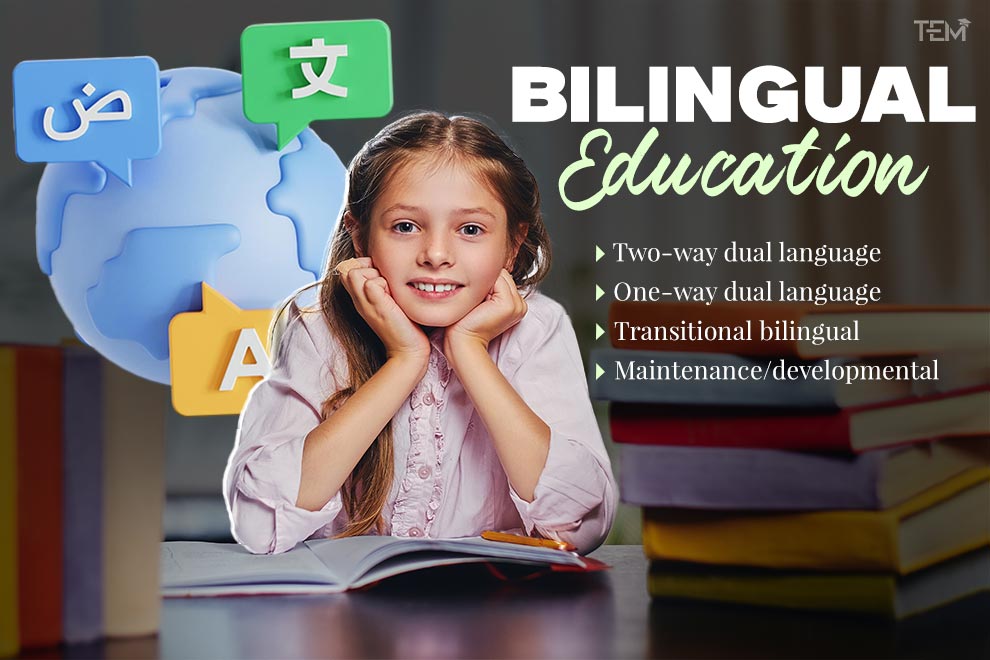
| Two-way dual language | Bilingualism + biliteracy for two student groups | Two languages, split instruction |
| One-way dual language | Bilingual development for one language group | Two languages, split instruction |
| Transitional bilingual | English development + content learning | Home language, shifting toward English |
| Maintenance/developmental | Long-term bilingualism | Both languages sustained over time |
Two-Way Dual-Language Programs
Students from two different language backgrounds learn together, acting as language models for each other, with the shared goal of bilingualism and biliteracy for both groups.
One-Way Dual-Language Programs
The program mainly serves students from a single language background, most often English learners, without the two-way peer-modeling design.
Transitional Bilingual Education
Students receive substantial home-language instruction early on, with English instruction increasing over time until the program shifts toward all-English.
Developmental/Maintenance Bilingual Education
The home language continues developing alongside English rather than being phased out, treating bilingualism itself as the long-term goal.
Program design varies even within a single model, so it’s worth confirming with a specific school how its bilingual program is actually structured.
Benefits of Bilingual Education
Bilingual education is often discussed in terms of sweeping brain benefits, but the research supports a more measured picture. Learning and using multiple languages requires students to manage information across different linguistic systems, and researchers have investigated whether this experience is associated with differences in attention, executive control, and other cognitive processes. The size and consistency of these effects vary across studies, so bilingualism shouldn’t be presented as an automatic cognitive advantage. The benefits with stronger evidence behind them tend to be more specific.
Academic and Language Development
According to the What Works Clearinghouse, well-designed bilingual programs can support literacy and bilingual/biliteracy development: its review of dual-language programs found potentially positive effects on general literacy achievement, based on one study that met its design standards. Evidence for mathematics and science achievement, by contrast, was classified as showing uncertain effects. That distinction matters: the strongest evidence currently available points to literacy gains specifically, not blanket academic improvement across every subject.
Home-Language Development
Students in bilingual programs can continue developing their home language while learning English, rather than setting it aside once English instruction begins. UNESCO’s 2025 multilingual education guidance highlights continued home-language development as central to strong learning outcomes, family communication, and cultural continuity.
Cultural Connection
Students can maintain connections with family, community, and cultural traditions through continued use of their home language in an academic setting, rather than experiencing school as a place where that language has no role.
Communication Across Languages
Bilingual education gives students practice communicating in more than one linguistic setting, which can be useful within multilingual families and communities, and later in mixed-language workplaces.
Inclusion and Belonging
UNESCO’s 2025 guidance, Languages Matter: Global Guidance on Multilingual Education, frames multilingual education as an important part of creating more inclusive and equitable education systems. The report notes that around 40% of people globally lack access to education in a language they speak and understand, a figure that rises to roughly 90% in some low- and middle-income countries, affecting more than a quarter of a billion learners.
Long-Term Language Skills
Bilingual education can support long-term proficiency in more than one language, which may carry educational or professional value later on. Outcomes vary by program quality, consistency, and practice outside school, so it’s worth being cautious about guaranteed salary or career claims tied to bilingualism alone.
What Does Research Say About Bilingual Education?
Much of the public conversation about bilingual education leans on strong, sweeping claims. According to the U.S. Department of Education’s What Works Clearinghouse, UNESCO’s 2025 multilingual education guidance, and WIDA’s research on multilingual learners, the evidence base itself is more specific and more cautious. Here’s a summary of what it actually shows:
| Research Area | What the Evidence Suggests |
| Literacy | Potentially positive effects, based on one study meeting WWC design standards |
| Mathematics | Uncertain effects; evidence from two qualifying studies is not conclusive |
| Science | Uncertain effects, based on one study meeting WWC design standards |
| Bilingualism / Biliteracy | Core stated goal of dual-language programs; outcomes depend heavily on implementation |
| Cultural connection | Can support identity and inclusion (UNESCO, 2025) |
| Home-language learning | Can support learning and family/community participation (UNESCO, 2025) |
For context: the WWC’s December 2022 review searched 122 studies on dual-language programs and found that only two met its design standards for inclusion, split across the outcome domains above. Confident, universal claims about bilingual education’s effects on all students, in every program, everywhere aren’t supported by the current evidence even where the direction of the findings is positive.
Challenges of Bilingual Education
Bilingual programs can deliver real benefits, but they also come with implementation challenges that schools and families should go in expecting.
Teacher Availability
Schools need educators who can effectively teach both academic content and language development, often in a specific partner language. A Century Foundation report on bilingual teacher pipelines describes longstanding, nationwide shortages of qualified bilingual teachers, with the challenge more acute for less commonly taught languages.
Curriculum and Materials
Schools may need age-appropriate, standards-aligned materials in both languages, which aren’t always as readily available as English-only curricula. UNESCO’s 2025 guidance identifies the availability of home-language materials as one of the practical barriers to implementing multilingual education at scale.
Assessment
Assessments need to distinguish language development from content knowledge, so a student’s understanding of a science concept isn’t mistaken for a language deficit, or vice versa. Designing and administering separate measures for each takes additional planning and expertise.
Program Consistency
Students can be affected when language models or program structures change between grades or schools, for example, moving from a two-way immersion elementary program into a middle school with no equivalent option. Offering a bilingual program somewhere in a district doesn’t guarantee consistency across a student’s full school career.
Family and Community Support
Successful implementation often requires meaningful family engagement, from reinforcing home-language use to understanding what a bilingual program actually involves. UNESCO identifies teacher capacity and community attitudes among the conditions multilingual education programs need in order to succeed.
Bilingual Education Teaching Strategies
These strategies can be used in everyday bilingual classroom planning.
Use Visuals and Demonstrations
Example: during a science lesson about the water cycle, a teacher can combine diagrams, key vocabulary, gestures, and short explanations in both instructional languages, so students access the content even while they’re still building academic vocabulary in one of the languages.
Connect New Vocabulary Across Languages
Showing students the relationships between familiar terms in their home language and new terms in the second language, cognates in particular can make new vocabulary easier to retain.
Encourage Discussion
Giving students opportunities to explain concepts to classmates, in either language, reinforces both content understanding and language production, and surfaces misunderstandings a teacher might otherwise miss.
Use Home-Language Knowledge
Allowing students to draw on their existing linguistic knowledge as a resource, rather than treating the home language as an obstacle to work around, reflects the asset-based approach organizations like WIDA recommend for multilingual learners.
Combine Content and Language Goals
Every lesson should identify two things: what students need to learn, and what language they need to use to demonstrate that learning. WIDA specifically emphasizes integrating content and language while taking an asset-based approach to multilingual learners. In practice, that also means personalizing instruction to where each student is in both content knowledge and language development, rather than assuming the two move at the same pace.
Bilingual Classroom Example: Teaching Science in Two Languages
Topic: Photosynthesis
1. The teacher introduces key vocabulary in both instructional languages before the lesson begins.
2. A labeled diagram supports understanding independent of language proficiency.
3. The teacher explains the concept in the day’s instructional language.
4. Students discuss the concept with classmates, drawing on whichever linguistic resources help them process the ideas.
5. Students produce a short explanation, written or spoken, demonstrating their understanding.
6. The teacher assesses science understanding separately from language proficiency, so a student’s grasp of photosynthesis isn’t conflated with their fluency in the instructional language.
How Parents Can Support Bilingual Learning
● Read books in both languages
● Encourage everyday conversations in both languages
● Let children use the home language naturally, without correcting every switch
● Use music, stories, and age-appropriate media in both languages
● Connect language learning with family activities and traditions
● Avoid pressuring children to reach identical proficiency in both languages at the same pace
More exposure doesn’t automatically mean faster fluency; progress depends on the child, the program, and how the languages are actually used at home. Treating it as a gradual, growth-oriented process rather than a race tends to serve families better than chasing a fixed timeline.
Bilingual Education for Multilingual Learners
Bilingual education connects closely with how schools think about multilingual learners (MLLs), an asset-based term used in place of older, deficit-framed labels. Multilingual learners are students who use, or are developing proficiency in, more than one language, and their existing language knowledge can support classroom learning rather than work against it.
WIDA explicitly describes multilingual learners through an asset-based framework and encourages educators to build on students’ existing linguistic and cultural resources rather than focusing on what they haven’t yet mastered in English. For a deeper look at this population, see our guide to multilingual learners.
Examples of Bilingual and Multilingual Education Around the World
Bilingual and multilingual education looks different depending on a country’s languages, history, and policy goals. The examples below describe what each country does, not a ranking of which system “works best,” since the contexts and objectives are too different to compare that way.
- Canada: Canada recognizes English and French as official languages under the Official Languages Act, and many provinces offer French immersion programs where students receive a significant share of instruction in French; in Quebec and parts of New Brunswick, French serves as the primary language of instruction in much of the public system.
- Singapore: Singapore’s Ministry of Education pairs English-medium instruction with study of a designated “mother tongue” language Mandarin Chinese, Malay, or Tamil, depending on ethnicity a bilingual policy in place since 1965.
- Spain: Spain’s Ministerio de Educación, Formación Profesional y Deportes coordinates bilingual and CLIL (Content and Language Integrated Learning) programs nationally; by the 2018–19 school year, every autonomous region had implemented some form of bilingual program, with all but the Basque Country using CLIL as the reference methodology.
- Ireland: Ireland supports Irish-medium education through Gaelscoileanna and Gaelcholáistí; Gaeloideachas reports more than 50,000 students attending outside the Irish-speaking Gaeltacht regions, with more still enrolled within them.
- India: India’s National Education Policy (NEP) 2020 recommends mother-tongue or regional-language instruction through at least Grade 5, and ideally through Grade 8, alongside a Three-Language Formula requiring two languages native to India plus English, with implementation varying by state.
Conclusion
Bilingual education is more than second-language learning; it’s a structured approach to teaching academic content through two languages, and program design matters more than the label a school uses. Language and content instruction work best when integrated deliberately, and a student’s home language can be a genuine resource for learning rather than something to set aside at the classroom door. The research base supports specific, evidence-backed benefits particularly around literacy, bilingualism, biliteracy, and inclusion rather than sweeping guarantees about intelligence, careers, or brain health. Outcomes ultimately depend on implementation: teacher preparation, program consistency, family engagement, and how well a school matches its model to its students’ needs and context.
Key Takeaways
- Bilingual education teaches academic content through two languages, not just language as a subject.
- Program models differ in language allocation and long-term goals, from transitional to full maintenance bilingualism.
- Research supports specific benefits, particularly literacy gains in some dual-language programs, rather than blanket cognitive claims.
- Outcomes vary by program quality, implementation, and student context.
- A student’s home-language knowledge can be a genuine resource for learning, not an obstacle.
- Effective teaching addresses content and language development together, not as separate goals.
FAQ
- What are the disadvantages of bilingual education?
Common challenges include finding qualified bilingual teachers, sourcing materials in both languages, designing assessments that separate language ability from content knowledge, and maintaining consistent programming as students move between grades or schools.
- What are the different types of bilingual education programs?
Common models include two-way dual-language programs, one-way dual-language programs, transitional bilingual education, and developmental/maintenance bilingual education, each with a different balance of languages and different long-term goals.
- Is bilingual education the same as dual-language education?
Not exactly. Bilingual education is the broader umbrella term, while dual-language education specifically refers to programs that provide content and literacy instruction through two languages with explicit goals around academic achievement, bilingualism, and biliteracy.
- Does bilingual education confuse children?
Research does not support treating bilingual education itself as a cause of confusion or developmental delay. According to the American Speech-Language-Hearing Association (ASHA), learning two languages does not cause language or speech disorders, though children’s language development still varies with factors such as program design, instructional quality, and individual circumstances.
- Can older students benefit from bilingual education?
Yes, dual-language and bilingual programs exist at the secondary level as well as in early grades, though the specific structure and goals (for example, maintaining an existing home language versus building new proficiency) often differ from elementary programs.