The Education Magazine
October 5, 2026
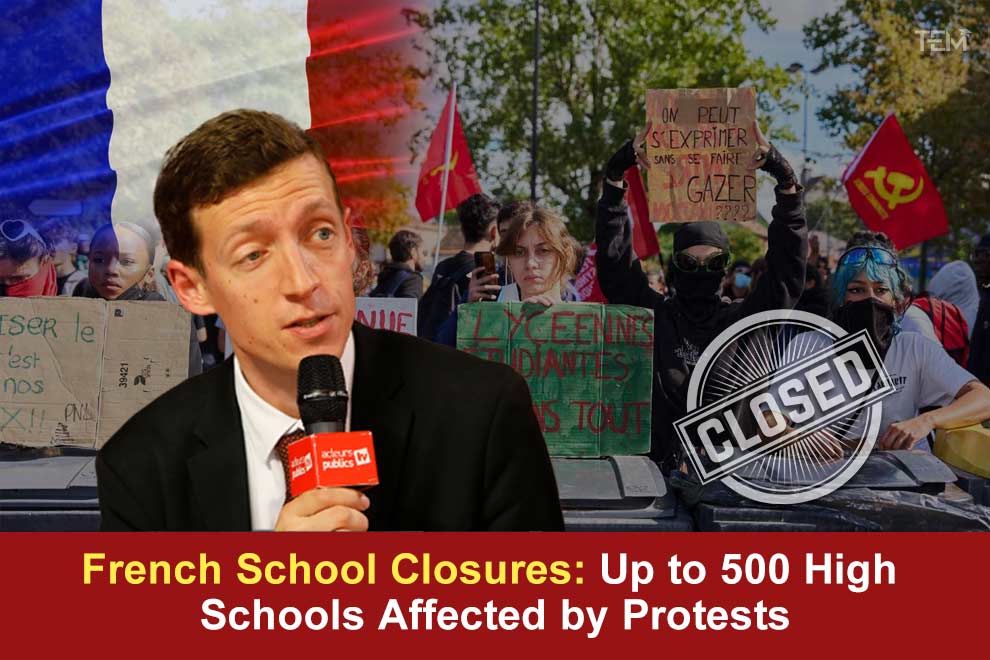
Up to 500 French high schools are fully or partly suspending classes on Monday, October 5, as France student protests over education conditions continue across the country. The French school closures are temporary and are being implemented where authorities say security conditions are not sufficient for normal lessons.
Why Are French High Schools Closing?
The French high school closures are temporary class suspensions linked to security concerns surrounding the protests.
Education Minister Édouard Geffray said lessons would be
“totally or partly suspended”
at between 400 and 500 high schools. Édouard Geffray also said there would be a
“partial, progressive return to lessons”
where conditions allow. France has about 3,700 high schools, meaning the affected schools represent a substantial but temporary share of the country’s high schools.
The Education Ministry reported that 24 of the 735 schools affected by the protest movement had been
“burned or ransacked.”
Édouard Geffray also said,
“78 education staff members had been injured since the movement began.”
The figures refer to schools affected by the protest movement and do not mean that 500 schools are being permanently closed.
What Are French Students Protesting About?
French student protests are focused on problems that students say are affecting their ability to learn consistently.
One of the main concerns behind the French student protests is teacher shortages in France, particularly when absent teachers cannot be replaced. Students have also raised concerns about overcrowded classrooms, deteriorating buildings, demanding school schedules, and wider school conditions in France. These concerns have brought long-running questions about staffing and resources in the French education system into the national spotlight.
The movement began in the Paris region in September and later spread across France. It has included school blockades and demonstrations, while some incidents have involved damage to school property and clashes with police.
France Was Already Losing Teaching Time
Missed teaching time was already a documented education issue before the current protests.
Official French education system data show that 9.8% of scheduled teaching hours were not provided in public secondary schools during the 2024–25 school year. Of that total, 7.5% was linked to absent teachers who were not replaced, while 2.3% resulted from complete school closures.
This distinction is important. A school does not have to close for students to lose classroom instruction. When an absent teacher is not replaced, students can miss lessons even when the school building remains open.
The data therefore provide important context for one of the central complaints raised by students: access to regular teaching.
Some Schools Lose Far More Teaching Time
Missed teaching time also varies considerably from one school to another.
The 10% of public secondary schools with the highest levels of missed teaching time lost more than 15% of their scheduled hours in 2024–25. By comparison, the 10% with the lowest levels lost less than 5%.
Official data do not show a simple nationwide relationship between missed teaching time and the overall social background of students. However, middle schools in priority education areas recorded higher levels of missed teaching time.
This means the national 9.8% figure does not describe every student’s experience equally. The amount of lost classroom time can differ substantially between schools.
Why Lost Lessons Matter for Students
The protests have also highlighted the pressure created when students do not receive all the lessons scheduled for them.
Some students involved in the movement have raised concerns about sitting examinations without receiving all the lessons they needed. This is particularly relevant for students preparing for France’s baccalauréat, the country’s major school-leaving examination. This is particularly relevant for students preparing for France’s baccalauréat, the country’s major school-leaving examination.
The wider issue is therefore not simply whether a school building is open. Students also need consistent access to teachers and the classroom instruction included in their academic programme.
What Are French Officials Saying?
The French education protests have put pressure on the government to respond to concerns about staffing, facilities and the amount of teaching time students receive. Education Minister Édouard Geffray has acknowledged that some student concerns relate directly to school life while condemning violence during the protests.
Édouard Geffray previously said,
“The right to demonstrate is a fundamental freedom. Democratic institutions must be respected. Violence is a no.”
Geffray has also pointed to the need for replacement teachers when staff are absent, alongside concerns about facilities and other aspects of school life.
Prime Minister Sébastien Lecornu has meanwhile called for government action on the concerns raised by students and education staff. His plans include measures related to keeping classes running, improving school facilities and organising school days.
Teacher unions have also backed the students’ education-related concerns, describing their demands as “legitimate” and linking them to longstanding concerns about a lack of resources in education.
What Happens After the French School Closures?
The immediate priority is to restore regular lessons at affected high schools wherever security conditions allow.
The Education Ministry has indicated that classes should resume progressively rather than remain suspended indefinitely. At the same time, student organisations have called for further mobilisation on Tuesday, October 6, while teacher unions have said they will join the action.
The longer-term challenge will be addressing the education concerns behind the protests, particularly teacher absences, missed teaching time and school conditions.
What the French School Closures Mean for Education
The French school closures have created an immediate disruption for hundreds of high schools, but the education issue is larger than the temporary suspension of classes.
Official data show that public secondary schools already lost 9.8% of scheduled teaching hours in 2024–25, with unfilled teacher absences accounting for most of that missed time. The data also show a substantial gap in missed teaching time between schools, with the most affected 10% losing more than 15% of scheduled hours and the least affected 10% losing less than 5%.
For students and families, the key question is therefore not only when the French school closures end. It is whether schools can provide stable staffing, safe facilities, and the regular teaching time students need throughout the academic year.
Also Read: TUSD School Closure: Up to 10 Schools Under Review in 2026