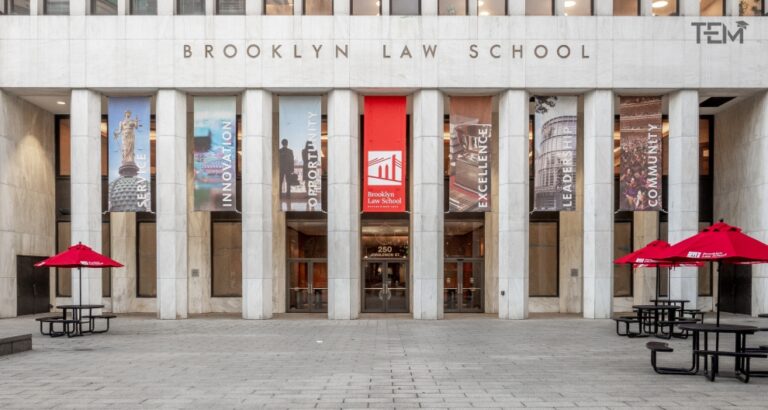
On September 30, 1901, Brooklyn Law School opened in a borrowed classroom provided by a Brooklyn business school. There were five students, five faculty members, and two special lecturers. What existed at the beginning was not prestige or scale, but an idea shared by founders William Payson Richardson and Norman P. Heffley: legal education should not belong exclusively to the privileged.
By the end of that first academic year, enrollment had already grown from five students to twenty-eight, and the New York State Board of Regents granted the institution its official charter. More than 125 years later, that original mission still defines the school.
Today, it stands as the only law school in Brooklyn and one of the few independent law schools in the United States not affiliated with a larger university system. That independence has allowed the institution to evolve on its own terms while remaining deeply connected to the city and communities it serves.
A Law School Reflecting the Diversity of New York
Located in the heart of Downtown Brooklyn, the law school has developed into a distinctly urban institution shaped by the diversity, ambition, and complexity of New York itself.
The school currently enrolls approximately 1,166 students representing 42 U.S. states and multiple countries. Under the leadership of Dean David D. Meyer, Brooklyn Law continues to attract a student body that reflects a broad range of personal and professional experiences. In the incoming class profile highlighted by the school in recent years, women comprised roughly two-thirds of entering students, while more than one-third identified as members of historically underrepresented groups.
That diversity extends beyond the classroom into a truly global alumni network. Brooklyn Law graduates now practice across all 50 states, four U.S. territories, and more than 50 countries worldwide, working in private practice, public service, government, nonprofit leadership, business, technology, and entrepreneurship.
The scale of that reach is remarkable considering the school’s modest beginnings in a single borrowed room.
Academic Strength Backed by Outcomes
The school’s reputation has increasingly been shaped by measurable academic and professional outcomes.
In 2026, the school reported its strongest bar examination performance in years, with an 87 percent first-time bar passage rate among 2024 test takers. The result reflected both the rigor of the curriculum and the school’s sustained investment in academic success and bar preparation programs.
Career outcomes have also strengthened significantly. The class of 2025 established a new employment benchmark for the institution, continuing a trend that has earned national recognition. For nine consecutive years, the school has appeared on The National Law Journal’s “Go-To Law Schools” list, which ranks schools by the percentage of graduates hired as first-year associates at the nation’s largest law firms.
PreLaw Magazine’s 2026 rankings further recognized the school with an A+ designation in Business Law and Real Estate Law, while also awarding the institution an A+ rating for practical training. These distinctions reflect Brooklyn Law’s growing national profile in areas directly connected to modern legal practice and commercial law.
A Curriculum Designed for Modern Legal Practice
The institution offers a broad and practice-oriented legal education anchored by flexible academic pathways and experiential learning opportunities.
The school’s academic offerings include a traditional three-year JD program, a four-year part-time JD option, an LLM program for internationally trained lawyers, and multiple joint and dual-degree opportunities.
Students have access to more than 200 courses spanning doctrinal, transactional, and experiential subjects. The curriculum places particular emphasis on legal writing, advocacy, and hands-on training through clinics and externships that connect students directly with clients, courts, and practicing attorneys.
Its centers and institutes reflect the evolving demands of the legal profession. These include the Center for Urban Business Entrepreneurship (CUBE), as well as academic concentrations and centers focused on Business Law and Regulation, International Business Law, Criminal Justice, Health, Science and Public Policy, Law, Language and Cognition, and Public Service Law.
This combination of theoretical rigor and practical engagement has become central to Brooklyn Law’s identity.
Faculty Influence and National Visibility
The faculty continues to shape important national conversations across legal scholarship and public policy.
In 2026, Criminal Law Professor Jocelyn Simonson was ranked No. 4 on the Top 100 Legal Scholars list, a recognition that highlighted the growing influence of the school’s academic community. Faculty members regularly contribute expertise in areas including constitutional law, criminal justice reform, civil liberties, business regulation, and public policy.
The institution’s influence is also visible through its alumni achievements.
At the 125th Commencement ceremony in 2026, the keynote address was delivered by Hon. Sparkle L. Sooknanan ’10, United States District Judge for the District of Columbia. Born in Trinidad and Tobago and arriving in New York at sixteen, Sooknanan reflected on how the institution had long served immigrants, first-generation professionals, and students seeking opportunity through legal education.
Her story mirrored the institution’s broader history. Since its founding in 1901, it has consistently positioned itself as a pathway for ambitious students from varied backgrounds to enter the legal profession and shape public life.
A Legacy Built on Access and Adaptability
What has allowed Brooklyn Law School to remain relevant across more than a century is not simply institutional endurance, but adaptability.
From its earliest years, the school challenged the exclusivity that once defined legal education. Today, it continues to evolve alongside the profession itself, balancing academic rigor with practical training, expanding opportunities in business and public interest law, and maintaining strong connections to one of the world’s most influential legal markets.
What began with five students in a borrowed classroom has become a global legal community spanning continents, industries, and generations — a testament to the enduring power of access, ambition, and legal education grounded in real-world impact.