By The Education Magazine | February 26, 2026
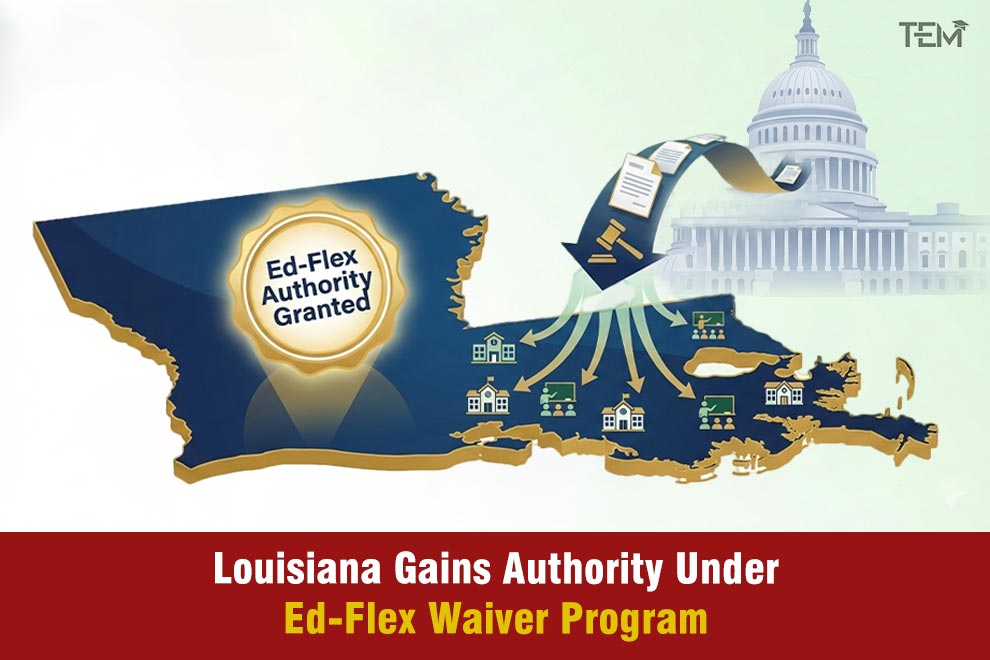
Louisiana has been granted authority under the Ed-Flex waiver program, giving state education leaders the power to approve certain federal requirement waivers for school districts without seeking separate approval from Washington for each request.
The U.S. Department of Education approved Louisiana’s application on February 25, 2026, with authority running through the 2029–30 school year.
The approval makes Louisiana the 13th state to hold Ed-Flex authority, joining Colorado, Delaware, Georgia, Indiana, Kansas, Massachusetts, North Carolina, Pennsylvania, Texas, Vermont, Wisconsin, and Iowa, which received approval in January 2026.
What the Approval Means for Districts
The Ed-Flex waiver program, created in 1999 and reauthorized under the Every Student Succeeds Act (ESSA) in 2015, permits state education agencies to waive select federal requirements that may slow local reform efforts without submitting each waiver to the U.S. Department of Education for individual review.
For Louisiana, the approval unlocks two immediate flexibilities:
- Districts can carry over more than 15% of Title I funds from one year to the next without federal approval, a significant change for a state that received nearly $400 million in Title I funding in 2025.
- Districts gain greater discretion over Title IV Part A spending, including technology allocations, under a grant that brought Louisiana nearly $28 million in 2025.
Previously, districts submitted waiver requests to the Louisiana Department of Education, which then had to seek federal approval. Under Ed-Flex, that second step is eliminated.
State Superintendent Speaks Out
State Superintendent Dr. Cade Brumley announced the approval, saying Louisiana is showing what is possible when states are trusted to lead. He said Ed-Flex allows the state to move faster, reduce bureaucracy, and ensure decisions about federal resources are made closer to students.
Brumley added that the authority allows educators to focus more on advancing student achievement and less on navigating administrative requirements and gives school systems greater discretion to direct federal resources where they can have the greatest impact.
Federal Oversight Remains in Place
Despite the expanded flexibility, Ed-Flex does not eliminate federal accountability and agency shifts. Louisiana must submit annual reports to the U.S. Department of Education detailing how the state oversees Ed-Flex and how approved waivers affect school and student performance.
States are also required to report on student achievement results for schools and districts where waivers have been in place for two or more school years.
How Ed-Flex Changes the Rules
| Federal Program | Standard Rule | Under Ed-Flex Waiver |
| Title I Fund Carryover | 15% cap on unspent funds rolled over annually | Districts can carry over more than 15% without federal approval |
| Title IV Part A Spending | Minimum spending thresholds across broad categories | Districts can shift allocations to local priorities, such as technology |
| Approval Process | District petitions U.S. Department of Education | District petitions state superintendent directly |
| Reporting | Detailed federal program reporting | Streamlined outcome-focused annual reporting to the state |
Broader National Implications
The expansion of the Ed-Flex waiver program reflects a wider federal push toward state-level control over education funding flexibility and federal pushes toward funding flexibility across both K-12 and higher education.
The U.S. Department of Education formally encouraged states to apply for Ed-Flex authority in a September 2025 letter, and the growing list of approved states suggests that push is gaining momentum.
Policy analysts say the approach allows federal agencies to maintain program goals and student outcome standards while reducing the procedural barriers that have historically slowed local implementation.
What Happens Next
For Louisiana districts, the immediate priority will be redesigning Title I carryover strategies and realigning Title IV spending plans under the new flexibility. State officials will also establish the oversight framework required to monitor how waivers are affecting student performance, a responsibility that now falls entirely to Baton Rouge rather than Washington.
For administrators nationwide, the Ed-Flex waiver program signals that federal education funding flexibility is expanding and that more states are likely to follow Louisiana’s lead before the 2026–27 school year begins.
FAQs
- What is the Ed-Flex waiver program?
Created in 1999 and reauthorized under ESSA, it allows approved state education agencies to waive certain federal program requirements for districts without seeking separate approval from the U.S. Department of Education for each request.
- Does Ed-Flex change how much federal funding Louisiana receives?
No. It changes how funds can be used and approved at the state level, not the total amount of federal funding allocated to Louisiana districts.